Hello! Welcome to the first lesson of our new module, "Dissolution of a Partnership Firm."
In all our previous modules—from the admission of a partner to their retirement or death—we focused on scenarios where the partnership agreement changed, but the business itself continued. This is known as the reconstitution of a partnership.
Today, we shift our focus to a completely different event: the permanent closure of the business. Our learning outcome is to distinguish between the dissolution of a partnership and the dissolution of a partnership firm. Mastering this foundational concept is essential, as the accounting treatment for firm dissolution is entirely different from anything we have covered so far.
What's the Difference?
At first glance, the terms "dissolution of partnership" and "dissolution of partnership firm" might seem similar, but in accounting, they mean very different things. Let's start with a clear, concise explanation from a video.
Dissolution of a Partnership firm | Chapter 6 | Accountancy Class 12 | Part 1
Watch this short segment from the video 'Dissolution of a Partnership firm' by Rajat Arora. It gets straight to the point and clarifies the core difference between these two critical terms.
Watch from timestamp 01:19 to 03:28. Focus on how the video defines 'dissolution of partnership' as an end to the agreement and 'dissolution of a firm' as an end to the business itself.
As the video explains, the distinction is fundamental:
-
Dissolution of Partnership: This refers to a change in the business relationship among the partners, leading to the termination of the old partnership agreement. However, the firm is not closed; it continues to operate under a new agreement. This is also called reconstitution of the firm. Every topic you've studied so far falls under this category:
- Change in Profit-Sharing Ratio
- Admission of a new partner
- Retirement or Death of a partner
-
Dissolution of a Partnership Firm: This means the business is completely shut down, and the firm ceases to exist. The economic relationship among all partners comes to a permanent end. As per Section 39 of the Indian Partnership Act, 1932, it is the "dissolution of partnership between all the partners of a firm."
Key Points of Distinction
To solidify your understanding, let's compare these two concepts side-by-side based on several key factors. The table in the image below provides a great high-level summary.
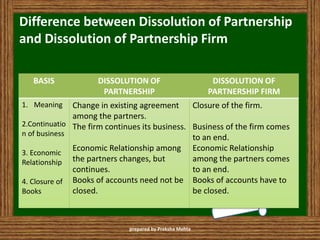
Now, let's explore these differences in more detail.
Difference between Dissolution of Firm and ...
The article 'Difference between Dissolution of Firm and Dissolution of Partnership' from GeeksforGeeks provides a structured comparison. Please read the definitions and the comparison table within it.
Read the sections 'What is Dissolution of Firm?', 'What is Dissolution of Partnership?', and pay close attention to the comparison table under 'Difference between Dissolution of Firm and Dissolution of Partnership'. This table expands on the points from the image above.
Based on the resources, here is a consolidated breakdown of the differences:
| Basis of Difference | Dissolution of Partnership (Reconstitution) | Dissolution of Partnership Firm (Termination) |
|---|---|---|
| Business Continuation | The business continues to operate, just under a new agreement. | The business of the firm is completely terminated and wound up. |
| Economic Relationship | The economic relationship between partners changes but continues. | The economic relationship between all partners comes to an end. |
| Closure of Books | Books of accounts are not closed. They are adjusted for the change. | Books of accounts are closed permanently after settling all accounts. |
| Accounting Treatment | Assets are revalued, and liabilities are reassessed through a Revaluation Account. The resulting profit/loss is shared by the old partners. | Assets are realized (sold), and liabilities are paid off through a Realization Account. The final profit/loss is shared by all partners. |
| Court Intervention | This is a voluntary process agreed upon by the partners. | Dissolution can be voluntary or ordered by a court under specific circumstances. |
Test your understanding!
For each scenario below, identify whether it represents a "Dissolution of Partnership" or a "Dissolution of a Partnership Firm."
- Partners A, B, and C decide to change their profit-sharing ratio from 3:2:1 to 1:1:1.
- Due to continuous losses, partners X and Y decide to sell all the firm's assets, pay off the creditors, and close the business.
- Partner M retires from the firm of L, M, and N. L and N decide to continue the business.
- A court orders the firm to be closed because its business has become illegal.
Show answer
- Dissolution of Partnership: The business continues, but the agreement among partners has changed.
- Dissolution of a Partnership Firm: The business is being permanently closed.
- Dissolution of Partnership: A partner is leaving, which changes the partnership agreement, but the firm continues.
- Dissolution of a Partnership Firm: The business is being terminated by court order.
What Happens When a Firm is Dissolved?
Understanding the consequences of firm dissolution further clarifies the distinction. When a firm is dissolved, a specific sequence of actions must be taken to close the books. This is very different from the revaluation process you are used to.
Dissolution of a Partnership firm | Chapter 6 | Accountancy Class 12 | Part 1
Let's return to the video by Rajat Arora. The next segment explains the practical steps involved when a firm shuts down.
Watch from timestamp 03:28 to 08:26. Notice the key activities mentioned: selling all assets, paying off all liabilities, and finally settling the partners' capital accounts. This is the core process of dissolution.
As the video highlights, the process involves:
- Selling all assets to convert them into cash.
- Using the cash to pay off all external liabilities (like creditors, bank loans, etc.).
- Paying off any loans made by partners to the firm.
- Finally, settling the capital accounts of the partners.
To manage this entire process, we prepare a special account called the Realization Account. Do not confuse this with the Revaluation Account.
- Revaluation Account: Prepared during reconstitution to record changes in the value of assets and liabilities.
- Realization Account: Prepared during dissolution to record the sale of assets and payment of liabilities, with the goal of closing the books.
We will dive deep into preparing the Realization Account in our next lesson.
Conclusion
You have now learned the crucial distinction that underpins this entire module. Understanding this difference is not just theoretical; it dictates the entire accounting procedure that follows.
Key Takeaways:
- Dissolution of Partnership is a reconstitution where the business continues under a new agreement (e.g., admission, retirement).
- Dissolution of a Partnership Firm is a termination where the business completely closes down.
- Reconstitution involves preparing a Revaluation Account.
- Dissolution of a firm involves preparing a Realization Account to wind up the business.
Preview of the Next Lesson:
Now that you understand what dissolution of a firm means, we will move on to how to account for it. In our next lesson, we will learn how to prepare a Realization Account by recording the transfer, sale, and settlement of all assets and liabilities. This is the first practical step in closing the firm's books.