Hello! Welcome back to our module on the Dissolution of a Partnership Firm.
In our last lesson, we established the fundamental difference between the dissolution of a partnership (reconstitution) and the dissolution of a firm (complete closure). You learned that when a firm is dissolved, the business shuts down, and we must sell all assets, pay off all liabilities, and close the books.
Today, we will learn how to execute the first and most crucial step in this process. Our learning outcome is to prepare a Realization Account by recording the transfer, sale, and settlement of all assets and liabilities. This account is the central hub for managing the entire dissolution process.
What is the Realization Account?
The Realization Account is a nominal account prepared to ascertain the profit or loss arising from the process of selling (or 'realizing') the firm's assets and settling its liabilities.
The logic is simple:
- The debit side records all assets to be sold and all payments made for liabilities and expenses.
- The credit side records all liabilities to be paid and all money received from the sale of assets.
The final balance of this account will reveal the net profit or loss from the entire dissolution process.
Let's start by getting a clear overview of the process and the format of the Realization Account.
Dissolution of a Partnership firm | Chapter 6 | Accountancy Class 12 | Part 1
This video from Rajat Arora provides an excellent, step-by-step introduction to the Realization Account. It breaks down the entire process into manageable steps.
Watch from timestamp 08:38 to 18:45. The video will walk you through three key stages: Transferring assets and liabilities into the account. Recording the sale of assets and payment of liabilities. Calculating the final profit or loss.
Now, let's break down those steps in detail.
Step 1: Transferring Assets and Liabilities to the Realization Account
The first step is to close the books of all assets and external liabilities by transferring their balances to the Realization Account. This effectively brings them all under one umbrella for settlement.
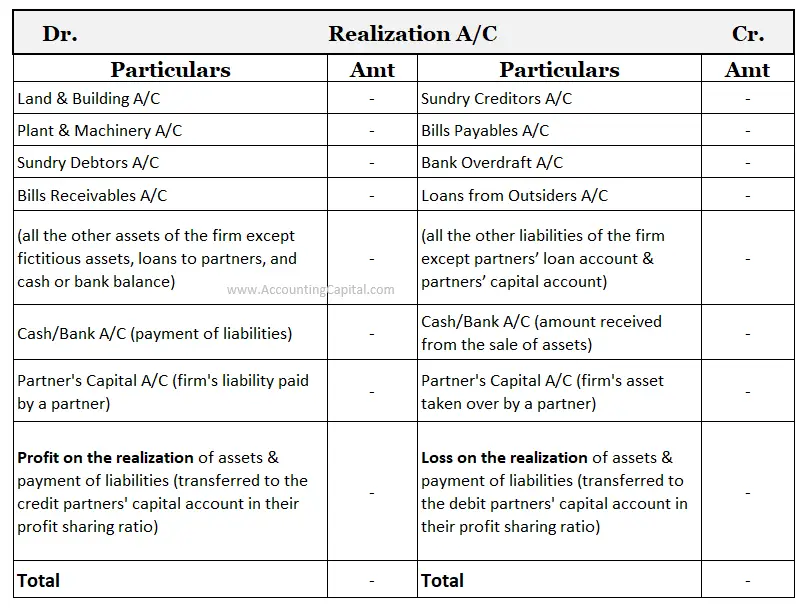
Transferring Assets
You will transfer all assets to the debit side of the Realization Account at their book value (the value shown in the Balance Sheet).
The journal entry for this is:
Realization A/c Dr.
To Sundry Assets A/c
Important Exceptions: The following items are NOT transferred to the Realization Account:
- Cash and Bank Balances (they are already realized).
- Fictitious Assets (e.g., Profit & Loss A/c debit balance, Advertisement Suspense A/c). These are directly debited to Partners' Capital Accounts.
- Loan to a Partner. This is settled through the partner's capital account.
Transferring Liabilities
You will transfer all external liabilities (money owed to third parties) to the credit side of the Realization Account at their book value.
The journal entry for this is:
Sundry Liabilities A/c Dr.
To Realization A/c
Important Exceptions: The following items are NOT transferred to the Realization Account:
- Partners' Capital and Current Account balances.
- Partners' Loans to the firm. These are paid off separately after external liabilities.
- Accumulated Profits and Reserves (e.g., General Reserve, Reserve Fund). These are directly credited to Partners' Capital Accounts.
- Special Note: Provisions created against assets (like Provision for Doubtful Debts or Investment Fluctuation Fund) are also transferred to the credit side of the Realization Account.
Step 2: Realizing the Assets and Settling the Liabilities
This is the core of the process where the actual sale and payment happen.
A. Realization of Assets
When assets are sold or taken over, the transaction is recorded on the credit side of the Realization Account.
-
When an asset is sold for cash/bank:
- The entry is recorded at the actual sale value.
- Journal Entry: Bank A/c Dr. / To Realization A/c
-
When an asset is taken over by a partner:
- The entry is recorded at the agreed value at which the partner takes it.
- Journal Entry: Partner’s Capital A/c Dr. / To Realization A/c
B. Settlement of Liabilities
When liabilities are paid off or taken over, the transaction is recorded on the debit side of the Realization Account.
-
When a liability is paid by the firm (cash/bank):
- The entry is recorded at the actual amount paid.
- Journal Entry: Realization A/c Dr. / To Bank A/c
-
When a liability is taken over by a partner:
- The entry is recorded at the agreed value the partner agrees to pay.
- Journal Entry: Realization A/c Dr. / To Partner’s Capital A/c
A crucial rule to remember: If the question is silent about the realization of an asset, assume it realized no value. However, if the question is silent about the payment of a liability, you must assume it was paid in full at its book value.
Let's watch a practical example of these adjustments being posted.
Preparation of Realisation A/c - Dissolution of Partnership Firm || Class 12 Accounts Dissolution |
The video from CA Hardik Manchanda provides an excellent walk-through of a problem. It shows how to handle various adjustments for assets and liabilities.
Watch from 01:27 to 12:47. Pay close attention to how the instructor posts entries for: An asset taken over by a partner (Stock). Sale of remaining assets (Stock and Debtors). Payment of creditors and an unrecorded liability. Notice how each adjustment is posted to the correct side of the Realization Account.
Test your understanding!
A firm's books showed Machinery at ₹50,000 and Creditors at ₹30,000. During dissolution:
- The machinery was sold for ₹45,000.
- The creditors were paid in full.
How would these transactions be recorded in the Realization Account? (Just state the side and amount).
Show answer
- Sale of Machinery: The Realization Account would be credited with ₹45,000 (as "By Bank A/c").
- Payment of Creditors: The Realization Account would be debited with ₹30,000 (as "To Bank A/c").
Step 3: Closing the Realization Account
After all assets are realized and liabilities are settled, we finalize the account.
-
Realization Expenses: Any expenses incurred to carry out the dissolution (e.g., auctioneer's fees, legal costs) are an expense of realization. If paid by the firm, they are debited to the Realization Account.
- Journal Entry: Realization A/c Dr. / To Bank A/c
-
Ascertaining Profit or Loss: Now, you total both sides of the Realization Account.
- If Credit side > Debit side → Profit on Realization.
- If Debit side > Credit side → Loss on Realization.
-
Distributing Profit or Loss: The final profit or loss is transferred to the Partners' Capital Accounts in their profit-sharing ratio.
- For Profit: Realization A/c Dr. / To Partners' Capital A/cs
- For Loss: Partners' Capital A/cs Dr. / To Realization A/c
This transfer closes the Realization Account.
A Comprehensive Example
Let's walk through a complete example to see all these steps in action.
CHAPTER 7 DISSOLUTION OF PARTNERSHIP FIRM
This document from Aspirations Institute contains a solved practical problem. We will focus only on the prepared Realisation Account to see how all the pieces fit together.
Please review the section titled 'Practical Problem'. First, look at the Balance Sheet given for the firm of X and Y. Then, carefully examine the prepared 'Realisation Account'. Try to trace each item in the Realisation Account back to the Balance Sheet or the adjustments given below it.
Let's analyze the Realisation Account from the problem:
Debit Side (Assets Transferred & Payments):
- To Goodwill, Buildings, Investments, Stock, Debtors: These are all assets from the Balance Sheet, transferred at their book values (Step 1).
- To X's Capital A/c (X's wife loan): Partner X agreed to pay his wife's loan (an external liability). This is a liability taken over by a partner (Step 2B).
- To Bank A/c (Bank overdraft, Creditors, Expenses, Commission): These are all cash payments made by the firm for external liabilities and dissolution expenses (Step 2B & Step 3).
Credit Side (Liabilities Transferred & Receipts):
- By Investment Fluctuation Fund, Provision for Doubtful Debts: These are provisions against assets, transferred from the Balance Sheet (Step 1).
- By Creditors, Bank overdraft, X's Wife Loan: These are all external liabilities from the Balance Sheet, transferred at their book values (Step 1).
- By Bank A/c (Asset realised): This is the total cash received from selling various assets (Debtors, Investment, Goodwill, etc.) (Step 2A).
- By Y's Capital A/c (Stock): Partner Y took over some stock. This is an asset taken over by a partner (Step 2A).
- By Loss transferred to...: The debit side total was larger than the credit side total, resulting in a loss, which is distributed between X and Y in their 4:1 ratio (Step 3).
This example perfectly illustrates the entire lifecycle of the Realization Account.
Conclusion
You have now learned the mechanics of preparing a Realization Account, which is the cornerstone of accounting for firm dissolution.
Key Takeaways:
- The Realization Account is a nominal account prepared to find the profit or loss on dissolution.
- Step 1: Transfer assets to the debit side and external liabilities to the credit side at book values.
- Step 2: Record the sale or takeover of assets on the credit side and the payment or takeover of liabilities on the debit side.
- Step 3: Record realization expenses on the debit side, then balance the account to find the profit or loss, and transfer it to the partners' capital accounts.
Preview of the Next Lesson:
While we have covered the structure of the account, the next lesson, "Account for the discharge of liabilities, including unrecorded liabilities and realization expenses," will dive deeper into the specific journal entries and various complex scenarios related to payments. This will solidify your understanding of the debit side of the Realization Account.