Hello! Welcome to our next lesson on Partnership Fundamentals.
In our last session, we looked at how to calculate interest on partners' capital, which is an expense for the firm and is debited to the Profit and Loss Appropriation Account. Today, we'll examine the opposite transaction: interest on drawings. This is an income for the firm, charged when partners withdraw funds for personal use.
Our learning outcome for this lesson is to calculate interest on partners' drawings using the product method and the average period method. By the end of this lesson, you'll be able to identify which method to use based on the pattern of withdrawals and apply the correct formula to find the interest amount.
What is Interest on Drawings?
When a partner withdraws money from the firm for personal use, it's called "drawings." If the Partnership Deed allows it, the firm charges interest on these drawings. This serves two purposes: it discourages excessive withdrawals and ensures fairness among partners, especially if their drawings are unequal.
Key points to remember:
- Interest on drawings is an income for the firm and an expense for the partner.
- It is credited to the Profit and Loss Appropriation Account.
- It is debited to the partner's Capital Account (fluctuating method) or Current Account (fixed method).
- It is only charged if the Partnership Deed specifies it. If the deed is silent, no interest is charged.
The method we use to calculate this interest depends on whether the drawings are made at regular or irregular intervals. Let's explore the two main methods.
Method 1: Product Method (for Irregular Drawings)
When a partner withdraws unequal amounts at irregular intervals, calculating interest for each individual drawing can be time-consuming. The Product Method offers a more efficient way to get the same result.
The logic is simple: instead of calculating interest multiple times, we find a "product" for each drawing (Amount × Time) and then calculate interest on the total of these products for a single period (usually one month).
The steps are:
- For each drawing, determine the period (in months) it was used, from the date of withdrawal to the end of the accounting year.
- Calculate the Product for each drawing by multiplying the amount by its period: .
- Sum all the individual products to get the Total Product.
- Calculate the interest for one month on the Total Product.
The formula is:
This video provides a very clear, quick demonstration of the product method.
Product method of Interest on Drawings | Class XII Accounts CBSE
Watch this short video from Arinjay Academy to see how the product method works with a simple example. Notice how it arrives at the same answer as calculating interest on each drawing individually, but with less work.
Watch the video from 00:31 to 03:23. Pay close attention to how the table is constructed: Date, Amount, Period, and Product. Understand how the final interest is calculated using the 'sum of products'.
The table used in the product method is a key tool. Here is a typical layout:
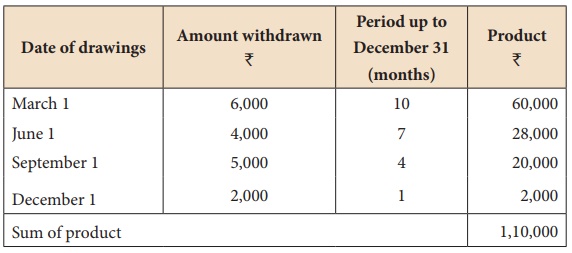
Method 2: Average Period Method (for Regular Drawings)
What if a partner withdraws a fixed amount at regular intervals (e.g., ₹5,000 on the first day of every month)? In this scenario, we can use an even faster shortcut: the Average Period Method.
Instead of calculating interest 12 times or using the product method, we calculate interest on the total annual drawings for an "average period."
The key is to first find this average period using a simple formula:
Once you have the average period, the interest calculation is:
To master this method, you need to understand how the average period changes based on the timing of the drawings. The following article explains this systematically.
Calculation of Interest on Drawings : Methods, Formula & ...
This article from GeeksforGeeks, 'Calculation of Interest on Drawings', clearly explains the average period method for various scenarios.
Read the sections on 'Interest on Monthly Drawings' (Case A, B, C) and 'Interest on Quarterly Drawings' (Case D, E, F). Focus on how the average period is derived in each case. You don't need to memorize the results right away, but understand the logic behind the formula.
Here is a summary of the most common average periods you will use. Understanding how they are derived using the formula is more important than memorizing them.
| Drawing Frequency | Timing | Average Period (in months) | Formula Derivation |
|---|---|---|---|
| Monthly | Beginning of each month | 6.5 | |
| Middle of each month | 6.0 | ||
| End of each month | 5.5 | ||
| Quarterly | Beginning of each quarter | 7.5 | |
| Middle of each quarter | 6.0 | ||
| End of each quarter | 4.5 |
This visual note can help you remember the calculations for monthly drawings:

Test your understanding!
Rohan and Sameer are partners in a firm, sharing profits and losses equally. The partnership deed provides for interest on drawings at 12% p.a. The firm's books are closed on March 31 every year.
Their drawings during the year 2022-23 were as follows:
Rohan's Drawings:
- He withdrew ₹10,000 on the first day of every month.
Sameer's Drawings:
- June 1, 2022: ₹15,000
- September 30, 2022: ₹10,000
- January 31, 2023: ₹5,000
Calculate the interest on drawings for both Rohan and Sameer.
Show answer
1. Calculation of Interest on Rohan's Drawings (Average Period Method)
Rohan's drawings are regular (fixed amount, fixed interval), so we use the Average Period Method.
- Total Drawings: ₹10,000 × 12 = ₹1,20,000
- Timing: Beginning of every month.
- Average Period: months.
- Interest on Drawings:
2. Calculation of Interest on Sameer's Drawings (Product Method)
Sameer's drawings are irregular (unequal amounts, irregular intervals), so we use the Product Method.
| Date of Drawing | Amount (₹) | Period (in months until Mar 31) | Product (₹) |
|---|---|---|---|
| June 1, 2022 | 15,000 | 10 | 1,50,000 |
| Sep 30, 2022 | 10,000 | 6 | 60,000 |
| Jan 31, 2023 | 5,000 | 2 | 10,000 |
| Total | 2,20,000 |
- Total Product: ₹2,20,000
- Interest on Drawings:
Conclusion
Great work! You have now learned the two primary methods for calculating interest on partners' drawings, a crucial skill for preparing partnership accounts.
Key Takeaways:
- Product Method: Use this for irregular drawings (unequal amounts at different dates). The formula is .
- Average Period Method: Use this as a shortcut for regular drawings (fixed amounts at fixed intervals). The formula is .
- Always check the Partnership Deed to see if interest on drawings should be charged and at what rate.
Preview of the Next Lesson:
We have now covered both interest on capital and interest on drawings. In the next lesson, we will move on to other common appropriations of profit: partner's salary and commission. We will learn how to calculate these amounts, including special cases like commission on net profit before or after charging such commission.