Hello! Welcome to our fifth lesson in the "Partnership Fundamentals" module.
In our last two lessons, we learned how to calculate interest on partners' capital and interest on partners' drawings. These are key adjustments made when distributing profits. Today, we'll build on that by learning how to handle other common forms of partner remuneration.
The learning outcome for this lesson is to compute a partner's salary and commission as per the partnership agreement. This is an essential skill for correctly preparing the Profit and Loss Appropriation Account, which we will cover comprehensively in our next lesson.
By the end of this session, you'll understand the rules, calculations, and accounting treatment for partner salaries and commissions, including the often-tricky "before charging" and "after charging" commission scenarios.
Why Pay Salary or Commission?
In a partnership, some partners may contribute more time, effort, or specialized skills than others. To compensate them fairly for these additional contributions, the partnership agreement might provide for a salary or a commission.
- Salary: Usually a fixed amount paid to a partner for managing the day-to-day operations of the business.
- Commission: Typically a variable amount, calculated as a percentage of profits, often paid to a partner for achieving specific targets, like boosting sales.
The Two Golden Rules
Before we get into calculations, there are two fundamental rules you must remember for any partner remuneration:
- It must be in the Partnership Deed: As per the Indian Partnership Act, 1932, no partner is entitled to a salary or commission unless it is explicitly mentioned in the partnership agreement. If the deed is silent, no remuneration is paid.
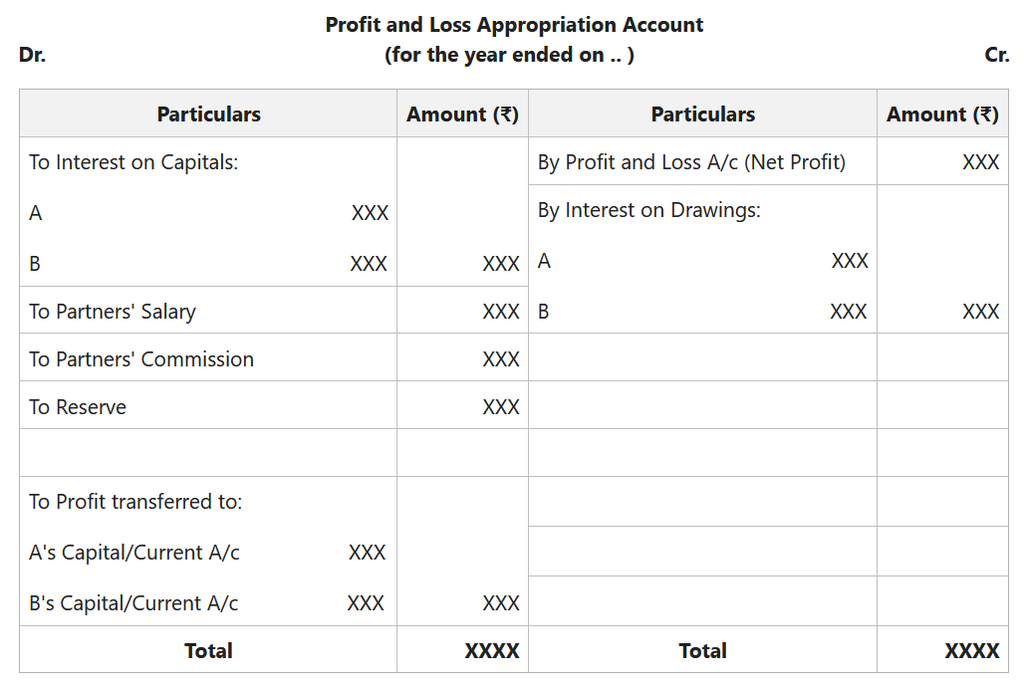
- It is an appropriation of profit: Salary and commission are treated as an appropriation (distribution) of profit, not a charge (expense) against profit. This means they are paid only if the firm has earned profits during the year. They are recorded on the debit side of the Profit and Loss Appropriation Account.
To reinforce this, please review the following text from your NCERT textbook.
This section from the 'Accounting for Partnership' chapter outlines the key provisions of the Partnership Act, 1932. Pay close attention to what it says about remuneration.
Read subsection (e) under 'Provisions of Partnership Act Relevant for Accounting'. Then, read the paragraph under section 1.5 'Distribution of Profit among Partners'. Note why the Profit and Loss Appropriation Account is prepared and what items are adjusted through it.
Calculating Partner's Salary
Calculating a partner's salary is generally straightforward. The key is to ensure you use the annual salary figure for the Profit and Loss Appropriation Account.
- If the salary is given as a lump sum (e.g., "₹60,000 per annum"), you can use that figure directly.
- If it's given on a periodic basis (e.g., "₹5,000 per month"), you must convert it to the annual amount (₹5,000 × 12 = ₹60,000).
The journal entries to record a partner's salary are:
- For allowing salary to the partner:
- Partner's Salary A/c Dr.
- To Partner's Capital/Current A/c
- For closing the salary account:
- Profit and Loss Appropriation A/c Dr.
- To Partner's Salary A/c
Calculating Partner's Commission
Calculating a partner's commission requires more attention because it is often based on the net profit, and the wording of the agreement is critical. There are two main scenarios.
To understand these scenarios in detail, we'll watch a very clear explanation.
Partners' Commission || Partnership Class 12 Accounts | Accounts Class 12 | Partnership Fundamentals
This video by CA Hardik Manchanda breaks down the concept of partner's commission brilliantly. It explains the logic behind the formulas for 'before charging' and 'after charging' commission, which will give you a solid conceptual foundation.
Watch the video from 01:01 to 14:40. First, focus on the explanation of 'before charging commission'. Then, pay close attention to the derivation of the formula for 'after charging commission'. Understanding why the denominator changes to '100 + Rate' is key.
Let's summarize the two methods discussed in the video.
1. Commission on Net Profit Before Charging Such Commission
This is the simpler case. The commission is calculated directly on the net profit figure before the commission itself has been deducted.
Formula:
Example: Net profit before commission is ₹1,10,000. A partner is entitled to a commission of 10% on the net profit before charging such commission.
Commission = ₹1,10,000 × (10 / 100) = ₹11,000
2. Commission on Net Profit After Charging Such Commission
This is the trickier case. The commission is a percentage of the profit that remains after the commission has already been paid. This creates a circular logic that the formula resolves.
Formula:
Example: Net profit before commission is ₹1,10,000. A partner is entitled to a commission of 10% on the net profit after charging such commission.
Commission = ₹1,10,000 × (10 / (100 + 10)) = ₹1,10,000 × (10 / 110) = ₹10,000
Advanced Scenario: Commission After Deducting Other Items
Sometimes, the partnership deed specifies that the commission should be calculated on profit after deducting other appropriations like salaries or interest on capital. In these cases, you must first adjust the profit base and then apply the commission formula.
Let's watch an example of this.
Partners' Commission || Partnership Class 12 Accounts | Accounts Class 12 | Partnership Fundamentals
Now, let's watch a more complex problem from the same video by CA Hardik Manchanda. This will show you how to calculate commission when the profit base is adjusted for salaries and other commissions.
Watch the video from 19:40 to 27:00. Observe how the commission for partner 'X' is calculated on a profit that is 'after charging partner salaries'. Then, for partner 'Y', notice how the profit base is adjusted for all commissions and salaries before applying the 'after charging' formula. This is a very important concept for complex problems.
The process is as follows:
- Start with the Net Profit as per the Profit & Loss Account.
- Subtract all the items mentioned in the deed (e.g., all partners' salaries, interest on capital, other partners' commissions).
- The resulting figure is your "Adjusted Profit".
- Apply the relevant commission formula ('before' or 'after' charging) to this "Adjusted Profit".
Let's practice this with a problem.
Test your understanding!
A and B are partners. The net profit of the firm for the year is ₹4,20,000. The partnership deed provides the following:
- A is entitled to a salary of ₹5,000 per month.
- B is entitled to a commission of 10% on the net profit after charging A's salary but before charging his own commission.
- C, the manager (not a partner), is entitled to a commission of 10% on the net profit after charging A's salary and all commissions (i.e., B's and C's).
Calculate the commission payable to B and C.
Show answer
First, let's calculate A's annual salary:
- A's Salary = ₹5,000 × 12 = ₹60,000
1. Calculation of B's Commission:
- The profit base for B's commission is Net Profit after A's salary.
- Adjusted Profit = ₹4,20,000 - ₹60,000 = ₹3,60,000
- B's commission is before charging his own commission, so we use the simple formula.
- B's Commission = ₹3,60,000 × (10 / 100) = ₹36,000
2. Calculation of C's Commission:
- The profit base for C's commission is Net Profit after A's salary and all commissions (B's and C's own).
- Let's find the profit after A's salary and B's commission:
- Profit available before C's commission = ₹4,20,000 - ₹60,000 (A's Salary) - ₹36,000 (B's Commission) = ₹3,24,000
- C's commission is 10% on this profit after charging his own commission. So, we must use the
Rate / (100 + Rate)formula on this adjusted profit.- C's Commission = ₹3,24,000 × (10 / (100 + 10)) = ₹3,24,000 × (10 / 110) = ₹29,455 (approx.)
Note: C's commission is a charge against profit (as C is a manager, not a partner) and would be debited to the P&L Account. B's salary is an appropriation and is debited to the P&L Appropriation Account. This distinction is important and highlights the difference between payments to partners vs. employees.
Conclusion
Excellent! You've now mastered the computation of a partner's salary and commission. This is a topic that frequently appears in exams, especially the nuanced commission calculations.
Key Takeaways:
- Authorization: Salary and commission are only allowed if specified in the Partnership Deed.
- Nature: They are appropriations of profit, paid only when the firm has profits, and debited to the P&L Appropriation Account.
- Salary Calculation: Always use the annual figure (e.g., monthly salary × 12).
- Commission Formulas:
- Before Charging:
Profit × (Rate / 100) - After Charging:
Profit × (Rate / (100 + Rate))
- Before Charging:
- Adjusted Profit: Always read the question carefully to see if you need to adjust the profit base by deducting salaries or other items before calculating the commission.
Preview of the Next Lesson:
We have now covered all the individual components of profit appropriation: interest on capital, interest on drawings, salary, and commission. In our next lesson, we will bring all of these elements together to prepare a complete Profit and Loss Appropriation Account with multiple appropriations to determine the final divisible profit.