Hello! Welcome to the sixth lesson in our "Partnership Fundamentals" module.
In our last few lessons, we've broken down the individual adjustments for partners: interest on capital, interest on drawings, salaries, and commissions. Now it's time to put all those pieces together. This lesson is where your understanding of partnership profit distribution will really take shape.
Our learning outcome for today is to prepare a Profit and Loss Appropriation Account with multiple appropriations to determine divisible profit. This is a cornerstone skill for partnership accounting and a frequent, high-value question in your CBSE exams.
Introduction: From Net Profit to Divisible Profit
In Grade 11, you learned to prepare the Trading and Profit & Loss Account to arrive at the Net Profit or Net Loss for a business. For a partnership, there's one more step. The Net Profit isn't the end of the story; it's the starting point for distribution among the partners.
The Profit and Loss Appropriation Account is an extension of the P&L Account. Its sole purpose is to show how the net profit is "appropriated" or distributed among the partners according to the terms of their partnership deed.
The Most Important Distinction: Charge vs. Appropriation
Before we build the account, we must be absolutely clear on the difference between a 'charge against profit' and an 'appropriation of profit'. Your ability to distinguish these two will determine whether you start your P&L Appropriation Account with the correct profit figure.
- Charge Against Profit: An expense that must be paid regardless of whether the firm makes a profit or a loss. These items are debited to the Profit and Loss Account before calculating Net Profit.
- Examples: Rent paid to a partner, Interest on a partner's loan, Manager's commission.
- Appropriation of Profit: A distribution of profit to partners. These are only paid if there is a profit. These items are debited to the Profit and Loss Appropriation Account.
- Examples: Interest on capital, Partner's salary, Partner's commission, Transfer to reserve.
To get a solid grasp of this concept, let's watch a clear explanation.
Fundamentals - Partnership | Charge vs appropriation | Part 7 | CBSE | ISC | State boards
In this video, Rajat Arora masterfully explains the difference between a charge and an appropriation. Understanding this is non-negotiable for getting your P&L Appropriation Account right.
Watch the video from 00:30 to 08:45. Focus on which account (P&L or P&L Appropriation) is used for each type of item and why. Take note of the key examples provided for both charges and appropriations.
The Structure of the P&L Appropriation Account
Here is the standard format. We will be filling this out step-by-step.
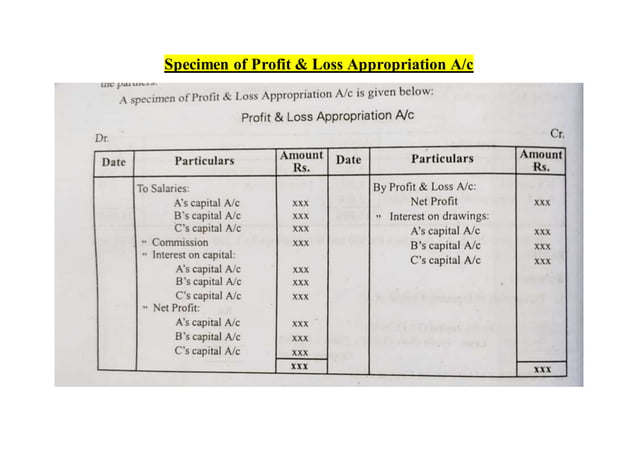
Preparing the Account: A Step-by-Step Guide
- Start with the Correct Net Profit: Begin on the credit side with the Net Profit transferred from the P&L Account.
- Crucial check: Read the problem carefully. Sometimes the given profit has been calculated before a charge (like interest on a partner's loan) or after an appropriation (like a partner's salary). You must adjust the profit to find the true Net Profit (i.e., after all charges but before all appropriations).
- If a charge is pending, subtract it from the given profit.
- If an appropriation has already been deducted, add it back.
- Crucial check: Read the problem carefully. Sometimes the given profit has been calculated before a charge (like interest on a partner's loan) or after an appropriation (like a partner's salary). You must adjust the profit to find the true Net Profit (i.e., after all charges but before all appropriations).
- Credit Interest on Drawings: This is an income for the firm from the partners. It is credited to the P&L Appropriation Account.
- Debit all Appropriations: On the debit side, enter all the distributions to partners as per the deed:
- Interest on Partners' Capital
- Partners' Salaries
- Partners' Commissions
- Transfers to General Reserve
- Calculate and Distribute Divisible Profit:
- Find the total of the credit side and the total of the debit side.
- Divisible Profit = (Total of Credit Side) - (Total of Debit Side)
- This final profit is transferred to the partners' capital (or current) accounts in their agreed profit-sharing ratio. If the ratio isn't given, it's shared equally.
Putting it into Practice: Worked Examples
Theory is one thing, but accounting is learned by doing. The following video walks through three comprehensive problems that cover the most common scenarios you'll encounter.
Profit and loss Appropriation Accounts class 12 | Fundamentals Partnership Commerce Champions
The 'Commerce Champions' video provides excellent, practical examples. It starts simple and progressively adds complexity, including the profit adjustments we just discussed. Follow along closely.
Watch the video from 01:44 to 19:17. First problem (01:44): A straightforward case with interest on capital and salary. Second problem (07:07): Note how the profit is adjusted by adding back the salary that was already debited. Third problem (12:37): This is a key example. See how the profit is first adjusted for the pre-debited salary (an appropriation, so add back) and then for the manager's commission (a charge, so subtract).
After watching, let's reflect on the key takeaway from the third example:
The starting profit was ₹24,000, given after युवराज's salary of ₹6,000.
- Add back the appropriation: Correct starting profit = ₹24,000 + ₹6,000 = ₹30,000.
- Deduct the charge: The manager's commission is 5% of this profit. Commission = 5% of ₹30,000 = ₹1,500.
- Final Net Profit for Appropriation: The figure that starts the P&L Appropriation A/c is ₹30,000 - ₹1,500 = ₹28,500.
This two-step adjustment is a very common and important technique.
Special Case: When Profits are Not Enough
What if the total value of appropriations (like interest on capital and salaries) is greater than the available net profit? For example, the profit is ₹80,000, but the total interest and salaries to be paid are ₹1,20,000.
Rule: In case of insufficient profit, you cannot provide the full appropriations. Instead, the available profit is distributed among the partners in the ratio of their appropriations, not their profit-sharing ratio.
Let's study a solved example that illustrates this perfectly.
Accounting for Partnership Firms| Fundamentals Part 2 Profit ...
This text from Unique Learning explains the rule for insufficient profits and provides a solved problem (Q4). This is a critical scenario for your exams.
First, read 'TIP 1' which states the rule clearly. Then, read Question 4 and its solution. Notice how the total appropriations (Interest on Capital ₹1,60,000 + Salary ₹96,000 = ₹2,56,000) are more than the available profit of ₹80,000. Pay close attention to how the available profit of ₹80,000 is distributed in the ratio of appropriations (1,60,000 : 96,000, which simplifies to 5:3).
Test your understanding!
X and Y are partners sharing profits in the ratio of 3:2. The Net Profit for the year, before any appropriations, is ₹1,50,000. The partnership deed provides for:
- Interest on Capital: X = ₹80,000; Y = ₹40,000.
- Salary to Y = ₹60,000 per annum.
Prepare the Profit and Loss Appropriation Account for the year.
Show answer
1. Check for sufficient profit:
- Available Profit = ₹1,50,000
- Total Appropriations = Interest on Capital (₹80,000 + ₹40,000) + Salary to Y (₹60,000) = ₹1,20,000 + ₹60,000 = ₹1,80,000.
- Since Appropriations (₹1,80,000) > Available Profit (₹1,50,000), the profits are insufficient.
2. Calculate the ratio of appropriations:
- Appropriations for X = Interest on Capital = ₹80,000
- Appropriations for Y = Interest on Capital + Salary = ₹40,000 + ₹60,000 = ₹1,00,000
- Ratio of appropriations (X : Y) = 80,000 : 1,00,000, which simplifies to 8:10 or 4:5.
3. Distribute the available profit in the ratio of appropriations:
- X's Share = ₹1,50,000 × (4/9) = ₹66,667
- Y's Share = ₹1,50,000 × (5/9) = ₹83,333
Profit and Loss Appropriation Account
Dr. Cr.
| Particulars | Amount (₹) | Particulars | Amount (₹) |
|---|---|---|---|
| To X's Capital A/c | 66,667 | By Profit and Loss A/c (Net Profit) | 1,50,000 |
| To Y's Capital A/c | 83,333 | ||
| Total | 1,50,000 | Total | 1,50,000 |
Note: The available profit is shown as transferred to the partners' capital accounts. It is not labelled as 'Interest' or 'Salary' because the full amounts cannot be paid.
Conclusion
Fantastic work today! You have successfully learned how to construct a complete Profit and Loss Appropriation Account. This brings together several smaller topics into one significant and practical statement.
Key Takeaways:
- The P&L Appropriation Account starts with the Net Profit and shows how it's distributed among partners.
- Always distinguish between charges (debited to P&L A/c) and appropriations (debited to P&L Appropriation A/c).
- Before you start, always adjust the given profit figure to ensure it is after all charges but before all appropriations.
- If profits are insufficient to cover all appropriations, distribute the available profit in the ratio of appropriations, not the profit-sharing ratio.
Preview of the Next Lesson:
Now that we know how to calculate the final divisible profit for each partner, the next logical step is to see where that profit goes. In our next lesson, we will prepare Partners' Capital Accounts under the fluctuating capital method. You will see how the divisible profit, along with interest on capital, salaries, and interest on drawings, all get recorded in the partners' individual capital accounts.