Hello! Welcome back to our series on Partnership Accounts.
In the last lesson, we established the difference between the Profit and Loss Account and the Profit and Loss Appropriation Account. We learned that the P&L Appropriation Account is where we distribute the firm's net profit among the partners through items like salaries, commissions, and interest on capital.
Today, we will dive into the first of these appropriations. Our goal is to calculate interest on partners' capital under both fixed and fluctuating capital methods. This involves two key skills: first, the mathematical calculation of the interest itself, and second, understanding how to record this interest depending on the accounting method the firm uses for its capital accounts.
Why and When is Interest on Capital Allowed?
Before we calculate, let's understand the purpose of Interest on Capital (IOC). It serves to compensate partners for the funds they have invested in the business. This is especially important when partners contribute unequal amounts of capital but share profits equally, or vice-versa.
However, according to the Indian Partnership Act, 1932, IOC is an appropriation of profit, not a charge. This means:
- It is only allowed if the Partnership Deed explicitly provides for it. If the deed is silent, no interest is paid.
- It can only be paid out of the firm's profits. If the firm incurs a loss, no interest is allowed. If profits are insufficient to cover the full interest, the available profit is typically distributed in the ratio of the interest due to each partner.
The Two Methods of Maintaining Capital Accounts
The way we record the calculated interest depends on how the partners' capital accounts are maintained. There are two methods, which will become very important in subsequent lessons.
To get a clear overview of these two methods, please watch the following video. It explains the core difference between the Fixed and Fluctuating capital methods.
Fixed & Fluctuating Capital Method : A Step-by-Step Guide |12 Accounts| Chapter1-Part 6 |Fundamental
This video from Accounts Funda provides a step-by-step guide to the Fixed and Fluctuating Capital Methods. It clearly explains which transactions go into which account under each method.
Watch the video from 00:58 to 23:20. As you watch, focus on answering these two questions: Fixed Capital Method: Why are two accounts (Capital and Current) maintained? What goes into each? Fluctuating Capital Method: Why is only one account (Capital) maintained? What does 'fluctuating' refer to?
Let's quickly summarize the key distinction:
- Fixed Capital Method: The partner's main capital contribution is kept 'fixed' in a Capital Account. This account only changes if a partner introduces or permanently withdraws capital. All other annual adjustments like salary, profit, drawings, and interest on capital are recorded in a separate Current Account.
- Fluctuating Capital Method: Only one Capital Account is maintained for each partner. All transactions—initial capital, additions, withdrawals, salary, drawings, and interest on capital—are recorded in this single account, causing its balance to 'fluctuate' throughout the year.
If a question doesn't specify the method, you should assume the Fluctuating Capital Method is being used.
Calculating Interest on Capital
Interest on capital is always calculated on the capital amount for the period it has been used in the business.
1. Simple Case: No Change in Capital
If a partner's capital remains the same throughout the year, the calculation is straightforward:
2. Complex Case: Capital Changes During the Year
When a partner introduces additional capital or withdraws capital during the year, we must calculate interest on the different capital balances for the specific periods they remained in the business.
This video from Rajat Arora demonstrates this calculation process very clearly, starting with simple examples and moving to more complex ones.
Partnership - Fundamentals | Interest on Capital | Important questions | Class 12
This video walks through several examples of calculating interest on capital when the capital amount changes during the year.
Watch from 04:46 to 18:29. Pay close attention to how the year is broken down into different time periods each time a partner adds or withdraws capital. Notice how interest is calculated separately for each period and then summed up to find the total.
The method shown in the video can be summarized as follows:
- Calculate interest on the opening capital balance from the start of the year until the date of the first change.
- Adjust the capital for the addition or withdrawal.
- Calculate interest on the new capital balance from the date of the change until the date of the next change (or the end of the year).
- Repeat this for any subsequent changes.
- Sum up the interest amounts from all periods to get the total interest for the year.
Recording Interest on Capital
Once calculated, the journal entry to record the interest on capital is:
Journal Entry:
Interest on Capital A/c .......... Dr.
To Partner's Capital/Current A/c
- Under the Fluctuating Method, you credit the Partner's Capital Account.
- Under the Fixed Method, you credit the Partner's Current Account.
Finally, the Interest on Capital account is closed by transferring it to the P&L Appropriation Account:
Journal Entry:
Profit and Loss Appropriation A/c .......... Dr.
To Interest on Capital A/c
Let's see this in action. The first video you watched also contains a worked example showing how all the pieces fit together.
Fixed & Fluctuating Capital Method : A Step-by-Step Guide |12 Accounts| Chapter1-Part 6 |Fundamental
Let's return to the 'Accounts Funda' video. The instructor now solves a comprehensive problem, preparing the accounts first under the Fixed method and then the Fluctuating method.
Watch from 25:08 to 33:39. Observe how the same set of transactions, including interest on capital, are posted differently in the two methods. This will directly help you master the learning outcome for this lesson.
A Note on Opening Capital
Interest is always calculated based on the capital at the beginning of the period. Sometimes, a problem might only give you the closing capital. In such cases, you must first calculate the opening capital by reversing the year's transactions.
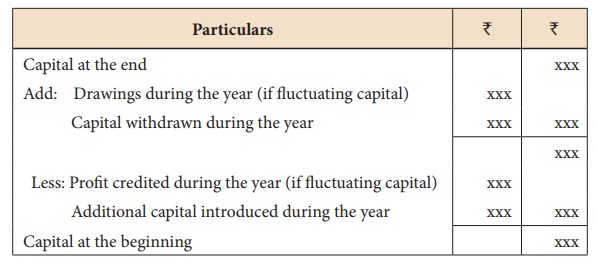
The formula, assuming the fluctuating method, is:
Opening Capital = Closing Capital + Drawings during the year – Additional Capital introduced – Profit credited + Loss debited
Test your understanding!
Amit and Binita are partners. On April 1, 2022, their capitals were ₹5,00,000 and ₹4,00,000 respectively. The partnership deed allows for interest on capital at 10% p.a.
On October 1, 2022, Amit introduced additional capital of ₹1,00,000.
The financial year ends on March 31, 2023.
- Calculate the interest on capital for Amit and Binita.
- State the journal entry to allow interest on capital, assuming the firm uses the Fixed Capital Method.
Show answer
1. Calculation of Interest on Capital:
For Amit:
- Interest on opening capital (₹5,00,000) for 6 months (Apr 1 to Sep 30):
- His capital on Oct 1 becomes ₹5,00,000 + ₹1,00,000 = ₹6,00,000.
- Interest on new capital (₹6,00,000) for the remaining 6 months (Oct 1 to Mar 31):
- Total Interest for Amit = ₹25,000 + ₹30,000 = ₹55,000
For Binita:
- Her capital remained unchanged throughout the year.
- Interest on ₹4,00,000 for the full year:
- Total Interest for Binita = ₹40,000
2. Journal Entry (Fixed Capital Method):
Under the fixed capital method, interest is credited to the partners' Current Accounts.
| Date | Particulars | L.F. | Debit (₹) | Credit (₹) |
|---|---|---|---|---|
| Mar 31 | Interest on Capital A/c .......... Dr. | 95,000 | ||
| To Amit's Current A/c | 55,000 | |||
| To Binita's Current A/c | 40,000 | |||
| (Being interest on capital allowed @ 10% p.a.) |
Conclusion
You've now learned a fundamental skill in partnership accounting. Let's recap the main points.
Key Takeaways:
- Interest on Capital (IOC) is an appropriation of profit, allowed only if specified in the Partnership Deed and if the firm has sufficient profits.
- When capital changes during the year, you must calculate interest on each capital amount for the period it was used.
- The accounting treatment for IOC depends on the capital method:
- Fixed Method: IOC is credited to the Partner's Current Account.
- Fluctuating Method: IOC is credited to the Partner's Capital Account.
Preview of the Next Lesson:
Having mastered interest on capital, we will now turn to the other side of the coin. In our next lesson, we will learn how to calculate interest on partners' drawings, which is an income for the firm and is credited to the P&L Appropriation Account.