Hello! Welcome back to our study of debentures.
In our last lesson, we established the fundamental nature of debentures as a form of borrowed capital. You learned that debenture holders are creditors, not owners, and that the interest paid to them is a charge against profit. This sets the stage for understanding the accounting treatment, which is our focus today.
This lesson is designed to help you master the learning outcome: to record journal entries for the issue of debentures at par, at a premium, and at a discount.
The great news is that your extensive work on issuing shares will be a huge asset here. The accounting procedure for issuing debentures is almost identical to that for shares. The main difference lies in the account names we use.
1. The Core Accounting Framework: Shares vs. Debentures
Before diving into specific cases, let's establish the key terminology change. The logic and flow of entries—receiving application money, making an allotment, and calling for further installments—remain the same.
The primary substitutions you'll make are:
- Share Application/Allotment/Call becomes Debenture Application/Allotment/Call.
- Share Capital Account becomes % Debentures Account (e.g., 9% Debentures A/c).
- Securities Premium Reserve Account is used for premiums on debentures, just as it is for shares.
- A new account, Discount on Issue of Debentures Account, will be introduced for issues at a discount.
To see a quick overview of how these entries are adapted, let's watch a short segment of a video.
Issue of debentures | Part 1 | Basic Concepts & Journal entries | class 12 Accounts Board exam 2025
This video from Sunil Panda will quickly walk you through the basic journal entries, highlighting the direct parallels with the issue of shares. This will help you see that you already know the fundamental structure.
Watch from 09:39 to 13:54. Focus on how the account names are simply swapped from 'Share' to 'Debenture' and 'Share Capital' to '% Debentures'.
Now, let's apply this framework to the three possible scenarios for issuing debentures for cash.
2. Case 1: Issue of Debentures at Par
When debentures are issued at par, the issue price is exactly equal to their face value (or nominal value). If a debenture has a face value of ₹100, it is issued for ₹100.
The journal entries follow the familiar two-step process for each installment (e.g., application, allotment):
- On receipt of money: Debit
Bank A/c, Credit the relevant installment account (e.g.,Debenture Application A/c). - On allotment/due date: Debit the installment account, Credit
% Debentures A/c.
Let's see this in action with a worked example.
Issue of debentures | Part 1 | Basic Concepts & Journal entries | class 12 Accounts Board exam 2025
This segment of the same video demonstrates how to pass journal entries for an issue at par, with the amount collected in installments.
Watch from 18:43 to 21:45. Follow the calculations and journal entries for application, allotment, and the first call. Notice how the '% Debentures A/c' is credited with the face value of the debentures.
As you saw, the process is a direct application of the principles you learned for issuing shares at par.
3. Case 2: Issue of Debentures at Premium
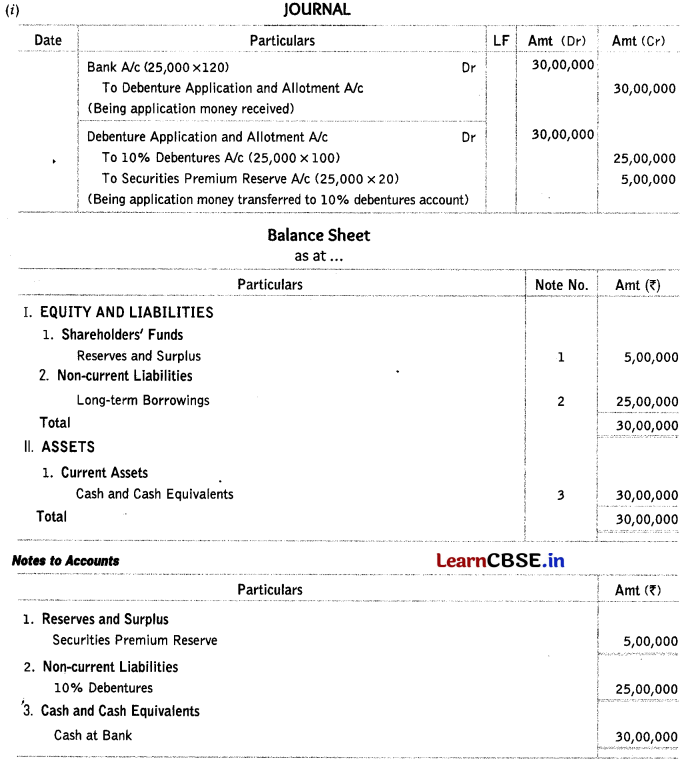
A company with a strong financial standing may issue debentures at a premium, meaning the issue price is higher than the face value (e.g., a ₹100 debenture issued for ₹110). The extra ₹10 is the premium.
Accounting Treatment:
- The premium amount is a capital profit.
- It is credited to the Securities Premium Reserve Account.
- This is typically done in the journal entry for making the allotment money due.
The allotment entry looks like this:
Debenture Allotment A/c ...Dr. (With total allotment money due)
To % Debentures A/c (With face value portion of allotment)
To Securities Premium Reserve A/c (With premium amount)
Let's watch another worked example.
Issue of debentures | Part 1 | Basic Concepts & Journal entries | class 12 Accounts Board exam 2025
This part of the video explains the accounting for debentures issued at a premium. Pay close attention to how the 'Securities Premium Reserve A/c' is credited in the allotment entry.
Watch from 21:45 to 25:02. Notice the breakdown of the allotment money into face value and premium.
After the entries are passed, the debentures appear as a long-term liability, and the premium appears under 'Reserves and Surplus' in the Balance Sheet.
4. Case 3: Issue of Debentures at Discount
This is where a key difference from shares arises. While the Companies Act, 2013 prohibits the issue of shares at a discount (except for re-issue of forfeited shares or sweat equity), there is no such restriction on debentures.
Debentures are issued at a discount when the issue price is less than the face value (e.g., a ₹100 debenture issued for ₹95). The ₹5 difference is the discount.
Accounting Treatment:
- The discount is a capital loss for the company.
- It is debited to a new account: Discount on Issue of Debentures A/c.
- This debit is also typically made in the journal entry for making the allotment money due.
The allotment entry is structured as follows:
Debenture Allotment A/c ...Dr. (With amount received for allotment)
Discount on Issue of Debentures A/c ...Dr. (With discount amount)
To % Debentures A/c (With full face value portion of allotment)
Let's see how this works in practice.
Issue of debentures | Part 1 | Basic Concepts & Journal entries | class 12 Accounts Board exam 2025
This final segment from the video explains the accounting for an issue at a discount. This is a crucial concept as it differs from the rules for shares.
Watch from 25:23 to 28:33. Observe how the 'Discount on Issue of Debentures A/c' is debited to record the loss.
The % Debentures A/c is always credited with its face value, regardless of whether the issue is at par, premium, or discount. The premium or discount accounts for the difference between the face value and the cash received.
Test your understanding!
A company issues 1,000, 9% Debentures of ₹100 each at a discount of 5%, payable entirely on application. Which of the following is the correct journal entry for the allotment of these debentures?
A) Bank A/c ...Dr. ₹1,00,000
To 9% Debentures A/c ₹1,00,000
B) Debenture Application & Allotment A/c ...Dr. ₹1,00,000
To 9% Debentures A/c ₹1,00,000
C) Debenture Application & Allotment A/c ...Dr. ₹95,000
Discount on Issue of Debentures A/c ...Dr. ₹5,000
To 9% Debentures A/c ₹1,00,000
D) Debenture Application & Allotment A/c ...Dr. ₹95,000
To 9% Debentures A/c ₹95,000
Show answer
C) is the correct answer.
Here's the logic:
- The company receives ₹95 per debenture (₹100 face value - ₹5 discount). The total amount received and held in the
Debenture Application & Allotment A/cis ₹95,000 (1,000 x ₹95). - The
Discount on Issue of Debentures A/cmust be debited with the total loss of ₹5,000 (1,000 x ₹5). - The
9% Debentures A/c(the liability account) must always be credited with the full face value, which is ₹1,00,000 (1,000 x ₹100).
Conclusion
You have now covered the journal entries for the three primary ways debentures can be issued for cash. By leveraging your knowledge of share capital accounting, you can see that the process is very manageable.
Key Takeaways:
- Journal entries for debenture issues follow the same pattern as for share issues.
- The key is to use the correct account names:
% Debentures A/cfor the liability,Securities Premium Reserve A/cfor premiums, andDiscount on Issue of Debentures A/cfor discounts. - The
% Debentures A/cis always credited with the face value of the debentures. - Crucially, unlike shares, debentures can be issued at a discount.
Preview of the Next Lesson:
So far, we have only dealt with debentures issued for cash. However, companies also issue debentures for other reasons. In our next lesson, we will explore how to account for the issue of debentures for consideration other than cash (e.g., to purchase an asset) and as collateral security (as additional security for a loan).