Hello! Welcome to our next lesson on Accounting for Debentures.
In our previous lesson, we covered the foundational journal entries for issuing debentures for cash, whether at par, premium, or discount. You saw that this process is very similar to issuing shares, with the key difference being that debentures can be issued at a discount.
Today, we'll build on that foundation to tackle two specific, and very common, scenarios. This lesson will help you master the learning outcome: to account for the issue of debentures for consideration other than cash and as collateral security.
We will break this down into two parts:
- Consideration other than cash: This is when a company pays for an asset or an entire business by giving the seller its own debentures instead of money. You've already encountered this concept in the Share Capital chapter, so you'll find the logic very familiar.
- Collateral security: This happens when a company uses its debentures as additional security to back up a loan from a bank or financial institution.
Let's get started.
1. Issue of Debentures for Consideration Other than Cash
Imagine a company wants to buy new machinery but prefers to conserve its cash. It can negotiate with the seller (the vendor) to pay by issuing debentures. The accounting for this is a two-step process:
- Record the Purchase: First, you record the purchase of the asset or business, creating a liability to the vendor.
Sundry Assets A/c Dr.To Vendor's A/c
- Settle the Payment: Then, you record the issue of debentures to settle the liability. The vendor's account is debited, and the debentures are issued.
Just like with a cash issue, these debentures can be issued at par, premium, or discount. The number of debentures to issue is always calculated as:
To see exactly how these entries are made, let's watch a detailed explanation.
Issue of Debentures at Discount & Consideration other than Cash | Class 12 Accounts Debentures |
This video from CA Hardik Manchanda clearly explains how to account for debentures issued to a vendor for purchasing an asset. It covers all three cases: issue at par, premium, and discount.
Watch the segment from 00:31:01 to 00:37:34. Focus on how the number of debentures is calculated in each case and how the journal entries for premium and discount are handled.
Purchasing an Entire Business
The concept extends to purchasing an entire business, which involves acquiring multiple assets and sometimes liabilities. Here, we introduce two important possibilities:
- Goodwill: If the Purchase Consideration (the price paid) is more than the value of Net Assets (Assets - Liabilities), the difference is debited to the Goodwill Account. This represents the price paid for the firm's reputation and earning capacity.
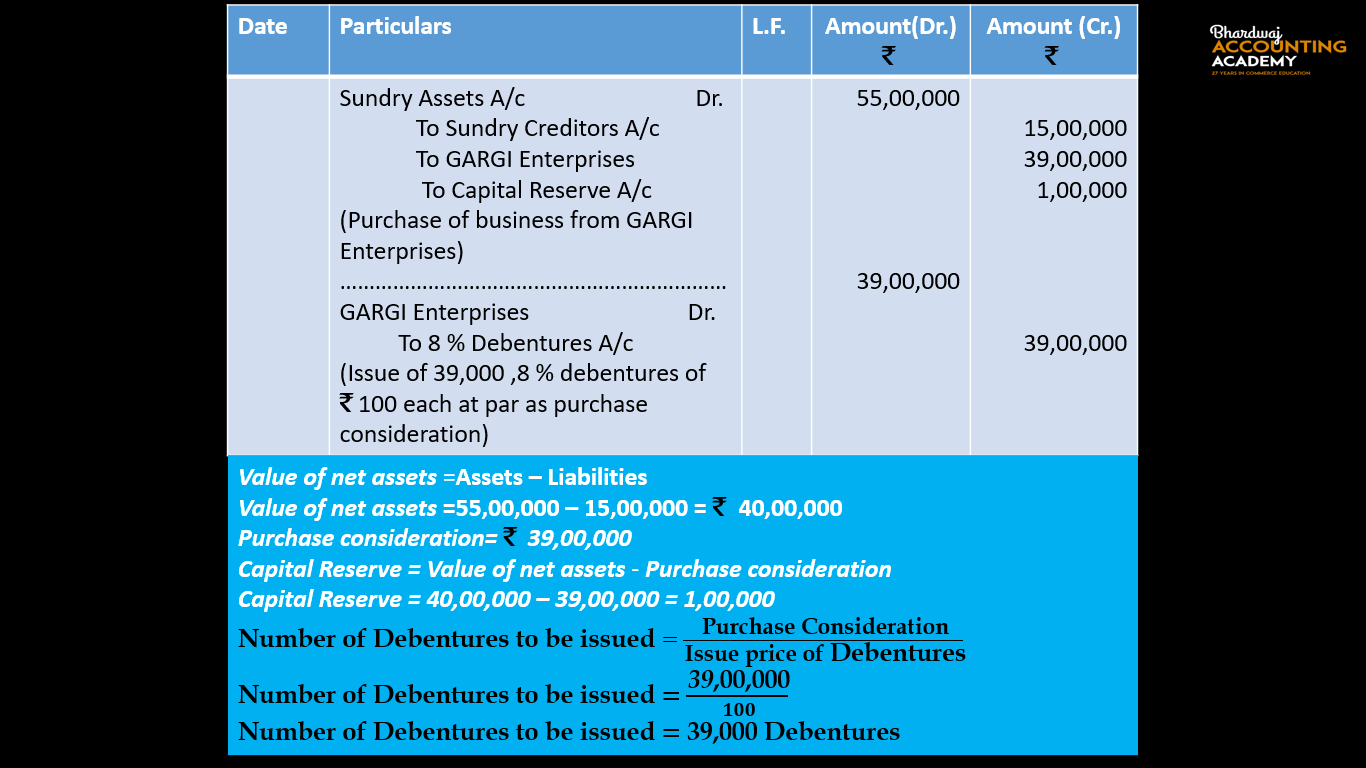
- Capital Reserve: If the Purchase Consideration is less than the value of Net Assets, the difference is a capital profit for the purchasing company and is credited to Capital Reserve Account.
Let's continue with the same video to see how this works.
Issue of Debentures at Discount & Consideration other than Cash | Class 12 Accounts Debentures |
This next segment demonstrates the accounting for purchasing a whole business. It explains how to calculate net assets and how to identify and record Goodwill or Capital Reserve.
Watch from 00:37:34 to 00:50:20. Pay close attention to how the balancing figure in the initial purchase entry is determined to be either Goodwill (debit side) or Capital Reserve (credit side).
Here is a static example summarizing the purchase of a business where the net assets are greater than the purchase consideration, resulting in a Capital Reserve.
To solidify your understanding, you can review the concepts and examples in your NCERT textbook.
Issue and Redemption of Debentures
The NCERT textbook provides a concise summary of the journal entries and several solved illustrations for issuing debentures for consideration other than cash.
Read through the section titled '2.6 Issue of Debentures for Consideration other than Cash'. Review Illustrations 6 through 13 to see the application of these principles in different scenarios, including those involving Goodwill and Capital Reserve.
Test your understanding!
A company purchases machinery worth ₹1,90,000 and pays the vendor by issuing 9% Debentures of ₹100 each at a discount of 5%. How many debentures will the company issue?
Show answer
First, calculate the issue price per debenture:
Face Value = ₹100
Discount (5% of ₹100) = ₹5
Issue Price = ₹100 - ₹5 = ₹95
Now, calculate the number of debentures:
Number of Debentures = Purchase Consideration / Issue Price
Number of Debentures = ₹1,90,000 / ₹95 = 2,000 debentures.
The journal entry would be:
Vendor's A/c Dr. 1,90,000
Discount on Issue of Debentures A/c Dr. 10,000
To 9% Debentures A/c 2,00,000
(2,000 debentures x ₹100 face value = ₹2,00,000; 2,000 debentures x ₹5 discount = ₹10,000)
2. Issue of Debentures as Collateral Security
When a company takes a loan, it usually pledges an asset (like a building) as the primary security. Sometimes, the lender (e.g., a bank) may demand additional security. In such cases, the company might issue its own debentures as this collateral (or secondary) security.
Key points to remember:
- No interest is paid on these debentures.
- The lender can only claim them if the company defaults on the loan repayment and the primary security is insufficient to cover the debt.
- If the loan is repaid, the debentures are returned to the company and cancelled.
There are two methods to account for this. Let's watch a video that explains the concept and both methods clearly.
Issue of DEBENTURES | Collateral security | Class 12 | Term 2 | Part 6
This video by Rajat Arora provides a very clear explanation of what collateral security is and walks through the two distinct accounting methods for it.
Watch from the beginning (00:00) to 13:29. The first part explains the concept. Then, pay close attention to the two different approaches to recording (or not recording) the issue.
As you saw in the video, here are the two methods:
Method 1: No Journal Entry
This is the simpler method. No journal entry is passed when the debentures are handed over to the lender. Instead, the fact is simply disclosed as a note within the Balance Sheet, under the loan for which the security is given.
Balance Sheet (Extract)
- Non-Current Liabilities
- Long-term Borrowings: ₹10,00,000
- Notes to Accounts
- Long-term Borrowings:
- Bank Loan: ₹10,00,000
- (Secured by issue of 12,000, 10% Debentures of ₹100 each as collateral security)
- Long-term Borrowings:
Method 2: Pass a Journal Entry
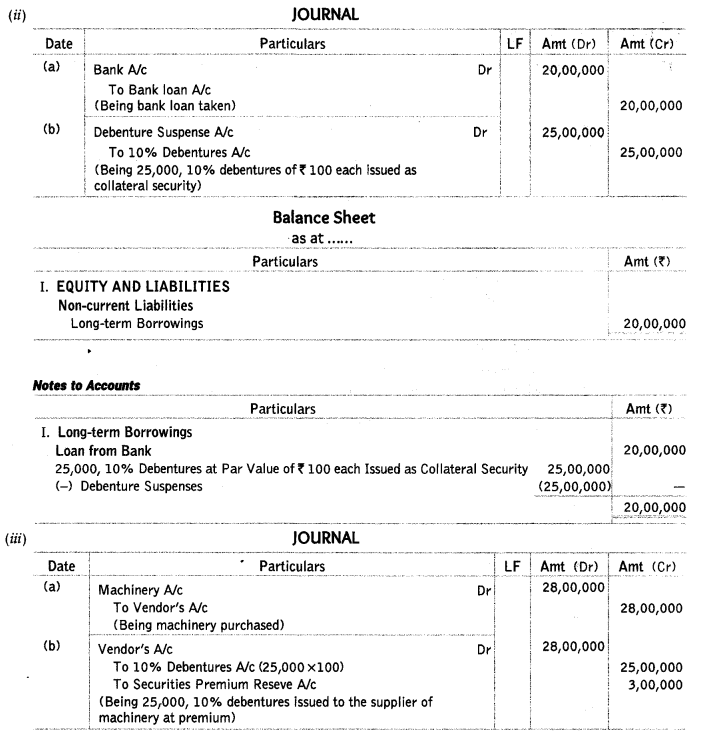
This method creates a record of the issue in the books. When the debentures are issued as collateral, the following entry is passed:Debenture Suspense A/c Dr.
To % Debentures A/c
The Debenture Suspense Account is a temporary account used because no cash or real value has been received. Its purpose is to nullify the liability created by crediting the Debentures Account.
Here’s how it's presented in the Balance Sheet.
Unless a question specifies otherwise, you can use either method, but Method 2 is often preferred as it creates a more complete accounting record.
Conclusion
In this lesson, you've learned how to handle two important special cases for the issue of debentures. Your prior knowledge of share capital accounting was a great help for the "consideration other than cash" topic, and you've now mastered the unique accounting for collateral security.
Key Takeaways:
- When issuing debentures for assets, the key is to first calculate the number of debentures to be issued based on the purchase consideration and issue price.
- When buying a business, the difference between purchase consideration and net assets taken over is treated as either Goodwill or Capital Reserve.
- When debentures are issued as collateral security, you can either pass no entry (and just disclose it as a note) or pass a journal entry using the Debenture Suspense Account, which is then shown as a deduction from the Debentures in the Notes to Accounts.
Preview of the Next Lesson:
So far, we have assumed that debentures are repaid (redeemed) at their face value. However, companies can also promise to repay them at a premium. In our next lesson, we will explore how to record journal entries for the issue of debentures when the terms of redemption are different, such as being issued at a discount but redeemable at a premium. This will introduce the important concept of accounting for a future loss at the time of issue itself.