Hello! Welcome to the first lesson in our new module, Accounting for Debentures.
In our last module, we completed a deep dive into Share Capital, concluding with a comprehensive problem. You've become proficient at understanding shares as a form of owned capital, where shareholders are the owners of the company. Today, we pivot to a different but equally important method of raising long-term finance: debentures, which represent borrowed capital.
This lesson directly addresses our learning outcome: to explain the features and types of debentures and distinguish them from shares. We will explore what a debenture is, what its key characteristics are, how it fundamentally differs from a share, and the various categories of debentures a company can issue.
1. What is a Debenture? From Ownership to Debt
While companies issue shares to raise capital from owners, these funds are often not enough for long-term projects. To fill this gap, companies often borrow money from the public. A debenture is the primary instrument for this.
At its core, a debenture is a formal acknowledgement of a loan taken by the company. To get an intuitive feel for this, let's start with a short video.
Introduction & Conceptual Accounting | Issue of Debentures - 1 | Class 12 Accounts (2024-25)
This video from CA Parag Gupta uses a simple analogy to explain what a debenture is. It clearly establishes a debenture as a loan instrument and introduces key terms like 'interest' and 'coupon rate'.
Watch the first 5 minutes and 17 seconds (00:00 - 05:17). Focus on the core idea: a company borrows money from the public and issues a 'piece of paper' (the debenture) as proof, promising to repay the principal and pay periodic interest.
As the video explains, a debenture holder is a creditor of the company, not an owner. They lend money in exchange for a promise of repayment and a fixed rate of interest.
Formal Definition
The Companies Act, 2013, provides a formal definition. To understand this, please read the first section of your NCERT textbook chapter on this topic.
A company raises its capital by means of issue of shares
This section from your NCERT textbook provides the formal, legal definition of a debenture and its origin. It's important to know the official definition as per the Companies Act.
Read the section titled 'Meaning of Debentures' (Section 2.1). Pay attention to the definition given under Section 2(30) of The Companies Act, 2013.
In summary, a debenture is a written instrument, under the company's seal, that:
- Acknowledges a debt.
- Contains a contract to repay the principal amount at a future date.
- Promises to pay interest at a fixed rate on specified dates.
An important related concept is the Trust Deed. Because there can be thousands of debenture holders, it's impractical for the company to deal with each one individually. Instead, the company appoints Debenture Trustees who act as intermediaries. The rights and duties of these trustees and the obligations of the company are detailed in a legal document called a Trust Deed. This deed protects the interests of the debenture holders.
2. Distinguishing Debentures from Shares
You've spent a lot of time on shares, so drawing a clear distinction is crucial. It's one of the most fundamental concepts in company accounts. While both are ways to raise finance, their nature is completely different.
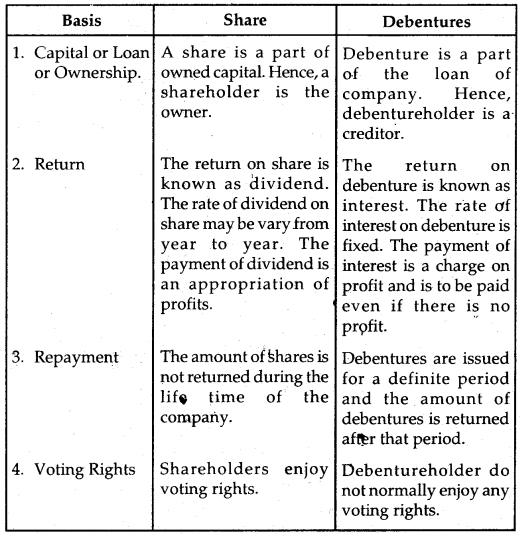
To explore these differences in more detail, let's watch another video that lays them out side-by-side.
What are Shares? | What are Debentures? | How Shares are different from Debentures? | CS Payal Popli
This video by Padhaku Log provides an excellent, clear comparison of shares and debentures, covering all the essential points of distinction.
Watch the segment from 11:07 to 14:39. Focus on the six points of difference discussed: Meaning, Holder, Status, Return, Voting Rights, and Convertibility.
Here's a summary of those key distinctions:
| Basis of Distinction | Shares | Debentures |
|---|---|---|
| Status | The holder is an owner of the company. | The holder is a creditor (lender) to the company. |
| Capital Type | Represents Owned Capital. | Represents Borrowed Capital or Loan Capital. |
| Return | Receives Dividend, which is an appropriation of profit. It's paid only if the company makes a profit. | Receives Interest, which is a charge against profit. It must be paid regardless of whether the company makes a profit or loss. |
| Repayment | The capital is generally not returned during the company's lifetime (except in a buy-back or winding up). | Repaid after a specified period as per the terms of issue. |
| Voting Rights | Shareholders (specifically equity shareholders) have voting rights. | Debenture holders have no voting rights. |
| Security | Shares are unsecured. | Debentures are often secured by a charge on the company's assets. |
| Convertibility | Shares cannot be converted into debentures. | Debentures can be converted into shares if they are issued as 'convertible debentures'. |
3. Types of Debentures
Companies can issue various types of debentures to suit their needs and market conditions. They are classified based on several criteria. The following video gives a great visual and conceptual overview of these types.
Introduction & Conceptual Accounting | Issue of Debentures - 1 | Class 12 Accounts (2024-25)
Let's return to the first video from CA Parag Gupta. This segment systematically explains the different types of debentures with helpful diagrams and examples.
Watch from 14:32 to 29:38. This covers the classification of debentures from the point of view of Security, Redemption, Registration, and Convertibility.
Now, let's document these types for your notes, incorporating the full classification from your NCERT textbook.
a) From the Point of View of Security
- Secured Debentures: These are secured by a charge on the company's assets. If the company fails to pay, the debenture holders can sell these assets to recover their money. The charge can be:
- Fixed Charge: On a specific, identified asset (e.g., a specific building).
- Floating Charge: On the general assets of the company.
- Unsecured Debentures: Also called "Naked Debentures," these are not secured by any charge on assets.
b) From the Point of View of Tenure (Redemption)
- Redeemable Debentures: These are issued for a fixed period and are repaid by the company on the expiry of that period. All debentures issued in India must be redeemable.
- Irredeemable Debentures (Perpetual Debentures): These are not repayable during the company's lifetime and are only paid back at the time of winding up. These are not permitted to be issued in India.
c) From the Point of View of Registration
- Registered Debentures: The company maintains a register with the names, addresses, and holdings of these debenture holders. They can only be transferred through a formal transfer deed.
- Bearer Debentures: The company keeps no record of the holders. They are transferable by mere delivery, like a currency note. Whoever holds the debenture is the owner.
d) From the Point of View of Convertibility
- Convertible Debentures: These give the holder an option to convert their debentures into equity shares after a specified period.
- Non-Convertible Debentures: These cannot be converted into shares.
e) From the Point of View of Coupon Rate
- Specific Coupon Rate Debentures: These carry a fixed rate of interest (e.g., 9% Debentures).
- Zero Coupon Rate Debentures: These do not carry a specific interest rate. Instead, they are issued at a significant discount and redeemed at their face value. The difference between the issue price and face value is the implicit interest.
Test your understanding!
State whether the following statements are True or False:
- Payment of interest on debentures is an appropriation of profit.
- Bearer debentures can be transferred by simple delivery.
- A debenture that is not secured by any charge on assets is called a perpetual debenture.
- Debenture holders are considered owners of the company.
Show answer
- False. Payment of interest is a charge against profit; it must be paid even if there are no profits.
- True. Bearer debentures are transferable by delivery, and the company does not keep a record of their holders.
- False. A debenture not secured by any charge is called an unsecured or naked debenture. A perpetual debenture is one that is not redeemable during the company's life.
- False. Debenture holders are creditors (lenders) of the company. Shareholders are the owners.
Conclusion
Excellent work! You've successfully taken the first step into the world of debentures. This foundational knowledge is essential before we move on to the accounting entries.
Key Takeaways:
- A debenture is a formal acknowledgement of debt, making the holder a creditor of the company.
- Unlike dividends on shares (appropriation of profit), interest on debentures is a charge against profit.
- Debentures differ from shares in terms of status (creditor vs. owner), return (interest vs. dividend), repayment terms, voting rights, and security.
- Debentures can be classified based on security, tenure, registration, convertibility, and coupon rate.
Preview of the Next Lesson:
Now that we understand the 'what' and 'why' of debentures, our next lesson will focus on the 'how'. We will learn to record the journal entries for the issue of debentures at par, at a premium, and at a discount. You will find that the mechanics are quite similar to what you learned for the issue of shares, which will give you a great head start.