Hello! Welcome to our final lesson in the "Forfeiture and Reissue of Shares" module. In our previous lessons, we've systematically built your understanding of oversubscription, pro-rata allotment, and the individual journal entries for forfeiture and reissue. Most recently, we saw how these transactions flow into the Share Forfeiture and Capital Reserve ledger accounts.
Today, we will bring everything together. Our goal is to solve a comprehensive problem involving oversubscription, pro-rata allotment, forfeiture, and reissue of shares. This is the culmination of this module and mirrors the kind of full-length questions you can expect in your CBSE Grade 12 exams. We will focus on a structured, step-by-step process that will allow you to tackle even the most complex scenarios with confidence.
The Anatomy of a Comprehensive Problem
Solving these large problems isn't about learning new concepts, but about applying the ones you know in a specific order. The key is to be methodical. Here’s a reliable process:
- Extract Data: Read the question carefully and jot down the key figures: shares issued, shares applied for, the call structure (Application, Allotment, Calls), any premium, and the details of the defaulting shareholders.
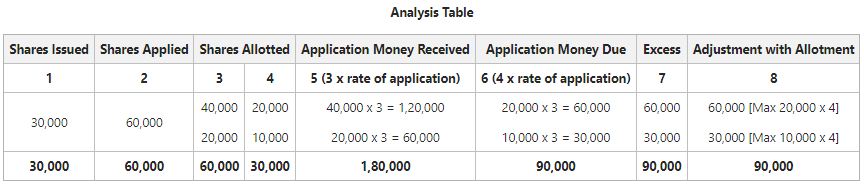
- Prepare a Pro-Rata Table (Analysis Table): This is your most important working note. It organizes the oversubscription and shows how excess application money is handled (refunded or adjusted).
- Calculate Arrears for Pro-Rata Defaulters: If a shareholder who defaulted was part of a pro-rata allotment group, you must create a separate working note for them. This is to calculate the actual amount of Calls-in-Arrears on allotment, after accounting for the excess application money they've already paid.
- Record Journal Entries: Pass the entries sequentially for Application, Allotment, and Calls, using the figures from your working notes.
- Forfeit the Shares: Pass the forfeiture journal entry for the defaulting shareholder(s).
- Reissue the Shares: Record the reissue entry.
- Calculate and Transfer Profit to Capital Reserve: The final step is to calculate the profit on the reissued shares and transfer it to the Capital Reserve. Remember to do this calculation only for the number of shares that were actually reissued.
The pro-rata table is the foundation of this process. Let's look at a typical structure.
A Guided Walkthrough of a Comprehensive Problem
The best way to master this is to see it in action. We are going to walk through a detailed problem from start to finish. The following video provides an excellent, step-by-step solution. We will break it down into logical parts.
Pro Rata + Forfeiture & Reissue of Shares| Most Important Questions |Share Capital Class 12 Accounts
We will use this video from CA Hardik Manchanda as our main guide. It perfectly demonstrates the process of solving a complex problem involving all the elements we've discussed.
You can watch the entire video as one continuous example. However, I will break it down for you section-by-section to focus on the key steps. Pay close attention to how the working notes are prepared before the journal entries are passed.
Step 1: Understanding the Problem and the Defaulter
First, let's understand the scenario and perform the first critical working note: figuring out the details of the defaulting shareholder.
Pro Rata + Forfeiture & Reissue of Shares| Most Important Questions |Share Capital Class 12 Accounts
Watch this first segment to understand the problem's details and the calculation for the number of shares applied for by the defaulting shareholder.
Watch from 01:18 to 09:24. Focus on two things: How the problem data is extracted and organized. The calculation to find the number of shares applied for when you are given the number of shares allotted to a defaulter in a pro-rata category. This is the first essential working note.
Summary of the Working Note for the Defaulter:
- Given: The shareholder was allotted 1,000 shares from the pro-rata category (60,000 applied vs. 40,000 allotted, a ratio of 3:2 or 6:4).
- Calculate Applied Shares:
- Calculate Excess Application Money:
- Excess shares applied = 1,500 - 1,000 = 500 shares.
- Excess money paid = 500 shares × ₹3 (application money) = ₹1,500.
- Calculate Actual Allotment Arrears:
- Allotment money due = 1,000 shares × ₹4 = ₹4,000.
- Less: Excess application money adjusted = ₹1,500.
- Actual Calls-in-Arrears on Allotment = ₹2,500.
This calculation is the most common point of error. The shareholder did not fail to pay ₹4,000; they failed to pay the net amount of ₹2,500.
Step 2: Journal Entries from Application to Calls
Now that we have the figures for the arrears, we can proceed with the journal entries for receiving money from all shareholders up to the final call.
Pro Rata + Forfeiture & Reissue of Shares| Most Important Questions |Share Capital Class 12 Accounts
This next segment shows the preparation of the second working note (Total Amount Received on Allotment) and the journal entries from application to the calls.
Watch from 09:24 to 20:55. Observe how the two working notes we've discussed are used to determine the figures for the 'Bank A/c' entry at the allotment and call stages.
Notice how the Bank A/c is debited with ₹1,37,500 on allotment. This is derived from:
- Total Allotment Due:
₹2,00,000 - Less: Total Excess Application Money Adjusted:
(₹60,000) - Less: Defaulter's Arrears (from Working Note 1):
(₹2,500) - Equals:
₹1,37,500
Step 3: The Forfeiture and Reissue Entries
With all calls made, the company forfeits the defaulter's shares and then reissues a portion of them.
Pro Rata + Forfeiture & Reissue of Shares| Most Important Questions |Share Capital Class 12 Accounts
This is the final and most crucial part. Watch how the forfeiture and reissue entries are passed, leading to the final calculation of the Capital Reserve.
Watch from 20:55 to 30:06. Pay close attention to: Forfeiture Entry: Note the amount credited to 'Share Forfeiture A/c' (₹4,500). It's the amount the shareholder actually paid (1,500 shares applied × ₹3). Reissue Entry: The reissue is at a discount, so 'Share Forfeiture A/c' is debited. Capital Reserve Calculation: This is the key. The profit is calculated proportionately for the 600 shares that were reissued.
Capital Reserve Calculation Recap:
- Total amount forfeited on 1,000 shares = ₹4,500.
- Proportionate amount forfeited on 600 reissued shares:
- Discount on reissue of 600 shares (reissued at ₹8, face value ₹10):
- Profit transferred to Capital Reserve:
Test your understanding!
Z Co. Ltd offered 20,000 shares of ₹100 each. The issue was oversubscribed. Applicants for 30,000 shares were allotted 15,000 shares on a pro-rata basis.
Monu, who applied for 2,000 shares in this group, failed to pay the allotment money of ₹40 and the first call of ₹40. His shares were forfeited.
Later, 750 of these forfeited shares were reissued at ₹105 per share, fully paid.
Calculate the amount to be transferred to the Capital Reserve.
Show answer
1. Calculate Monu's Allotted Shares:
- Ratio of allotment = 15,000 allotted / 30,000 applied = 1/2.
- Monu's allotted shares = 2,000 applied × (1/2) = 1,000 shares.
2. Calculate Amount Forfeited on Monu's Shares:
- Monu only paid the application money of ₹30.
- He applied for 2,000 shares, so amount paid = 2,000 shares × ₹30 = ₹60,000.
- Note: The excess application money is also part of the forfeited amount.
- Money for allotted shares = 1,000 shares × ₹30 = ₹30,000.
- Excess application money = ₹60,000 - ₹30,000 = ₹30,000. This was adjusted against allotment but is forfeited since Monu defaulted.
- Total Amount Forfeited on 1,000 shares = ₹60,000.
3. Calculate Profit on Reissue:
- The shares were reissued at a premium (₹105), so there is no discount. The entire forfeited amount related to the reissued shares is profit.
- Proportionate forfeited amount for 750 reissued shares:
- Since the discount is zero, the entire ₹45,000 is transferred to the Capital Reserve.
Conclusion
Congratulations on completing this challenging but vital topic! You have now integrated all the components of accounting for share capital, from issue to forfeiture and reissue.
Key Takeaways:
- A structured approach using working notes is essential for accuracy.
- Always prepare an Analysis Table for pro-rata allotment.
- For a defaulting shareholder from a pro-rata group, you must calculate the actual Calls-in-Arrears after adjusting their excess application money.
- The profit transferred to Capital Reserve must always be calculated proportionately based on the number of shares reissued.
This lesson marks the end of our module on Share Capital. You are now well-equipped to handle complex problems on this topic.
Preview of the Next Lesson:
In our next session, we will begin a new topic: Accounting for Debentures. We will start by exploring the fundamental differences between shares and debentures, understanding that while shares represent ownership capital, debentures represent borrowed capital. We will cover the features and different types of debentures as per the Companies Act, 2013.