Hello! Welcome to your fourth lesson in the "Project Showcase" module.
In our last lesson, you mastered the technical art of exporting, learning how to choose the right codecs and compression settings to create a high-quality video file. You now have a finished product, perfectly rendered and ready to go. But how do people find it? How do you convince them to watch it?
Today, we'll focus on that crucial next step: writing effective metadata for YouTube and film festival submissions. Metadata is the text that surrounds your video—its title, description, and keywords. It's the signpost that guides both human audiences and search algorithms to your work. A great video with poor metadata can get lost in the digital noise, while effective metadata can ensure your creation finds the audience it deserves.
We'll tackle this topic in two parts, reflecting your dual interests in creating short films and YouTube content:
- Crafting materials for film festival submissions, where the goal is to intrigue programmers and convey your film's artistic vision.
- Optimizing metadata for YouTube, where the goal is to rank in search results and earn clicks from viewers.
By the end of this lesson, you'll be able to package your projects effectively for these two very different, but equally important, distribution channels.
1. The Filmmaker's Pitch: Loglines and Synopses for Festivals
When you submit a short film to a festival, you're not just sending a video file. You're also providing a package of materials designed to sell your film to the selection committee. Two of the most important pieces of this package are the logline and the synopsis.
The Logline: Your Film in a Nutshell
A logline is a one-sentence summary of your film's central conflict. Its job is to hook the reader immediately and communicate the core concept of your story. Think of it as the ultimate elevator pitch.
To understand what makes a good logline, let's start with a reading.
Logline and Synopsis: Characteristics, Features, ...
The article 'Logline and Synopsis' from Festagent provides a clear definition and breaks down the essential components of a compelling logline.
Please read Part 1, focusing on the sections 'Logline,' 'The main character,' and 'Goal.' Pay attention to what a logline should communicate and the advice on how to describe your protagonist and their objective.
As the article explains, a strong logline answers four key questions:
- Who is the protagonist? (e.g., "A conceited official," not "John Smith")
- What is their goal or what action do they take? (e.g., "tries to survive")
- What is the central conflict or obstacle? (e.g., "after a plane crash in a snowy wasteland")
- What is the main intrigue? (e.g., "hunted by a pack of wolves")
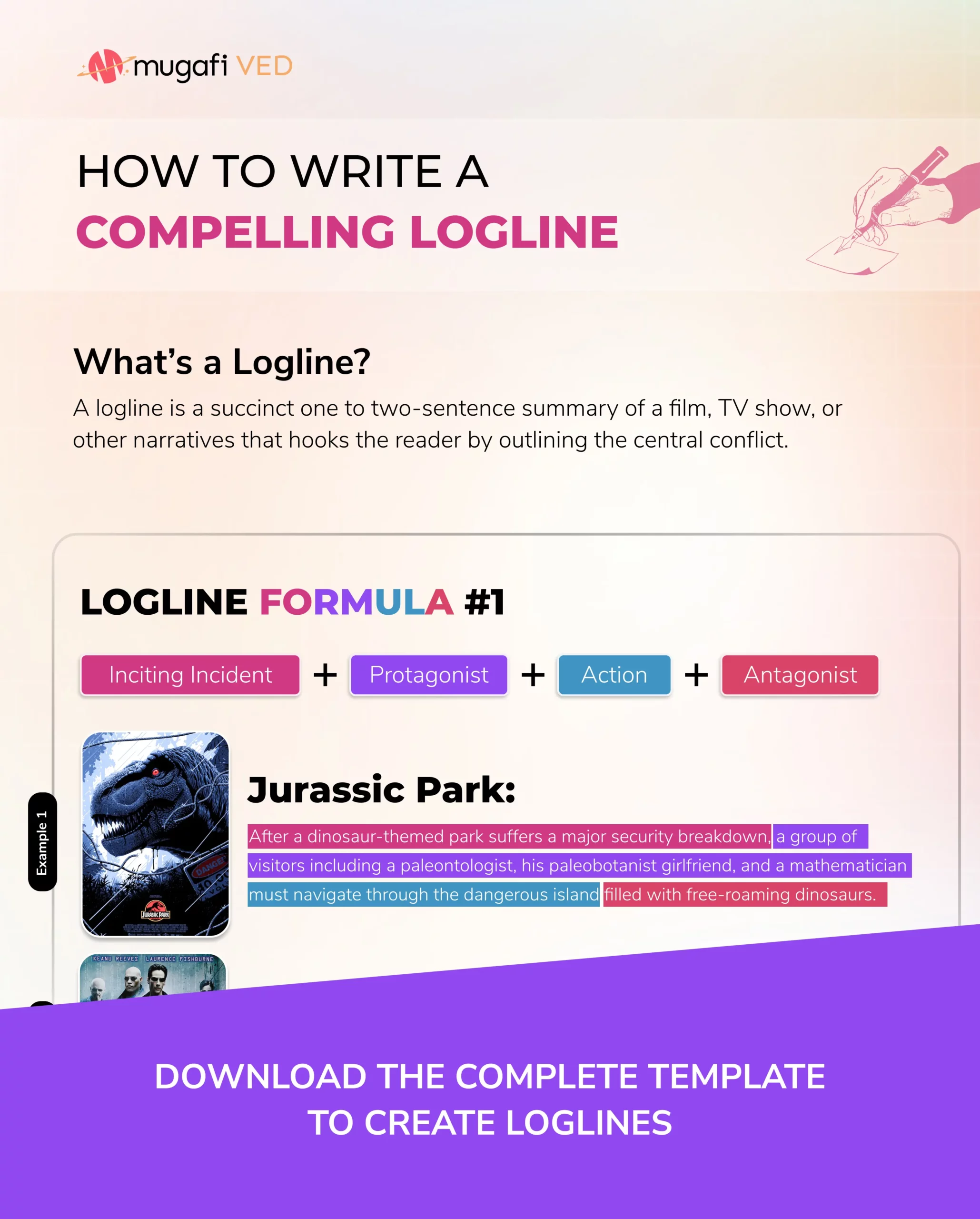
The following image provides a simple but powerful formula for constructing a logline.
Test your understanding!
Using the formula from the image, try to write a logline for the movie Finding Nemo. Think about the key elements:
- Inciting Incident: What kicks off the story?
- Protagonist: Who is the main character and what is their defining trait?
- Action: What must they do?
- Antagonist/Obstacle: What stands in their way?
Show answer
Here’s one possible logline for Finding Nemo:
"After his son is captured in the Great Barrier Reef and taken to Sydney, a timid clownfish (Protagonist) must brave the dangers of the open ocean (Action) to bring him home (Goal)."
Your version might be slightly different, but it should contain these core elements: an overly cautious father, the capture of his son, and the dangerous journey he must undertake.
The Synopsis: Telling the Story
While a logline is a hook, a synopsis is a brief retelling of your film's story. It's longer than a logline (typically a paragraph or two) and gives the reader a clearer idea of the plot's progression, including key turning points and the overall narrative arc.
Logline and Synopsis: Characteristics, Features, ...
Now let's look at the second key component, the synopsis. This reading will explain how it differs from a logline and the conventions for writing one.
Please read Part 2, focusing on the definition of 'Synopsis' and the section on 'Synopsis size.' This will help you understand its purpose and how to adapt its length for different requirements.
Key takeaways for writing a synopsis:
- Tell the story chronologically. Present the main plot points as they happen.
- Write in the present tense. (e.g., "Daniel meets the master," not "Daniel met the master.") This makes the story feel more immediate.
- Focus on the protagonist's journey. What choices do they make? How do they change?
- Reveal the ending... or don't. For a short synopsis for a festival catalog, you want to maintain intrigue. For a longer synopsis meant for a programmer who is deciding whether to watch the film, you might reveal more of the plot, including the ending. Always check the festival's specific guidelines.
2. The YouTube Blueprint: Titles, Descriptions, and Tags
For YouTube, your metadata serves a different master: the search and discovery algorithm. Your goal is to make your video as easy as possible for YouTube to understand and recommend to the right viewers. The key components are the title, description, and tags.

The Title: Your Video's First Impression
A YouTube title has two jobs:
- Inform the algorithm what your video is about using relevant keywords.
- Intrigue a human viewer enough to make them click.
How to Write a YouTube Title and Description That Ranks
The article 'How to Write a YouTube Title and Description That Ranks' offers an excellent guide to creating effective metadata for discoverability.
Please read the sections 'Why Your YouTube Title and Description Matter' and 'How to Write a High-Performing YouTube Title.' Focus on the role of keywords, matching search intent, and the title formulas provided.
As you've read, a strong title is clear, concise (under 60 characters is best), and keyword-focused. Instead of a generic title like "My Short Film," a more effective title would be "A Sci-Fi Short Film About a Time-Traveling Robot | 'Chrono-Cross'." This title includes the genre ("Sci-Fi Short Film"), the premise ("Time-Traveling Robot"), and the film's title, hitting keywords a potential viewer might search for.
The Description: Adding Context and Value
The description is where you provide more detail for both the algorithm and your viewers. Only the first few lines are visible without clicking "Show more," so make them count!
How to Write a YouTube Title and Description That Ranks
Now, let's look at how to structure your description to maximize its impact.
Read the section 'How to Optimize Your YouTube Description for Search.' Pay close attention to the recommended template, including the summary, timestamps, and calls to action.
A well-optimized YouTube description often follows this structure:
- A strong opening summary (1-2 sentences): Restate the video's topic using your main keywords. For a short film, this is the perfect place for your logline!
- Timestamps (Chapters): Break your video into sections. For a narrative film, you could mark key scenes. This improves the viewer experience and is favored by the algorithm.
- More Context: Add your full synopsis, credits (director, actors, music), and any "behind-the-scenes" info.
- Links & Call to Action (CTA): Link to your social media, other videos, or your portfolio. Ask viewers to subscribe, comment, or share.
Tags & Keywords: The Signposts for Search
Keywords are the search terms people use to find content. You should strategically place them in your title and description. YouTube also has a dedicated "Tags" section where you can list additional relevant keywords.
How to Write a YouTube Title and Description That Ranks
To effectively use tags, you first need to understand how to research and choose the right keywords. This final reading explains that process.
Please read the section 'Using Keywords the Right Way.' Focus on the difference between primary and secondary keywords and the concept of 'long-tail' phrases.
To find good keywords, think like your audience. What would they type into the search bar?
- Primary Keywords (Broad): "short film," "sci-fi film"
- Secondary Keywords (Specific): "dystopian short film," "robot love story"
- Long-Tail Keywords (Very Specific): "short film inspired by Blade Runner," "how to make a short film on a budget"
Your tags should be a mix of these. Don't "stuff" the section with irrelevant tags; focus on terms that accurately describe your video's content, genre, and themes.
Conclusion
You've successfully exported your video and now you know how to package it for the world. While both film festivals and YouTube require you to write about your work, their goals are distinct.
Key Takeaways:
- For Film Festivals: Your metadata (logline, synopsis) is a persuasive tool to attract curators. It should be evocative, well-written, and focused on narrative and theme.
- For YouTube: Your metadata (title, description, tags) is an SEO tool to attract the algorithm and viewers. It should be clear, keyword-rich, and structured to answer a search query or pique curiosity.
- The logline is a versatile tool that can serve as the core of your festival submission and the hook in your YouTube description.
In our next lesson, we'll step back and look at a project in its entirety. You'll learn how to critique a complete project to identify its strengths and areas for improvement. This skill is essential for growing as a filmmaker, allowing you to learn from your work and refine your craft for the next project.