Hello! Welcome to the next lesson in our module on Cinematic Language.
In our previous lesson, we explored how to create visual hierarchy and depth by composing a shot in three layers: foreground, midground, and background. You learned how to guide the viewer's eye using tools like focus, light, and contrast.
Today, we build directly on that foundation. We're moving from composing a space to composing the people within it. This is the art of blocking, and it’s where a scene truly comes to life. By the end of this lesson, you will be able to block and frame scenes with multiple subjects to visually represent their relationships and power dynamics, adding a layer of unspoken story to your films.
1. What is Blocking?
Before we can use blocking to tell a story, we need to be clear on what it is. In filmmaking, "blocking" and "staging" are two concepts that work hand-in-hand to create a scene's visual narrative.
- Blocking refers to the precise movements and positions of the actors in a scene. Where do they stand? When do they move? How do they interact with their environment?
- Staging involves the placement of the camera, as well as objects and props, in relation to the actors' blocking.
When a director combines thoughtful actor blocking with intentional camera staging, they create visual subtext—telling the audience how characters feel and relate to one another without needing a single line of dialogue.
To get a more formal definition, let's turn to a helpful article.
Blocking and Staging a Scene like Spielberg, Kubrick, and ...
The article 'Blocking and Staging a Scene' from StudioBinder provides a clear distinction between these two crucial concepts.
Please read the sections 'What Is Blocking' and 'Scene Staging Definition.' The goal is to understand how actor performance (blocking) and camera/object placement (staging) work together.
Now that we have the definitions, let's explore practical techniques you can use in your own short films and videos.
2. The Geometry of Relationships: The Triangle Method
When you have three or more subjects in a frame, arranging them can feel complicated. A simple but incredibly effective technique for organizing them is the Triangle Method. By positioning characters at the points of an imaginary triangle, you create a composition that feels balanced, dynamic, and visually interesting.
This arrangement naturally guides the viewer's eye between the characters, highlighting their connection and making dialogue scenes more engaging.
Filmmaking Techniques Film Blocking (2025)
The article 'Filmmaking Techniques Film Blocking' explains this geometric approach to blocking clearly.
Read the section 'Utilizing the Triangle Method in Blocking,' up to (but not including) the examples. Focus on understanding the basic principle and how it enhances dialogue scenes.
As the article mentions, this method turns static conversations into visually stimulating experiences. It helps define roles within the conversation: one point of the triangle might be the main speaker, another the active listener, and a third an observer, creating a natural flow of attention.
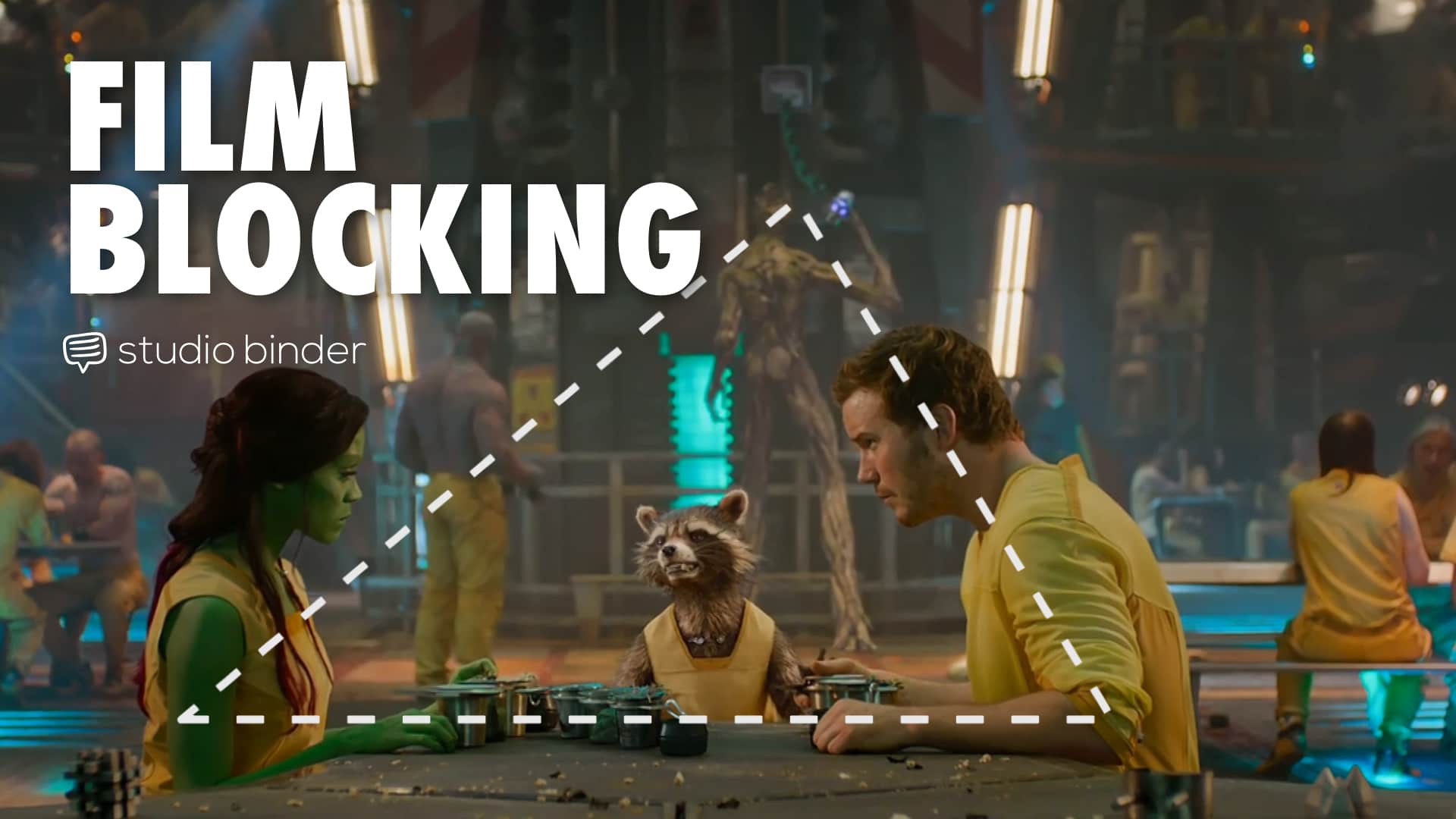
This technique is used constantly not just in film, but in video game cutscenes to frame interactions between multiple characters in a way that feels natural and directs player focus.
3. Blocking for Power Dynamics
Beyond showing connection, blocking is one of a filmmaker's most potent tools for communicating power. The spatial relationship between characters in the frame can instantly tell the audience who is dominant, who is submissive, and how that dynamic might be shifting.
How can you achieve this? By manipulating a few key variables:
- Height & Camera Angle: A character positioned higher than another appears more powerful. Shooting a character from a low angle makes them seem imposing, while a high angle can make them appear small and vulnerable.
- Space & Position: A character who takes up more space, is in the foreground, or is placed in the center of the frame often reads as more dominant. A character pushed to the edge or into the background seems less significant.
- Movement: A character who can move freely has more agency and power than one who is stationary or confined.
Filmmaking Techniques Film Blocking (2025)
Let's return to the 'Filmmaking Techniques' article for a structured look at how these elements work.
Read the subsections 'Using Spatial Relationships to Convey Power' and 'Blocking Techniques to Emphasize Dominance and Submission.' Notice how simple changes in height and framing can establish a clear visual hierarchy.

Case Study: Shifting Power in Minority Report
Power dynamics aren't always static. Great blocking can show power shifting within a single scene. Steven Spielberg is a master of this, using character placement and movement to mirror the subtext of the conversation.
Let's analyze a scene where a comfortable authority figure is slowly undermined.
Blocking and Staging a Scene like Spielberg, Kubrick, and ...
The StudioBinder article we looked at earlier has a brilliant breakdown of a scene from 'Minority Report' that demonstrates dynamic blocking for power.
Read the section 'Staging a scene like Steven Spielberg.' Pay close attention to how the characters' physical positions change as the dialogue challenges the status quo. Notice how John Anderton starts in a comfortable, powerful position and ends up visually deflated.
As the analysis shows, the scene is a masterclass in visual storytelling:
- Initial Power: Anderton is in control, casually demonstrating the pre-crime technology. He literally holds justice in his hands.
- The Challenge: Witwer stands apart, creating a visual and ideological split. The camera places the viewer in the middle of their debate.
- The Shift: As Witwer reveals his warrant, he moves into Anderton’s space, crouching down and composing a shot that visually diminishes Anderton's power. The comfortable seat is now a hot seat.
This is the goal: to make your blocking support your story. The physical actions on screen should reflect the emotional and psychological journey of the characters.
Test your understanding!
Think of a scene with a tense confrontation or argument from a movie you love. How are the characters positioned? Does one character stand while the other sits? Does one invade the other's personal space? How do the camera angles (high, low, eye-level) contribute to who you perceive as having the upper hand?
Show answer
A great example is any scene between Darth Vader and a subordinate in Star Wars. Vader, being physically tall and clad in black, almost always towers over other characters. He is often shot from a slightly low angle, enhancing his authority. In contrast, the officers he speaks to are often shot at eye-level or from a slightly high angle, making them seem smaller and at his mercy. Their rigid, still posture contrasts with his imposing presence.
Conclusion
Today, we've unlocked a fundamental layer of cinematic language. You've moved beyond just framing a pretty picture to staging a story. By thoughtfully placing your actors, you can reveal their inner lives and their relationships with each other, creating a richer, more compelling experience for your audience.
Key Takeaways:
- Blocking is Storytelling: The positions and movements of your actors are a powerful narrative tool.
- Use Triangles for Groups: The triangle method is a simple, effective way to create dynamic and balanced compositions with multiple subjects.
- Visualize Power: Use height, camera angles, and spatial positioning to establish clear power dynamics between characters.
- Show, Don't Just Tell: Let your blocking and staging reveal the subtext of a scene—the unspoken alliances, tensions, and shifts in power.
Next Lesson Preview:
We've now covered how to compose a shot with depth and how to arrange subjects within it. But how do you capture these compositions effectively? In our next lesson, "Execute static shots using tripods for stable footage," we'll get practical and technical, ensuring your carefully planned shots are captured with professional stability and control.