Hello! Welcome to the next lesson in our OSPF module.
In our last lesson, we focused on OSPF design, specifically how to use different area types (stub, NSSA, etc.) to control Link-State Advertisement (LSA) flooding. This is a crucial technique for improving scalability by reducing the size of the Link-State Database (LSDB) and minimizing CPU-intensive SPF calculations.
Today, we'll build on that foundation by tackling another key optimization technique: route summarization. While filtering LSAs is important, reducing the sheer number of routes in the routing table is equally vital for a stable and efficient network. This lesson directly addresses the learning outcome: Configure and verify OSPF route summarization at ABRs and ASBRs. We will explore how to condense multiple network prefixes into a single summary route at the natural boundaries of an OSPF domain, leading to smaller routing tables and a more resilient network.
1. The "Why" and "Where" of OSPF Summarization
Route summarization, also known as route aggregation, is the process of advertising a single, less-specific prefix that covers multiple, more-specific prefixes. For example, instead of advertising 192.168.0.0/24, 192.168.1.0/24, 192.168.2.0/24, and 192.168.3.0/24 individually, a router can advertise a single summary route: 192.168.0.0/22.
The benefits are significant:
- Smaller Routing Tables: Reduces memory consumption and speeds up route lookups on downstream routers.
- Improved Stability: If a link within the summarized block flaps (e.g., the
192.168.1.0/24network goes down), the change is not advertised to other areas. The summary route192.168.0.0/22remains stable as long as at least one of its component subnets is still up. This contains network instability and prevents unnecessary SPF recalculations across the OSPF domain.
Unlike some routing protocols, OSPF is very particular about where summarization can occur. To maintain a consistent LSDB within an area, summarization is only permitted at area boundaries.
To get a clear overview of these concepts, let's start with a short video.
The video 'OSPF Route Summarization' from Kevin Wallace Training provides a great introduction. It explains the core benefits and clearly identifies the two types of routers where summarization is performed.
Please watch the first 3 minutes and 25 seconds of the video. Focus on the two key locations for OSPF summarization: the Area Border Router (ABR) and the Autonomous System Boundary Router (ASBR).
As the video explained, we have two distinct types of summarization:
- Inter-area Summarization: Performed on an ABR to summarize routes from one area into another. This generates a Type 3 Summary LSA.
- External Summarization: Performed on an ASBR to summarize external routes that are being redistributed into the OSPF domain. This generates a Type 5 External LSA.
We'll now look at the configuration and verification for each.
2. Inter-Area Summarization on an ABR
This is the most common form of summarization in a multi-area OSPF design. When an ABR connects, for example, Area 1 to Area 0, it can summarize the prefixes from within Area 1 before advertising them into the backbone.
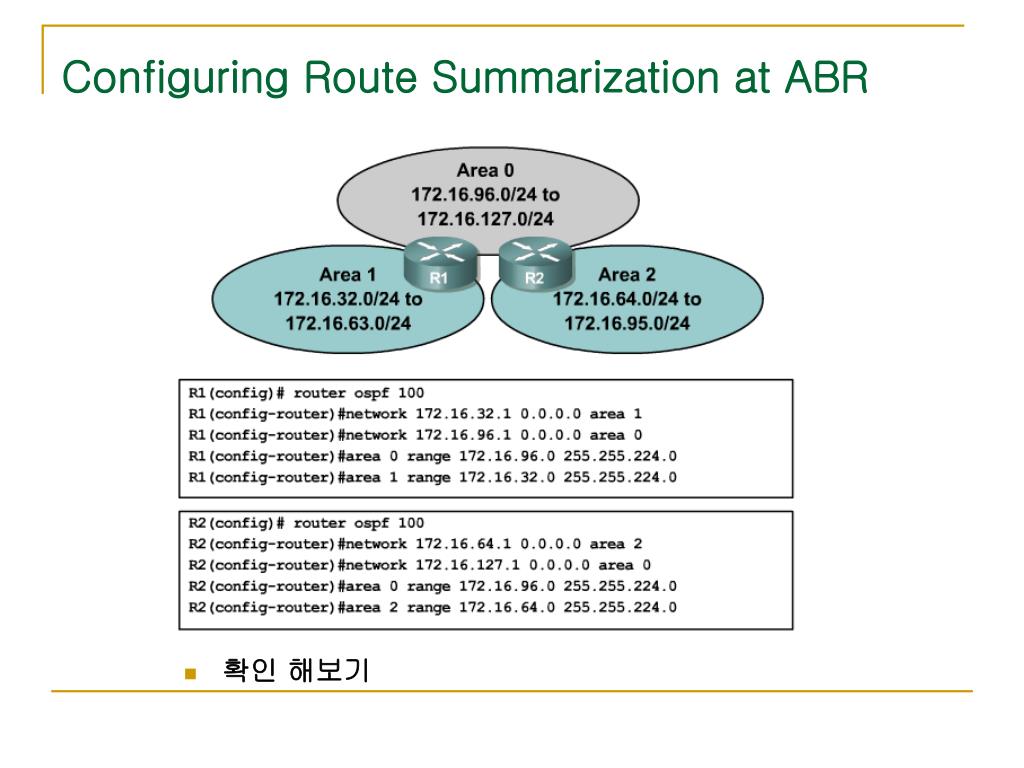
Configuration
To configure inter-area summarization on an ABR, you use the area range command from within the router ospf configuration mode.
Command Syntax:area <area-id> range <ip-address> <mask>
area-id: This is the ID of the area that contains the routes you want to summarize. This is a critical detail. If you are on an ABR summarizing prefixes that exist in Area 1 to advertise into Area 0, the command isarea 1 range ....ip-addressandmask: The calculated summary address and mask.
The process for calculating the summary route involves converting the network addresses to binary and finding the number of common leading bits. Given your CCNA background, this should be familiar, but the resource below provides a quick refresher if needed.
OSPF Inter-area route summarization
The article 'OSPF Inter-area route summarization' from the Cisco Community provides a concise guide to the configuration command and the three steps for calculating a summary route.
Please read the 'Background' and 'Summary route calculation' sections. This will reinforce the command syntax and the logic behind creating a summary address.
Now, let's see this command in action.
We'll return to Kevin Wallace's video to see a practical demonstration of configuring and verifying ABR summarization.
Watch from 06:51 to 09:22. Note the 'before' and 'after' state of the routing table on the router in Area 0. Also, pay attention to the explanation of which area ID to use in the area range command.
The Null0 Discard Route
An important behavior to notice is that when you configure a summary route, the ABR automatically creates a route for that summary pointing to the Null0 interface in its own routing table.
ABR1# show ip route ospf
O IA 192.168.0.0/22 is a summary, 00:05:10, Null0
This is a loop-prevention mechanism. Imagine the ABR receives a packet for an IP address that falls within the summary range but doesn't actually exist (e.g., 192.168.5.5 in our 192.168.0.0/22 summary). Without the Null0 route, the ABR might forward the packet based on a less-specific route, such as a default route, potentially sending it back where it came from and creating a routing loop. The Null0 route ensures that any packet for a non-existent network within the summary range is immediately discarded.
3. External Summarization on an ASBR
When you redistribute routes from another routing domain (like EIGRP or BGP) into OSPF, the router performing the redistribution is an ASBR. If you are importing many prefixes, it's highly beneficial to summarize them into a single external route.

Configuration
To configure external summarization on an ASBR, you use the summary-address command from within the router ospf configuration mode.
Command Syntax:summary-address <ip-address> <mask>
- This command is more straightforward than the ABR command. It simply tells the ASBR to create a single Type 5 LSA for the specified summary range, suppressing the advertisement of the more specific individual external routes.
Let's see the demonstration.
Let's watch the final segment from Kevin Wallace's video, where he configures and verifies summarization on an ASBR.
Watch from 03:25 to 06:51. Observe how the summary-address command is used on the ASBR during redistribution and how it cleans up the routing table on the internal OSPF router (R1).
Test your understanding!
You are the network engineer for a company with a multi-area OSPF network.
- Router R5 is an ABR connecting Area 10 to Area 0. Area 10 contains the subnets
10.10.16.0/24through10.10.31.0/24. - Router R8 is an ASBR redistributing a large number of static routes into OSPF Area 20. These static routes all fall within the
172.25.0.0/16range.
You need to configure summarization to optimize the network. Which command would you use on each router?
A) On R5: summary-address 10.10.16.0 255.255.240.0
B) On R5: area 10 range 10.10.16.0 255.255.240.0
C) On R8: area 20 range 172.25.0.0 255.255.0.0
D) On R8: summary-address 172.25.0.0 255.255.0.0
Choose one command for R5 and one for R8.
Show answer
The correct answers are B and D.
- On R5 (ABR): You must use the
area rangecommand for inter-area summarization. The correct summary for10.10.16.0/24through10.10.31.0/24is10.10.16.0/20(mask255.255.240.0). The commandarea 10 range ...correctly identifies Area 10 as the source of the routes to be summarized. - On R8 (ASBR): You must use the
summary-addresscommand to summarize external routes during redistribution. The commandsummary-address 172.25.0.0 255.255.0.0correctly creates a single Type 5 LSA for the entire/16range.
4. Summarization for Path Manipulation
Beyond simply reducing routing table size, summarization can be a powerful tool for traffic engineering. Because routers always prefer a more specific route (longest prefix match), you can influence path selection by advertising a summary route over one path and more specific routes over another.
Imagine a scenario where a router has two equal-cost paths to reach a block of subnets. By default, it might load-balance. However, if you configure the ABR on one path to summarize those subnets, while the ABR on the other path continues to advertise them individually, the router will always prefer the path with the more specific individual routes.
This is a more advanced application, but highly relevant in a solutions engineering context where controlling traffic flow is often a key design requirement.
Advance OSPF Route Manipulation | OSPF Summarization
The video 'Advance OSPF Route Manipulation' by PM Networking demonstrates exactly this scenario. It shows how summarization on one ABR can be used to force traffic through another.
Please watch from 36:10 to 46:21. The setup involves two ABRs providing redundant paths to a set of networks. Observe how configuring a summary on just one of the ABRs deterministically shifts the traffic flow to the other ABR, which still advertises the more specific routes.
Conclusion
In this lesson, we moved from the theoretical design of OSPF areas to the practical configuration of route summarization. We saw how this technique is essential for building scalable, stable, and efficient enterprise networks.
Key Takeaways:
- Route summarization reduces routing table size, LSA flooding, and the impact of link failures.
- OSPF summarization is strictly performed on boundary routers: ABRs and ASBRs.
- On an ABR, use the
area <source-area-id> range <prefix> <mask>command to perform inter-area summarization (Type 3 LSA). - On an ASBR, use the
summary-address <prefix> <mask>command to perform external route summarization (Type 5 LSA) during redistribution. - Summarization automatically creates a Null0 discard route on the summarizing router to prevent routing loops.
- Beyond optimization, summarization can be used for path manipulation by leveraging the longest prefix match rule.
Preview of the Next Lesson:
We have now learned how to structure our OSPF domain with areas and how to optimize it with summarization. The final piece of building a robust OSPF deployment is security. In our next lesson, we will learn how to implement OSPF authentication (MD5 and SHA) for routing security, ensuring that your routers only form adjacencies and accept routing updates from trusted neighbors.