In our first lesson, we established the marketing funnel as a business's strategic framework for guiding potential customers from awareness to conversion. Now, we're going to flip our perspective. Instead of looking from the business out, we'll look from the customer in. This lesson is all about understanding and mapping the customer journey.
The learning outcome for today is to map a customer journey for a specific sample business across the awareness, consideration, and conversion stages. We'll build on your knowledge of the funnel, but focus on the path a real person takes, including their thoughts, feelings, and actions along the way. This is a crucial skill for any marketer, as it helps you spot exactly where you can improve your customer's experience.
From Funnel to Journey: The Customer's Perspective
While the marketing funnel is a great model for a business to structure its activities, customers don't experience it as a neat, linear process. They navigate a more complex and personal path. The customer journey map is a tool we use to visualize this path from their point of view.
A journey map tells the story of your customer's experience: from their initial discovery of your brand to their final purchase and beyond. It helps you understand what they're doing, thinking, and feeling at each interaction, or "touchpoint."
Let's begin by defining the key components that make up a typical customer journey map.
Customer Journey Map Examples - NiCE
This section from a guide by NiCE breaks down the essential components that you need to include when building a customer journey map. Understanding these elements is the first step to creating your own.
Please read the first half of the article, focusing on the sections titled What Is a Customer Journey Map? and Key Elements of a Customer Journey Map. As you read, pay close attention to the definitions of: Customer Personas Touchpoints Customer Emotions Pain Points Channels and Platforms
What a Customer Journey Map Looks Like
Now that you know the theoretical components, let's look at some real examples. Journey maps can range from simple charts to complex diagrams, but they all share the goal of visualizing the customer's experience over time.
Here is a straightforward example for a software product. Notice how it tracks the customer's actions, emotions, and the touchpoints where they interact with the brand across the different stages.
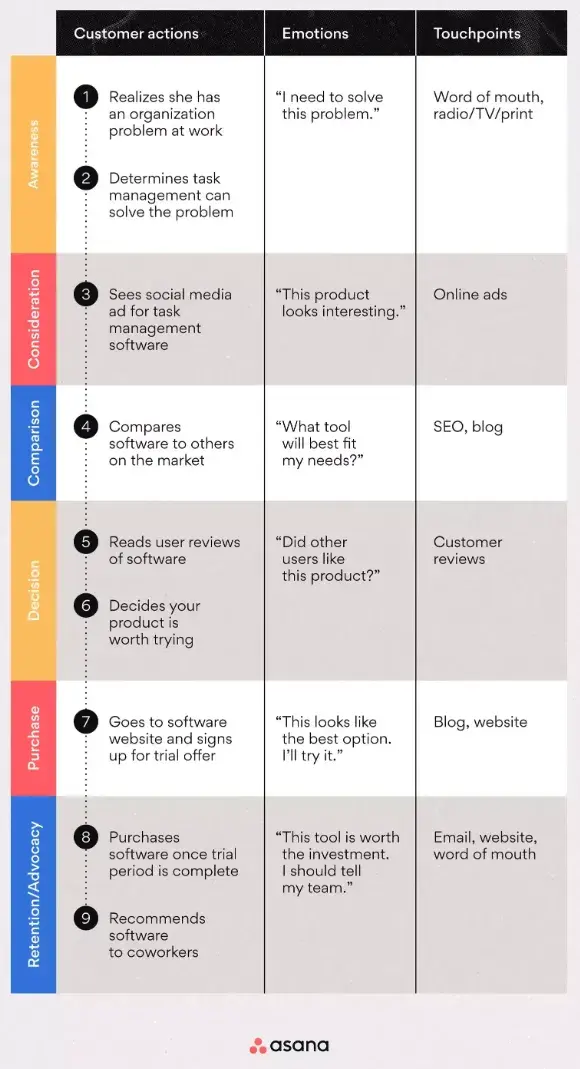
As you can see, the customer's emotions fluctuate. They start with a problem ("I need to solve this"), feel interest ("This looks interesting"), but also uncertainty ("What tool will best fit my needs?"). Identifying these emotional shifts is key to understanding where you can provide reassurance and build trust.
Journey maps can also be more detailed, especially in a business-to-business (B2B) context. The map below includes more granular information like key metrics, specific business responses, and opportunities for improvement at each stage.

While this looks more complex, the core idea is the same: it tracks the customer's path and helps the business understand how to improve it.
How to Create a Customer Journey Map: A Walkthrough
Let's move from observing to creating. Building a journey map is a practical exercise in empathy. The goal is to put yourself in your customer's shoes.
To see how this is done, we'll watch a short, practical video from HubSpot. It walks through creating a map for a sample business: a soccer camp for kids.
How To Make An Effective Customer Journey Map In 1 Hour (FREE Templates)
This video provides a clear, step-by-step walkthrough of how to map the customer journey for a simple business, focusing on the three core stages we've been discussing.
Please watch the segment from the three major steps. The video breaks down what a customer is thinking, doing, and researching at each of the Awareness, Consideration, and Decision stages, and what the business can do to help move them along.
The video demonstrates a simple but powerful process: for each stage, you ask what the customer is feeling, doing, and where they are looking for information. Then, you identify what you, as the marketer, can do to meet them there.
Let's solidify this with another clear, text-based example.
Modern Customer Journeys: Mapping Touchpoints in a Digital ...
This article provides a concise but detailed example of a customer journey map for a B2B marketing manager. It's a great illustration of how to apply the concepts we've discussed.
Please read the section titled Digital Customer Journey Map Example. Notice how for each of the five stages, it clearly lists the Touchpoints, Customer action, Customer question, and Opportunity for the business.
Tying It All Together: Your First Journey Map
You've seen the theory and a few examples. Now, let's create a simple journey map together.
Imagine our sample business is an online store called "Easy Green," which sells houseplants for beginners. Our customer is "New Plant Parent Alex."
Here’s what Alex’s journey might look like across the first three stages:
| Stage | Customer Actions | Customer Thoughts & Feelings | Touchpoints | Pain Points / Opportunities |
|---|---|---|---|---|
| Awareness | Realizes their apartment looks bare. Searches on Google for "best indoor plants for beginners." Scrolls through plant photos on Instagram. | "I want some plants, but I have no idea where to start. I'll probably just kill them." (Feeling: Overwhelmed, Anxious) | Google Search, Instagram | Pain Point: Fear of failure. Opportunity: Create content like a blog post "5 Plants Even You Can't Kill" and promote it via SEO and Instagram. |
| Consideration | Clicks on Easy Green's blog post from Google. Browses the "Low-Light Plants" section of the website. Compares the price of a Snake Plant to a competitor's site. | "Okay, this 'Snake Plant' sounds promising. Is this a good price? The photos look nice." (Feeling: Hopeful, Curious) | Blog, Website Product Pages | Pain Point: Indecisive about the right plant. Opportunity: Create a simple "Find Your Perfect Plant" quiz. Use clear photos and customer reviews as social proof. |
| Conversion | Adds the Snake Plant and a ceramic pot to the cart. Goes to the checkout page. Enters payment and shipping info. | "I'm doing it! My apartment is going to look great. Ugh, why are there so many fields to fill out?" (Feeling: Excited, slightly annoyed) | Shopping Cart, Checkout Page | Pain Point: A long or complicated checkout process. Opportunity: Simplify the checkout form. Offer guest checkout. Send an immediate order confirmation email to build excitement. |
This table is a basic customer journey map. It organizes the customer's experience into a clear story, and for each step, it gives the business a concrete opportunity to make that experience better.
Conclusion
Today, we shifted our focus from the business-centric funnel to the customer-centric journey. This empathetic approach is at the heart of effective digital marketing.
Here are your key takeaways:
- A customer journey map is a visual story of a customer's interactions with a brand, capturing their actions, thoughts, feelings, and pain points.
- The core components of a map include stages, touchpoints, customer actions/emotions, and opportunities for the business.
- Building a journey map is a practical exercise that helps you identify friction in the customer experience and uncover opportunities to improve it.
You now have two foundational models for marketing strategy: the funnel and the journey map. In our next lesson, we'll get even more specific about who our customer is. We'll learn how to define a target audience and create a buyer persona, which is the first step in building a truly detailed and effective customer journey map.