Welcome to the first lesson of your digital marketing course! It’s great to have you here. This course is designed to take you from a curious observer to a capable, hands-on digital marketer, ready for an entry-level role.
Today, we'll start with the most fundamental concept in marketing strategy: the marketing funnel. Think of it as the strategic roadmap that guides all of a company's marketing efforts. We will break down this funnel into its core stages and then identify the main digital marketing channels—the tools of the trade—that you'll be using throughout this course. By the end of this lesson, you will be able to connect each of these channels to the specific role it plays in guiding a person from a complete stranger to a loyal customer.
Understanding the Customer's Path
Before we dive into the business side of things, it's helpful to think from the customer's perspective. Every time you buy a product or sign up for a service online, you go on a "customer journey." This journey is the complete set of interactions you have with a brand, from the moment you first hear about it to the point you become a happy user, and maybe even recommend it to a friend.
Digital marketing is all about understanding and improving this journey. To get a clear picture of this concept, let's start with a short video from Google's Digital Marketing & E-commerce Certificate program.
The Customer Journey & the Marketing Funnel | Google Digital Marketing & E-commerce Certificate
This video introduces the concepts of the customer journey and the marketing funnel. It explains how they are related but distinct, with the journey map taking the customer's perspective and the funnel taking the business's perspective.
First, watch the section that explains the customer journey using the example of finding a weather app. Pay attention to the idea of "touchpoints"—the different interactions a person has with a brand. Next, watch the segment that introduces the marketing funnel. This part breaks down the four key stages: Awareness, Consideration, Conversion, and Loyalty. Notice how the funnel model simplifies the complex customer journey into a strategic framework for businesses.
The Four Stages of the Marketing Funnel
As you just saw in the video, the marketing funnel is a model that businesses use to visualize the process of turning potential leads into customers. It's called a funnel because it's wide at the top (many potential customers) and narrows at the bottom (a smaller number of actual customers).
Our focus will be on this four-stage model, which is a common and effective framework used by marketers:
- Awareness: The potential customer becomes aware of your brand or product for the first time. They have a problem or a need, and they're just starting to look for solutions.
- Consideration: The potential customer shows interest. They are actively researching and comparing different options to solve their problem.
- Conversion: The potential customer decides to take action. This is usually a purchase, but it could also be signing up for a newsletter, booking a demo, or downloading a resource.
- Loyalty: The customer has had a positive experience and continues to engage with the brand, making repeat purchases and potentially advocating for it.
This infographic provides a simple visual summary of a similar process.

The Digital Marketer's Toolkit: Key Channels
Now that we have our strategic framework—the funnel—let's look at the primary tools, or channels, that digital marketers use to move people through it. For this course, we'll focus on five main channels.
To get a quick and clear definition of each, please watch the following short clips from a video by Reliablesoft Academy.
What Is Digital Marketing? Introduction to Digital Marketing for Beginners
This video provides concise definitions for the most important types of digital marketing. Watch these five short segments to understand the role of each channel.
Content Marketing: This clip explains how content like blog posts and videos is used to attract an audience. Search Engine Optimization (SEO): Watch this part to understand how SEO helps a website rank higher in search results to get "free" traffic. Pay-Per-Click (PPC) Advertising: This segment defines PPC, a form of paid advertising where you pay for each ad click. When this is done on search engines like Google, it's a key part of Search Engine Marketing (SEM). Social Media Marketing: This clip describes using social networks like Facebook and Instagram to reach customers, both organically and through paid ads. Email Marketing: Finally, learn how email is used to engage with an audience and guide them towards a purchase.
To be clear on the terminology:
- SEO is about earning traffic through unpaid or "organic" search engine results.
- SEM is a broader term that encompasses all marketing on search engines, including SEO and paid methods like PPC. In practice, many marketers use "SEM" specifically to refer to their paid search activities.
Mapping Channels to the Funnel
The key to an effective digital marketing strategy is using the right channel at the right time. A marketer's job is to orchestrate these channels to guide the customer smoothly through the funnel.
This next image maps the funnel stages to different channel types, tools, and user actions. It uses slightly different terminology—Top, Middle, and Bottom of the Funnel (TOFU, MOFU, BOFU)—which directly corresponds to Awareness, Consideration, and Conversion.
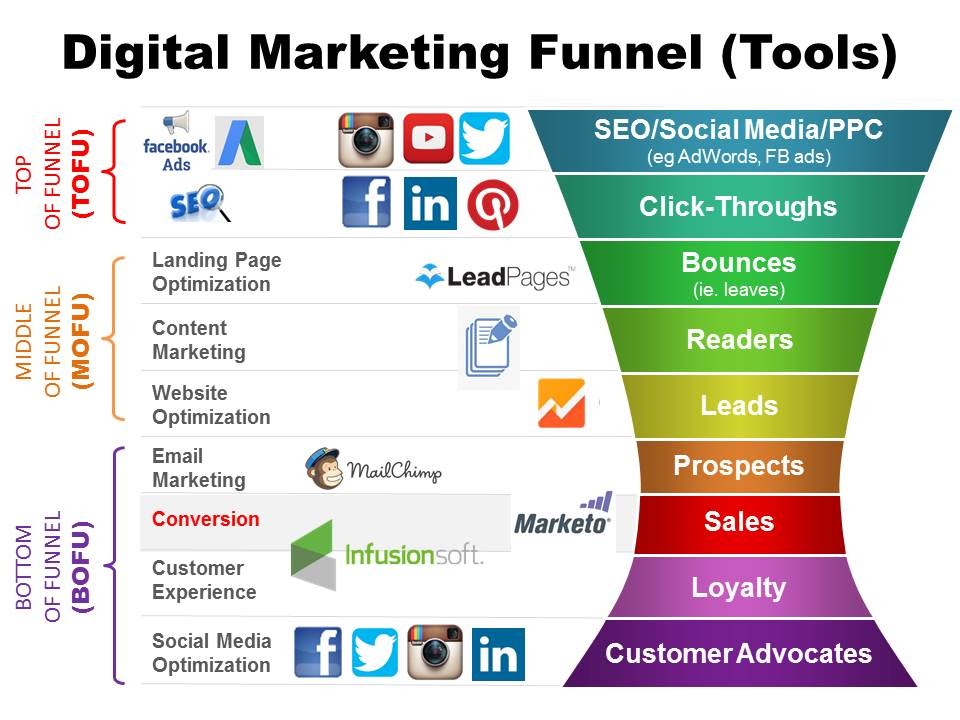
Let's break this down stage by stage, using this image and the concepts from the Google video as our guide.
1. Awareness Stage (Top of the Funnel - TOFU)
- Goal: Reach a broad audience and introduce them to your brand. You're trying to capture their attention.
- Primary Channels:
- Content Marketing: Creating blog posts, videos, or infographics that answer broad questions or address common problems. Example: A skincare brand writes a blog post titled "The Top 5 Causes of Dry Skin."
- SEO: Optimizing that content so it appears on the first page of Google when someone searches for "causes of dry skin."
- Social Media Marketing: Sharing that blog post on Instagram or Facebook to reach followers and new audiences.
- SEM (PPC): Running ads on Google or Facebook that target people interested in skincare, directing them to your website.
2. Consideration Stage (Middle of the Funnel - MOFU)
- Goal: Nurture the interest of people who are now aware of you. You want to build trust and show them why your solution is the best one for them.
- Primary Channels:
- Content Marketing: Creating more in-depth content like comparison guides, case studies, or webinars. Example: The skincare brand creates a guide comparing "Hyaluronic Acid vs. Glycerin: Which is Better for Your Skin?"
- Email Marketing: A visitor who downloaded the comparison guide might have given their email address. Now you can send them a "welcome series" of emails with more helpful tips and information about your products.
- SEM (Retargeting): Showing specific ads to people who have already visited your website, reminding them of the products they viewed.
3. Conversion Stage (Bottom of the Funnel - BOFU)
- Goal: Persuade the potential customer to take a specific action, like making a purchase.
- Primary Channels:
- Email Marketing: Sending a limited-time discount or an "abandoned cart" reminder to someone who added a product to their cart but didn't check out.
- SEM (PPC): Running ads that target very specific keywords like "buy [your brand's serum] online." People searching for this are ready to buy.
- Content/Website: Your product pages must have clear descriptions, high-quality photos, customer reviews, and a simple, frictionless checkout process.
To see how these activities work together in detail, let's turn to an in-depth guide from Santa Clara University's My Own Business Institute (MOBI).
This guide provides a comprehensive breakdown of the marketing funnel and the specific digital marketing activities for each stage. It uses a five-stage model, but the principles are the same. Think of their "Discovery" stage as part of Consideration, and "Customer Relationship" as Loyalty.
Please read the section The Best Digital Marketing Activities for Each Stage of the Funnel. This section is divided into subsections for each funnel stage. As you read, focus on the following: Awareness Stage: Note the descriptions of SEO, SEM, Social Media, and Content Creation. Discovery & Consideration Stages: See how the focus shifts to Email Marketing, more specific content (problem/solution, benefits), and retargeting ads. Conversion Stage: Pay attention to how the tactics become more direct, using custom campaigns and specific email strategies like abandoned cart reminders.
Conclusion
In this lesson, we've laid the groundwork for your entire journey into digital marketing. You now have a strategic map—the marketing funnel—and an understanding of the primary tools you'll use to navigate it.
Here are the key takeaways:
- The marketing funnel is a model that describes the customer's journey through four key stages: Awareness, Consideration, Conversion, and Loyalty.
- Digital marketers use five main channels to guide customers through this funnel: SEO, SEM (including PPC), Social Media Marketing, Content Marketing, and Email Marketing.
- The choice of channel depends on the goal of the funnel stage. Broad channels like SEO and content marketing are used for awareness, while more targeted channels like email and retargeting ads are used for consideration and conversion.
This framework is the "why" behind the "what" of digital marketing. As we move forward, we'll be diving deep into the practical "how" of using each of these channels.
In our next lesson, we will make this abstract funnel concrete. We will take a sample business and map out a detailed customer journey, showing how a real person might interact with these different channels on their path from awareness to conversion.