Introduction
Welcome to the final module of our course. Having explored a diverse array of musical traditions, from Indian ragas to ambient soundscapes, we now arrive at the capstone: synthesis. Over the next few lessons, we will bring together all the principles we've discussed to forge your master frameworks for curation. We'll begin by examining the most fundamental and powerful element in music's toolkit: rhythm.
In our last module on Indian Classical Ragas, you learned how the tala (rhythmic cycle) provides a grounding structure that allows the music to unfold. Today, we will dive deep into the psychoacoustics of rhythm itself. Our objective is to analyze how repetitive and complex rhythmic patterns—including the polyrhythms central to your jazz background—can synchronize our internal physiological rhythms to induce focused, relaxed, or even trance-like states. This lesson will form the rhythmic foundation for the master playlists you will build.
The Driving Force: Rhythmic Entrainment
At the heart of rhythm's power is a phenomenon called entrainment. This is the process where our internal biological rhythms—such as brainwaves, heart rate, and even breathing—naturally synchronize with a powerful, external rhythmic pulse. It's the reason a whole crowd can clap in unison or why your foot starts tapping to a compelling beat without conscious effort.
To understand this in a practical and historical context, let's look at one of the oldest uses of rhythmic entrainment: shamanic drumming.
Jeff Strong Explores Theta Tempo Drumming for Meditation, Intuition, Creativity, and Problem-solving
In this video, "Jeff Strong Explores Theta Tempo Drumming," the creator of Rhythmic Entrainment Intervention explains the core concept of driving consciousness with rhythm.
Please watch the first few minutes, from the beginning of the video. Pay close attention to his explanation of: Entrainment: How the brain's wave patterns synchronize to the drumming rhythm. Target Brainwave State: The specific focus on the Theta state (4-8 cycles per second or Hertz), which is associated with deep meditation, internal focus, and visualization. The Rhythm: Notice the extreme simplicity and steadiness of the 4 beats-per-second pulse he demonstrates.
The key takeaway is that for deep, meditative states, a slow, highly predictable, and repetitive rhythm is most effective. It provides the brain with a clear, unwavering signal to lock onto.
From a neuroscientific perspective, this isn't just a metaphor. Research shows that listening to a rhythm activates not just the auditory cortex, but also motor areas of the brain like the basal ganglia and supplementary motor area (SMA), even when you're sitting perfectly still. Your brain is, in a sense, "dancing" internally, rehearsing the movements the rhythm suggests. This is a core part of what is known as embodied cognition—the idea that the mind doesn't just process information abstractly but understands the world through a physical, bodily lens.
From Simple Pulse to Complex Groove
While a simple, metronomic pulse is powerful for inducing deep meditative states, our relationship with rhythm is more nuanced. As the tempo increases, a perfectly steady pulse can become monotonous or even irritating. To maintain engagement and create a different kind of entrancing state, the rhythm must evolve in complexity.
Jeff Strong, in the same video, provides an excellent demonstration of this principle. He explains that as he moves from the low-end of Theta (4 bps) towards the upper-end (7-8 bps), he must introduce more rhythmic variation to keep the brain engaged and prevent the experience from becoming jarring.
- At 5 bps (for intuition), he introduces a simple, repeating Mambo pattern (a 3-3-2 rhythm).
- At 6 bps (for creativity), he uses that pattern but adds more accents and variations.
- At 7 bps (for problem-solving), the rhythm becomes even more complex, using patterns like a Samba.
This spectrum from simple repetition to rhythmic complexity leads us directly to a concept you know well from jazz: groove.
Groove can be defined as the pleasurable urge to move in response to music. It's that compelling, forward-propelling quality that makes music feel alive. As you know, this is often created not by perfect metronomic timing, but by syncopation, expressive micro-timing (like swing), and the interplay of different rhythmic layers.
The Hypnotic Power of Polyrhythm
This interplay of rhythmic layers brings us to polyrhythm—the simultaneous use of two or more conflicting rhythms. While a single, steady pulse can entrain the brain through sheer predictability, polyrhythms create a hypnotic effect through their captivating complexity.
Let's clarify what a polyrhythm is.
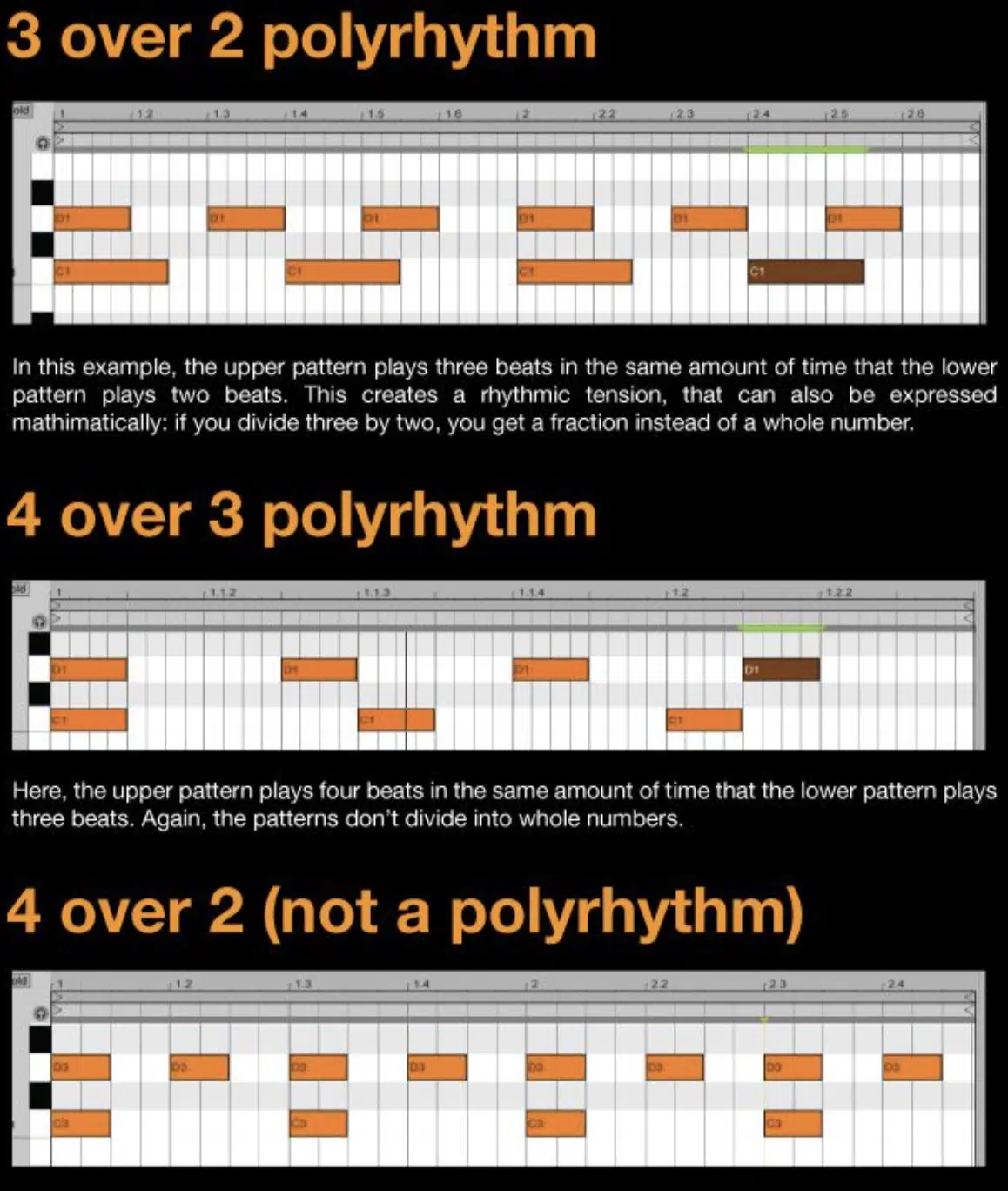
It's also useful to distinguish polyrhythm from its close cousin, polymeter. In a polyrhythm, the measure or cycle length is the same, but the beat is divided differently. In polymeter, the subdivision feels the same, but the measure lengths are different, causing the downbeats to shift.

Our focus here is on polyrhythm, which is a foundational element in many of the world's trance-inducing musical traditions, particularly those from West Africa and the African Diaspora, whose legacy is at the core of jazz.
The Rhythm of Spirit Possession: An Entrancing Legacy
This article from Nomos Journal draws a direct line from the polyrhythmic music of Afro-Atlantic spirit possession rituals to the rhythms of popular music, including jazz.
Please read these two short sections: Start with the paragraph beginning "As anyone who has inquired". This section explicitly defines polyrhythm in this context and links it to traditions like Vodun and Santería. Then, read the section that starts with "Whereas Western musicians count". This introduces the concept of the clave—a repeating rhythmic key that functions as a groove rather than a strict count starting on "one."
The concept of the clave highlights that the goal of these rhythms isn't mathematical precision, but the creation of a cyclical, entrancing feel. This is achieved by creating a "multistable" rhythmic perception, where the listener's brain can alternate between focusing on the different rhythmic streams, generating a state of heightened, yet stable, engagement.
Rhythm, Harmony, and Feeling: The Grand Unification
Now, we arrive at a truly fascinating synthesis that connects rhythm directly to harmony and emotion. Polyrhythms are, at their core, mathematical ratios. What happens when we treat these rhythmic ratios as harmonic frequency ratios?
The following video demonstrates this profound connection. It shows how "easy to feel" polyrhythms are related to consonant harmonies, while "hard to feel" polyrhythms are related to dissonant ones.
New Horizons in Music: Polyrhythms | Loop
This segment from an Ableton presentation provides a stunning demonstration of the deep connection between rhythm and pitch.
Please watch the section from tying it all together. The presenter explains and demonstrates how: Simple polyrhythmic ratios like 3:2, 4:3, and 5:4 correspond to the consonant musical intervals of a perfect fifth, perfect fourth, and major third. The 4:5:6 polyrhythm, when sped up, becomes a major chord. Notice how the rhythm itself feels "triumphant" and stable. A complex polyrhythm like 15:8, which is very difficult to feel, becomes a tense and dissonant major seventh interval when sped up. The dissonant rhythm feels like popcorn going off, creating sonic and psychological tension.
This is a powerful unifying principle for curation. It means that consonance and dissonance are not just properties of harmony; they are fundamental properties of rhythm.
- Simple, stable polyrhythms (e.g., 3:2) create a feeling of stability and groundedness. They are easy for the brain to process and entrain to, making them excellent for calm, relaxation, and gentle focus.
- Complex, unstable polyrhythms (e.g., 15:8) create a feeling of tension, excitement, or agitation. They challenge the brain and can be useful for creating energy, but are generally unsuitable for relaxation or deep focus, as they can be cognitively demanding or jarring.
This explains, on a fundamental level, why the rhythms of genres like lo-fi (simple, repetitive loops) are calming, while the complex polyrhythms of free jazz can be stimulating or even anxiety-inducing.
Conclusion
In this lesson, we have unpacked the powerful mechanism of rhythmic entrainment and explored how different types of rhythmic patterns can guide the brain toward specific states.
Key Takeaways:
- Entrainment is the foundation: Our brains and bodies have a natural tendency to synchronize with external rhythms.
- Rhythm is a spectrum of complexity: Simple, slow, repetitive pulses are ideal for inducing deep meditative (Theta) states. As tempo increases, rhythmic complexity must increase to maintain an engaging groove.
- Polyrhythms induce trance through complexity: The interplay of multiple rhythmic streams creates a hypnotic, "multistable" perception that is central to many contemplative and ecstatic traditions.
- Rhythm is Harmony is Feeling: The mathematical ratio of a polyrhythm directly corresponds to its harmonic consonance or dissonance when sped up. This provides a fundamental principle for curation: simple rhythmic ratios feel stable and calming, while complex ratios feel tense and stimulating.
This understanding of rhythm as a tool for modulating arousal and feeling is not just a "cheat sheet" for this topic; it's a foundational principle you will use in the upcoming lessons as we synthesize all our knowledge to build your master playlists for focus, relaxation, and sleep.
In our next lesson, we will begin this final synthesis, creating a comprehensive framework that integrates rhythm, harmony, texture, and timbre to identify the key characteristics of effective focus music across all the genres we have studied.