Introduction
Welcome to our final lesson on Indian Classical Ragas. Over the past few lessons, we've journeyed from the foundational concepts of Samay Siddhanta (the time theory) and rasa (emotional mood) to the practicalities of listening. You've learned how the unmetered alap section and tanpura drone create a meditative space, how tala grounds the music, and, crucially, how the specific artist, instrument, and performance style can completely transform the experience of a raga.
In this lesson, we will synthesize all of this knowledge. Our goal is to fulfill the primary objective of this module: to create a comprehensive "curator's cheat sheet." This will be your personal, practical reference guide for selecting ragas, moving beyond theory to build effective playlists for focus, relaxation, and sleep. We will organize the ragas we've discussed, along with new ones, into a framework you can use for years to come.
The Principles of Curation: Why, How, and What
Before we build the cheat sheet itself, let's codify the principles that guide our choices. Think of this as the "user manual" for your reference guide. It's based on three core ideas: the underlying theory, the practical method of identification, and the specific raga characteristics.
First, let's briefly review the theoretical underpinnings from a fantastic resource on Raga Therapy.
Raag Therapy: What It Is and How It Works
This article from Manasukh Dhvani clearly outlines the core principles of how ragas are thought to affect us.
Please read the section "How Does Raag Therapy Work?". This will provide a concise summary of the three key mechanisms we're interested in as curators: Swar and Chakras: The connection of specific notes to energy centers (less of a focus for us, but part of the tradition). Rasa and Emotional Resonance: The most important principle for curation—matching the raga's emotional flavor to your desired state. Time Theory (Samay Siddhanta): Aligning your listening with the natural rhythms of the day to enhance the raga's potency.
These principles answer the why of raga selection. But how do you, as a curator without decades of formal training, learn to identify these ragas in the wild? This is where a practical, listener-focused approach comes in.
The following video lecture provides an excellent framework for the "lay listener" to develop their raga identification skills over time.
Lec-dem: Raga identification techniques and methods part 1
In this lecture-demonstration, Vidya Subramanian discusses practical techniques for raga identification that don't require years of formal training.
Watch these key segments to understand the long-term process of building your listening skills: First, watch the introduction from the beginning. The speaker distinguishes between the intensive, formal method and the "approximation approach" for listeners, which is our path. Next, from using film songs, she discusses using popular music as a potential (though imperfect) bridge to identifying classical ragas. This acknowledges a common entry point. From focusing on the 'big six', she highlights a crucial strategy: start by learning to recognize the most common ragas. She also introduces the concept of "key phrases," which, much like a signature lick in jazz, are a raga's sonic fingerprint. Finally, from repeated listening, she demonstrates how listening to different compositions in the same raga (Kambhoji, in this case) helps you build a mental model of its core identity.
The key takeaway is that raga identification is a skill built through patient, repeated listening. Your cheat sheet is the map that will guide this exploration.
The Curator's Cheat Sheet for Indian Classical Ragas
Now we arrive at the main task. We will construct a detailed reference guide. This builds upon the small table from our last lesson, expanding it with more ragas, specific moods, and listening suggestions drawn from our resources.
First, here is a helpful visual chart that summarizes the time theory for a selection of Hindustani ragas and their female counterparts, raginis.
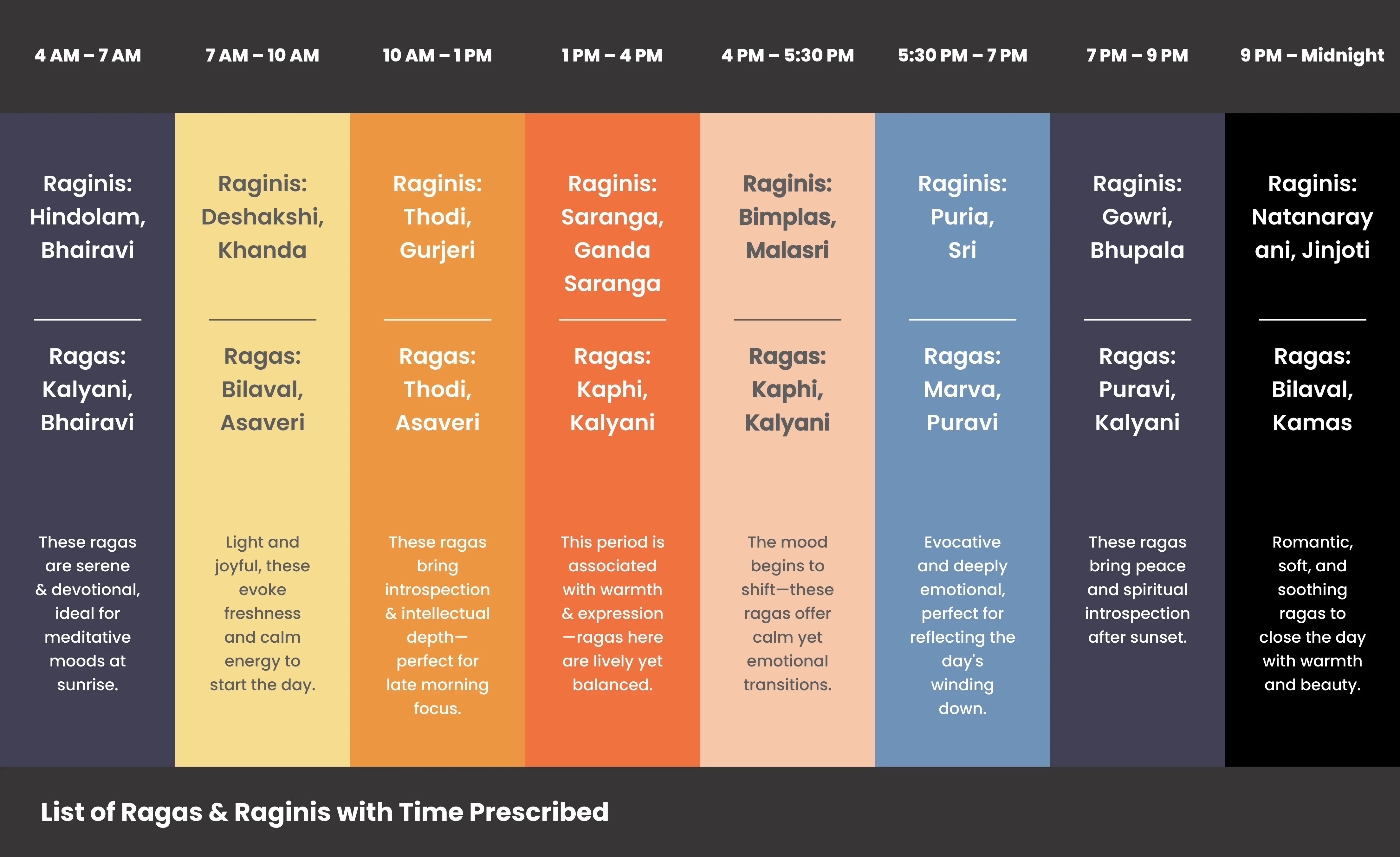
The following table is your primary tool. It integrates information from all our previous lessons and resources into a single, functional guide.
| Goal | Time of Day | Raga Name | Key Mood / Rasa (The "Feel") | Suggested Listening (Artist/Instrument) |
|---|---|---|---|---|
| Focus | Morning (7-10am) | Asaveri / Todi | Introspection, intellectual depth, sensitivity. Good for analytical tasks. | Instrumental versions (Sarod, Sitar). Ustad Amjad Ali Khan (Sarod). |
| Focus | Midday / Afternoon (1-4pm) | Bhimpalasi / Kafi | Contemplative, balanced, soothing. Restores energy without being distracting. | Ken Zuckerman (Sarod), Rakesh Chaurasia (Bansuri). |
| Relaxation | Morning (4-7am) | Ahir Bhairav / Bhairavi | Serene, devotional, peaceful, calm. For gentle awakening or morning meditation. | Shashank Subramanyan (Flute), Debasmita Bhattacharya (Sarod). |
| Relaxation | Late Afternoon (4-5:30pm) | Puriya Dhanashree | Shift in mood, calm yet emotional transition from day to evening. | Pandit Shivkumar Sharma (Santoor). |
| Relaxation | Evening (5:30-7pm) | Yaman / Marwa | Peace, devotion, optimism. Deeply emotional, for reflecting on the day. | Budhaditya Mukherjee (Sitar), Ustad Rashid Khan (Vocal). |
| Introspection | Evening (7-9pm) | Jog / Gavati | Soulful, luminous, introspective. Eases the mind into a reflective state. | Pravin Godkhindi (Bansuri), Eesher Singh (Santoor). |
| Deep Calm | Late Night (9pm-12am) | Darbari Kanada | Gravity, strength, profound emotional depth. For processing grief or deep feeling. | Dagar Brothers (Dhrupad Vocal), Ustad Amjad Ali Khan (Sarod). |
| Sleep | Late Night (9pm-12am) | Malkauns | Grounding, deep healing, tranquil. Can feel mysterious and profound. | Ustad Amir Khan (Vocal), Hariprasad Chaurasia (Bansuri). |
| Sleep | Night (any) | Bihag | Calm, inducing a sense of surrender. Romantic and peaceful. | Ustad Rashid Khan (Vocal), Pandit Nikhil Banerjee (Sitar). |
| Uplifting | Any Time | Desh / Kamas | Joy, nostalgia, refreshment. Graceful and versatile for any time of day. | Kaushiki Chakraborty (Vocal), Jayanthi Kumaresh (Veena). |
Putting It into Practice: An Immersive Listening Session
To truly internalize these concepts, let's use the cheat sheet. Find Raga Kafi in the "Focus" category. The description notes it's a midday raga for balanced, soothing energy. Now, let's experience it directly.
(1 hour) Vedic Traditional Music for Study, Focus and Meditation - Kafi Raga
This video from Bhaktivedanta Academy Mayapur is a one-hour, uninterrupted instrumental performance of Raga Kafi, intended for study and meditation.
You don't need to listen to the entire hour. Instead, use this as a background track while you review this lesson or do some light work for 10-15 minutes. Notice how the music maintains a steady presence without demanding your full attention. The instrumental texture (likely a combination of harmonium, sitar, and flute) is clear and the pace is consistent—hallmarks of a good focus track.
This exercise demonstrates how to use the cheat sheet: identify a goal, select a raga, and then find a performance that matches the intended feel.
Conclusion
You have now built a powerful, personalized tool for curating Indian classical music. This cheat sheet synthesizes the core principles of rasa and samay with practical listening advice, allowing you to move from simply knowing raga names to discerning which specific performances will achieve your desired mental state.
Key Takeaways:
- Your cheat sheet is a map: It guides your exploration, helping you connect goals (focus, relax, sleep) with the appropriate time, raga, mood, and artist style.
- Curation is an art of listening: The sheet provides the starting point, but your ear is the final judge. Always listen for the performance style—is it meditative and steady, or virtuosic and distracting?
- Build your knowledge bank: As the video lecture suggested, true mastery comes from repeatedly listening to different versions of the same raga. Use this guide to seek out recordings of ragas like Yaman, Bhairavi, and Malkauns by various artists.
In our next and final module, we will begin the capstone project. You will draw upon this cheat sheet—and all the others you've created throughout the course—to synthesize your knowledge and curate your own master playlists for focus, relaxation, and sleep.