Hello! Welcome to your next lesson in designing your personal performance system.
In our last session, you did the crucial work of designing keystone habits to support your process goals. You now have a clear plan for the positive actions you need to take consistently. This is the offensive strategy for achieving your goals—building the automatic behaviors that drive progress.
However, even the best offensive plan needs a strong defense. Life is unpredictable. You will inevitably face setbacks, distractions, and internal resistance. High performers aren't people who never face obstacles; they are people who anticipate them and have a plan in place before they strike.
Today's lesson is about building that defense. Our learning outcome is to create an obstacle plan for your goal using mental contrasting and pre-commitment strategies. We will move beyond wishful thinking and learn a scientifically-backed method to make your plans resilient to real-world challenges.
1. The Problem with Pure Positive Thinking
In the world of self-improvement, "thinking positive" is often promoted as the key to success. While optimism is valuable, research reveals a surprising downside to only focusing on the positive. Fantasizing about achieving your goals can trick your brain into feeling like you've already accomplished them, which can reduce your motivation to do the hard work required.
To understand this counterintuitive finding, let's start with a short video that summarizes over two decades of research on this topic.
This video, 'What is WOOP?', explains why simply dreaming about a positive future often leads to poor results and sets the stage for a more effective strategy.
Watch the video from the beginning to 01:36. Pay close attention to the research findings mentioned at the start. Notice how the strategy proposed isn't to abandon positive thinking, but to combine it with acknowledging obstacles.
As the video highlights, dreaming about your desired future is not enough. It gives you a destination but no map and no energy for the journey. We need a method that combines the motivational pull of a positive vision with a realistic understanding of the challenges ahead.
2. Mental Contrasting: Energizing Action
The solution to the pitfalls of positive thinking is a technique called mental contrasting. Developed by psychologist Gabriele Oettingen, it's a simple but powerful cognitive process.
Mental contrasting involves juxtaposing your desired future (the dream) with the internal obstacles in your present reality that stand in the way of achieving it.
This act of contrasting does two critical things:
- It forces a realistic assessment of whether your goal is achievable.
- If the goal is achievable, the contrast creates a psychological tension—a sense of "necessity to act"—that energizes your brain and mobilizes you to overcome the obstacles.

To get a deeper understanding of the theory behind this, let's turn to an article that breaks down the concept.
What Is Mental Contrasting and How Can We Benefit From It?
The article 'What Is Mental Contrasting and How Can We Benefit From It?' provides a clear explanation of the underlying theory and how it differs from simple positive thinking.
Please read two sections from this article: Start at the beginning and read the section titled 'What Is Mental Contrasting?'. This will give you the foundational theory. Then, scroll down to the comparison table and review the key differences between mental contrasting and positive thinking. Focus on understanding why contrasting a positive fantasy with a negative reality is more effective for goal commitment than indulging in either one alone.
3. WOOP: Your Framework for Action
Mental contrasting is the theory. The practical, step-by-step application of this theory is a framework also developed by Dr. Oettingen called WOOP. It's an acronym that turns the abstract idea into a concrete exercise.
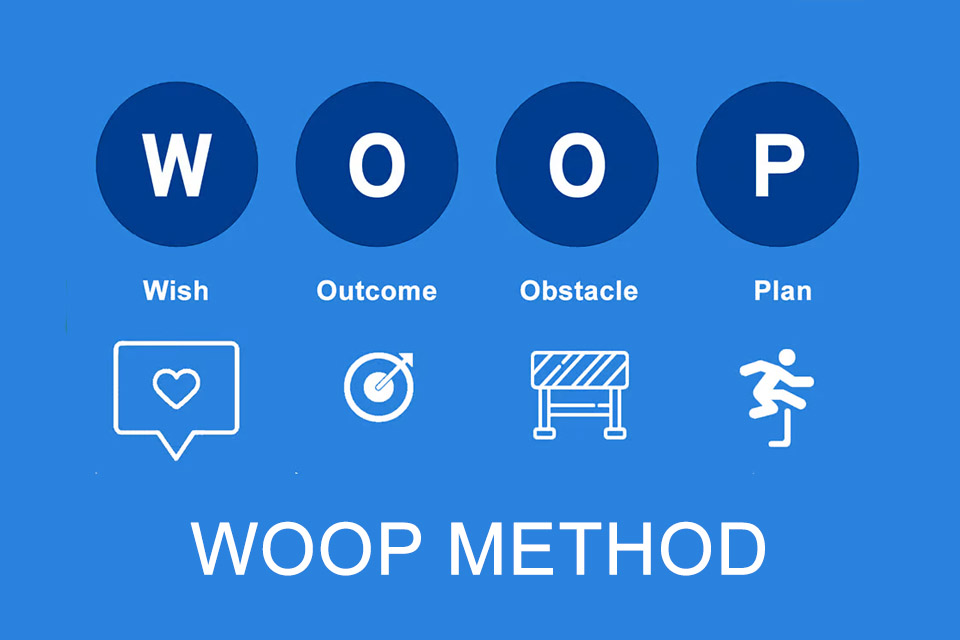
The four steps are:
- Wish: Identify your most important goal.
- Outcome: Visualize the best possible result of achieving your goal.
- Obstacle: Identify the main internal obstacle that could prevent you from achieving it.
- Plan: Create an "if-then" plan to overcome that obstacle.
Let's hear Dr. Oettingen herself explain how to perform this powerful 5-minute exercise.
Interview Larry King with Gabriele Oettingen
In this interview with Larry King, Dr. Gabriele Oettingen, the inventor of WOOP, provides a masterful breakdown of each step in the process.
Watch the clip from 03:35 to 07:43. As you listen, notice the specific details she emphasizes for each step: Wish: It should be challenging but feasible. Outcome: You should vividly imagine and feel the outcome. Obstacle: Crucially, this must be an inner obstacle—something in you that holds you back (e.g., an emotion, a habit, a belief). Plan: It takes the form of a simple 'if-then' statement.
The WOOP framework brilliantly integrates goal setting (Wish), motivation (Outcome), and obstacle analysis (Obstacle) into a single, effective process. The final step, the Plan, is where we formalize our defense strategy.
4. Pre-Commitment Strategies: "If-Then" Plans
The "Plan" in WOOP is a pre-commitment strategy. You are deciding, in a calm and rational state, how you will respond to a predictable future challenge. This specific type of plan is also known as an implementation intention.
The format is simple:
If... [trigger/obstacle], then... I will [action].
For example:
- If I feel the urge to check social media while working, then I will immediately stand up and stretch for 60 seconds.
- If I feel too tired to go to the gym after work, then I will put on my gym clothes and do just the 5-minute warm-up (my "low bar" routine).
This simple structure is incredibly effective because it automates your response. When the obstacle appears, you don't have to waste willpower or time deciding what to do; the decision has already been made. Your brain can move directly from cue (the obstacle) to routine (your planned action).
5. Your Task: Create Your WOOP Plan
It's time to apply this framework to the goal you are pursuing in this course. You have already defined your goal and the process goals to achieve it. Now, you will build a plan to protect your progress from your most significant internal obstacle.
Open your notebook or a new document and use the following template to create your WOOP plan. Be thoughtful and specific.
My WOOP Plan
1. Wish:
(State your primary long-term goal for this project. Be specific and set a timeframe, e.g., "To complete a 10,000-word draft of my performance psychology report in the next 10 days.")
2. Outcome:
(What is the single best outcome if you fulfill this wish? How would it make you feel? Take a minute to vividly imagine this feeling, e.g., "I will feel a huge sense of accomplishment and confidence in my ability to execute on big projects.")
3. Obstacle:
(What is the main internal obstacle that could stop you? What is it in you that holds you back? Dig deep. Is it a distracting emotion (anxiety, boredom), a bad habit (procrastination), or an irrational belief (imposter syndrome)? E.g., "My main internal obstacle is my habit of seeking distraction whenever a task feels difficult or unstructured.")
4. Plan (If-Then):
(Create a specific if-then plan to counter your obstacle. The "if" should be your obstacle, and the "then" should be a concrete action you will take to get back on track.)
-
If...
[I experience my internal obstacle] -
...then I will...
[take this specific action]. -
Example: If I feel the urge to open a new browser tab when I'm supposed to be writing, then I will immediately get up from my desk and do 10 push-ups to reset my focus.
Take the next 15 minutes to complete this exercise. The clarity you gain from identifying your true obstacle and pre-committing to a solution is a cornerstone of resilient performance.
Conclusion
Today you've learned a powerful, evidence-based strategy to make your plans robust and resilient. By anticipating challenges, you move from being a hopeful dreamer to a strategic doer.
Key Takeaways:
- Relying solely on positive thinking can be detrimental, as it may reduce your motivation to act.
- Mental contrasting—juxtaposing your desired future with the reality of your internal obstacles—creates the psychological energy needed for goal pursuit.
- WOOP (Wish, Outcome, Obstacle, Plan) is a practical, four-step framework for applying mental contrasting.
- "If-then" plans are pre-commitment strategies that automate your response to predictable obstacles, saving your willpower for when you truly need it.
Preview of the Next Lesson:
You now have a goal hierarchy, keystone habits to drive action, and a WOOP plan to handle obstacles. The next step is to fit all these pieces into a coherent structure. In our next lesson, we will focus on how to design a weekly schedule that incorporates blocks for deep work, skill acquisition, and strategic recovery, creating a sustainable rhythm for high performance.