Hello! Welcome to the next-to-last lesson in our journey to build your personal performance system.
In our previous lessons, we've laid a robust foundation. You've structured your long-term goal into a hierarchy, designed keystone habits to drive daily progress, and created a WOOP plan to anticipate and overcome internal obstacles. You have the "what" and the "how" for your goals. Now, we need to address the "when."
Today, we transition from planning to programming. Our learning outcome is to design a weekly schedule that incorporates blocks for deep work, skill acquisition, and strategic recovery. An abstract plan is a dream; a scheduled plan is a commitment. This lesson will provide you with the framework to build a sustainable, high-performance weekly rhythm.
1. The Philosophy of a High-Performance Schedule
To build an effective schedule, we first need a philosophy for how we treat our time. In performance psychology, a key insight is that not all work is created equal. Cal Newport, a computer science professor and author, popularized a critical distinction between two types of effort:
- Deep Work: Professional activities performed in a state of distraction-free concentration that push your cognitive capabilities to their limit. These efforts create new value, improve your skill, and are hard to replicate.
- Shallow Work: Non-cognitively demanding, logistical-style tasks, often performed while distracted. These efforts tend not to create much new value in the world and are easy to replicate.
Your goal is to design a life that maximizes deep work while minimizing and containing shallow work. The primary tool for this is time blocking.
How to schedule deep work: Time blocking | Cal Newport and Lex Fridman
Let's start with a short clip where Cal Newport introduces the core idea of time blocking. This is a fundamental shift from working off a reactive to-do list to proactively assigning a job to every minute of your day.
Watch the first minute of this video (00:11 - 01:13). Focus on how Newport contrasts reactive work (driven by your inbox) with the intentionality of time blocking.
Time blocking turns your calendar into a detailed map for your day, which reduces decision fatigue and protects your most valuable resource: your focused attention.
To explore this concept further, let's read a more detailed guide.
Cal Newport’s Planning System (In Detail)
The following article, 'Cal Newport’s Planning System (In Detail)', breaks down the principles and practical steps of time blocking.
Please read three sections from this article: 'What is Time Blocking?': This section explains the concept and its benefits. 'How to Implement Time Blocking': This provides a practical, step-by-step guide. 'Deep Work vs. Shallow Work': Read the introduction and the definitions of Deep and Shallow work in this section to solidify your understanding of this crucial distinction. As you read, consider how this structured approach contrasts with a typical, unstructured day.
Now that we have the core technique—time blocking—and the core distinction—deep vs. shallow work—let's look at the key components to schedule.
2. Component 1: Scheduling Deep Work & Skill Acquisition
Deep work is where you make meaningful progress on your most important goals. Skill acquisition is a specific form of deep work focused on improving your capabilities. These are the engine of your progress and must be scheduled with intention.
When should you schedule deep work?
Your ability to focus isn't constant throughout the day. It follows predictable biological rhythms. By aligning your deep work sessions with these rhythms, you work with your biology, not against it.
Our brains operate on ultradian cycles, which are roughly 90-minute periods of alternating high and low alertness. A powerful strategy is to structure your deep work into 90-minute blocks. Furthermore, your body's core temperature provides a clue for your peak focus time. Your cognitive function tends to be highest during the rising phase of your body's daily temperature cycle, which typically occurs a few hours after waking.
Maximize Productivity, Physical & Mental Health With Daily Tools | Huberman Lab Essentials
Neuroscientist Dr. Andrew Huberman provides a science-based toolkit for daily performance. This video explains how to leverage your body's natural rhythms to optimize focus.
Watch the segment from 08:20 to 14:03. Pay close attention to the concepts of: 90-minute ultradian cycles for focused work. Timing your work session based on your body's temperature rise after your 'temperature minimum'. Creating an environment optimized for focus (screen height, white noise).
Scheduling Skill Acquisition with Deliberate Practice
When your goal is to learn a new skill, your deep work block becomes a deliberate practice session. This isn't just mindless repetition; it's a structured effort to improve performance by targeting specific weaknesses.
The Ultimate Deliberate Practice Guide: How to Be the Best
This guide on deliberate practice explains how to structure your learning sessions for maximum effectiveness.
Read two key parts of this article: The subsection under 'Deliberate practice is structured and methodical', focusing on the 'How to implement this' part. This explains how to break down a skill and plan your practice. The section titled 'Deliberate practice leverages the spacing effect'. This explains why consistent, spaced-out practice sessions are superior to cramming. This will give you the principles to design your skill acquisition blocks.
3. Component 2: Scheduling Strategic Recovery
High performance is not about working non-stop. It's a pulse between intense effort and intelligent rest. Strategic recovery is not a luxury; it is a biological necessity for consolidating learning, restoring energy, and preventing burnout. Your schedule must protect time for recovery with the same seriousness as it protects time for work.
What does strategic recovery look like? It includes high-quality sleep, physical activity, nutrition, and mental downtime.
Maximize Productivity, Physical & Mental Health With Daily Tools | Huberman Lab Essentials
Let's return to the Huberman Lab Essentials video. Dr. Huberman outlines several daily protocols that are essential for physical and mental recovery.
Watch the following segments, thinking about them as schedulable 'recovery blocks': Morning Routine (01:46 - 08:20): Notice the focus on morning sunlight, movement, and hydration to set your circadian clock. Physical Exercise (14:03 - 16:51): See how exercise is positioned as a tool for brain health. Afternoon & Meals (16:51 - 21:45): Note the protocols for afternoon light viewing and post-meal walks. Optimizing Sleep (21:45 - 29:41): Understand the critical link between temperature, light, and sleep quality. This is your most important recovery period.
The article on deliberate practice also emphasizes the importance of rest. Elite performers rarely sustain more than 3-5 hours of true deliberate practice a day. They understand that rest is when the brain consolidates gains made during focused work.
4. Your Task: Design Your Weekly Schedule
Now it's time to integrate these concepts and design a draft of your ideal weekly schedule. This is your architectural plan for high performance.
First, look at this example of a time-blocked week.

There isn't one single "correct" way to schedule deep work. The best approach depends on your personal chronotype and life circumstances. Here are a few common models:
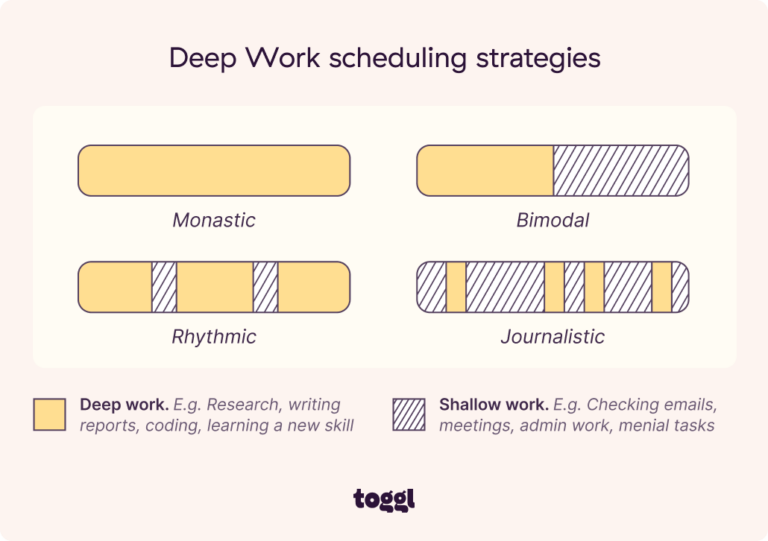
Instructions:
Open your notebook or a digital calendar and draft your schedule for one week. Follow these steps:
-
Block in Non-Negotiables:
- Start by scheduling your "big rocks." First and foremost, block out 8 hours for sleep each night. Be specific with your bedtime and wake-up time.
- Add blocks for meals and any existing fixed commitments (appointments, etc.).
-
Schedule Deep Work & Skill Acquisition:
- Based on your biological peak time (likely mid-morning), schedule at least one 90-minute, completely uninterrupted Deep Work Block each weekday. Label it (e.g., "Deep Work: Project X"). This is for your most important process goal.
- If you have a skill to learn, schedule a separate 60-90 minute Deliberate Practice Block 3-4 times per week.
-
Schedule Strategic Recovery:
- Schedule a 10-20 minute walk outside in the morning and late afternoon to get sunlight.
- Block 45-60 minutes for physical exercise on your chosen days.
- Schedule 15-30 minute buffer times after major work blocks.
- Schedule at least one hour of true downtime in the evening with no screens.
-
Batch Your Shallow Work:
- Create one or two 30-minute "Shallow Work Blocks" per day for things like email, planning, or administrative tasks. Schedule them for your low-energy periods (e.g., right after lunch).
-
Review and Refine:
- Your schedule should now look quite full. This is a draft, not a rigid prison. The goal is intentionality, not perfection.
Spend the next 15 minutes creating this first draft.
Conclusion
You have now created a blueprint for a high-performance week. This schedule translates your goals and habits into a concrete operational plan, ensuring a healthy rhythm between intense work and strategic recovery.
Key Takeaways:
- Time blocking is the practice of assigning a specific task to every block of time in your day.
- A high-performance schedule prioritizes deep work (high-value, focused tasks) and contains shallow work (low-value, logistical tasks).
- Schedule your deep work blocks during your biological peak focus times (e.g., mid-morning) in ~90 minute sessions to align with ultradian cycles.
- Strategic recovery—including sleep, sunlight, exercise, and downtime—is a non-negotiable component of sustainable performance and must be explicitly scheduled.
Preview of the Next Lesson:
A system is only as good as its feedback loop. A static plan will quickly become obsolete. In our final lesson, we will complete your performance system by learning how to create a weekly review process, including key metrics and reflection questions, to track progress and adjust your plan. This is how you will ensure your system evolves and improves over time.