Welcome to the first lesson in our new module, Mastering Focus and Deep Work.
In our previous module, we established the crucial role of mindset in performance. You learned to cultivate a growth mindset, build self-efficacy, and take ownership of your outcomes through an internal locus of control. Most recently, you practiced reframing setbacks as opportunities for growth—a skill that builds the resilience needed for any ambitious undertaking.
Now, we shift from the "what you believe" to "how you work." Your goal is to achieve immense results, and that requires not just working hard, but working deeply and intelligently. This module is dedicated to the science and practice of intense, undistracted concentration.
Our journey begins by confronting a primary villain of modern productivity: multitasking. The learning outcome for this lesson is to explain the cognitive costs of multitasking and context switching on performance. By understanding the science of why multitasking is so detrimental, you'll have a strong foundation for building the habits that lead to high-quality output.
1. The Great Multitasking Myth
In our hyper-connected world, the ability to juggle multiple tasks is often seen as a strength. We send an email while on a video call, or check notifications while trying to read a report. We feel busy, and therefore, productive. However, neuroscience reveals a very different story.
What we call "multitasking" is, in fact, a myth. The human brain cannot process multiple attention-rich tasks simultaneously. Instead, it engages in rapid task switching.
To get a clear picture of this, let's start with a short video that debunks this myth.
Multitasking Is a Myth, and to Attempt It Comes at a Neurobiological Cost | Big Think
This video from Big Think, featuring neuroscientist Daniel Levitin, quickly explains why true multitasking doesn't exist and what your brain is actually doing instead.
Watch the clip from 00:06 to 00:43. Pay close attention to the distinction between simultaneous processing and rapid switching, and how this 'fractionates' your attention.
As the video explains, your brain isn't running multiple programs in parallel. It's frantically jumping from one task to another, giving each one a sliver of your attention before moving on. This creates the illusion of doing many things at once, but as we will see, it comes at a significant cost.
To understand the mechanics of this switching process, let's look at a more detailed breakdown.
Your Brain on Multitasking: Why It's Killing Your Output
The article 'Your Brain on Multitasking' from Brain.fm provides an excellent explanation of what's happening on a neural level when you attempt to multitask.
Read the first two sections: 'The Great Multitasking Myth: What Your Brain Is Actually Doing' and 'The Illusion of Parallel Processing'. Focus on the four steps involved in a single task switch: disengagement, reorientation, re-engagement, and performance degradation.
2. The "Switch Cost": A Tax on Your Performance
Every time your brain switches tasks, it pays a price. Cognitive scientists call this the "switch cost." It's a measurable drop in performance, both in terms of speed and accuracy, that occurs when you shift your focus from one task to another.
This isn't just a momentary hiccup. The cost is a fundamental consequence of how your brain's attentional systems are designed.
Multicosts of Multitasking - PMC - NIH
This article from the National Institutes of Health (NIH), 'Multicosts of Multitasking,' explains the scientific basis for switch costs.
Please read the section titled 'Switch Costs in Mind and Brain'. This section formally defines the 'switch cost' and describes the fMRI evidence showing increased brain activity in frontoparietal regions during a switch. This is the hard evidence of the extra effort your brain expends.
While the NIH article gives us the scientific definition, the concept of "attention residue" provides a powerful metaphor for the practical experience of switch costs. Coined by researcher Dr. Sophie Leroy, it describes the lingering thoughts from a previous task that interfere with your ability to fully concentrate on the new one.
Even after you've switched tasks, part of your cognitive bandwidth is still stuck on what you were doing before. You've moved on, but your brain hasn't. This residue clogs your working memory, making it harder to think clearly and perform at your best.
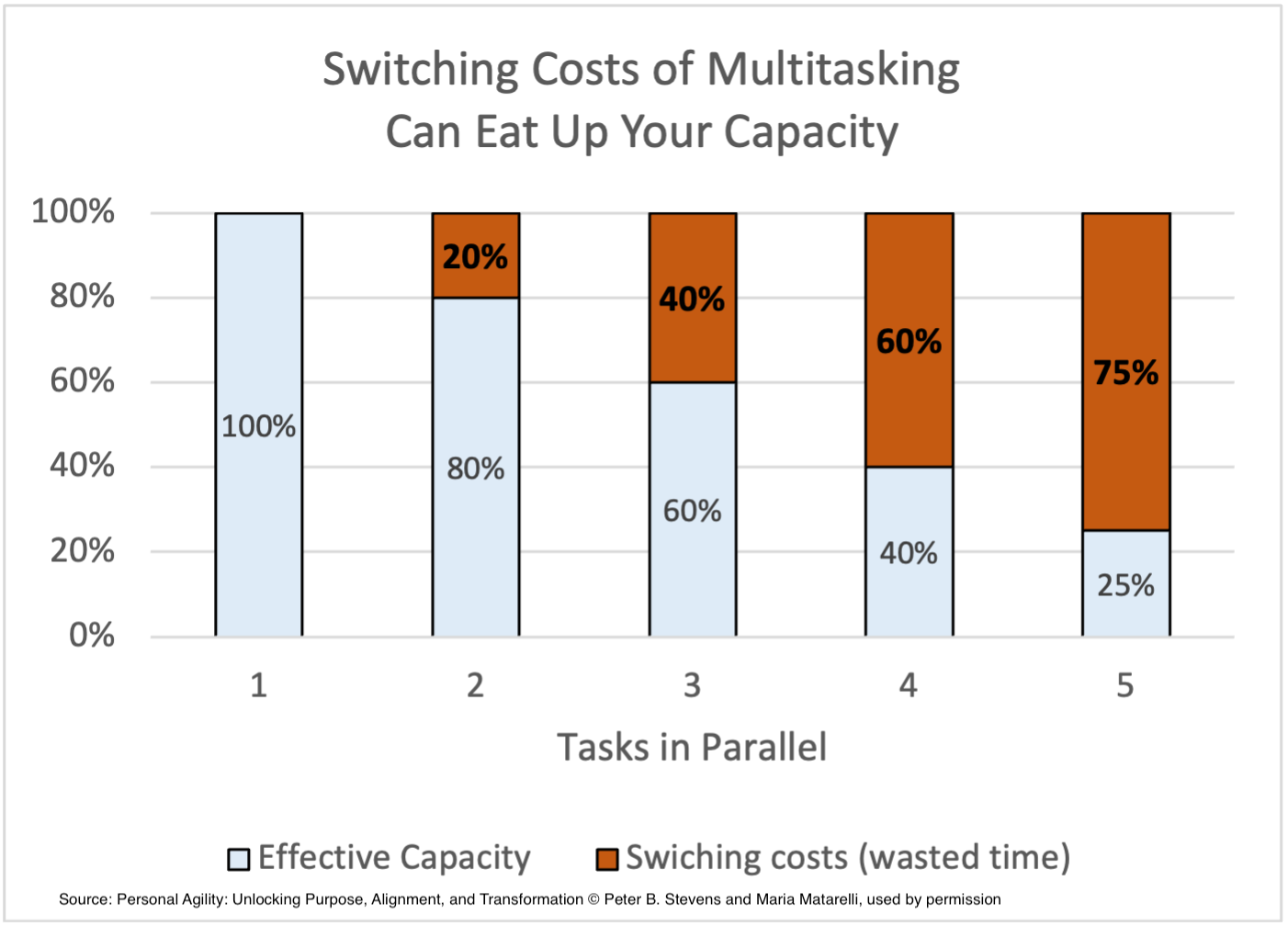
The following images visually summarize the devastating impact of these switch costs.

3. The Neurobiological Price Tag
Why do these switch costs occur? To answer this, we need to look at the brain's "executive control" architecture. You have specific neural networks responsible for directing your attention and managing your goals. Multitasking places these limited-capacity networks under immense strain.
Multicosts of Multitasking - PMC - NIH
Let's return to the NIH article to understand the specific brain systems involved. This directly addresses the 'why' behind the performance drop.
Read the section just before the one you read earlier (it starts with 'Together with studies of patients...'). Focus on understanding the roles of the three key networks mentioned: the frontoparietal control network, the dorsal attention network, and the ventral attention network. The key insight is that having multiple competing goals causes interference between these networks.
This constant switching and re-routing of information doesn't just make you less effective; it literally burns through your brain's fuel.
Multitasking Is a Myth, and to Attempt It Comes at a Neurobiological Cost | Big Think
Let's revisit the Big Think video to hear about the biological cost of this process.
Watch the clip from 00:43 to 01:42. Note the explanation of how task switching depletes crucial neural chemicals, leading to fatigue and an inability to focus. This is why you feel mentally exhausted after a day of 'multitasking'.
4. The Domino Effect on Performance
The cognitive costs of multitasking are not isolated. They create a cascade of negative effects that sabotage your performance in multiple ways:
- Reduced Quality & Increased Errors: As the "attention residue" concept shows, your cognitive capacity for the new task is diminished. This leads to shallower thinking and more mistakes. Research cited in the Brain.fm article suggests even brief interruptions can increase error rates by up to 20%.
- Wasted Time: The milliseconds it takes to switch tasks add up. Constantly reorienting your brain can consume a significant portion of your productive time. The Brain.fm article estimates this can be up to 40%.
- Impaired Memory and Learning: Heavy multitasking has been linked to poorer performance on tasks involving working memory and long-term memory. A fascinating finding from research on "media multitasking" (e.g., browsing social media while watching a show) is that heavy multitaskers can perform worse than their peers even when they are focused on a single task.
Multicosts of Multitasking - PMC - NIH
The NIH article discusses this surprising finding about media multitasking.
Scan the text for the sub-heading 'A Spotlight on Media Multitasking'. Read the paragraphs that follow, specifically looking for the finding that 'HMMs [heavier media multitaskers] sometimes perform worse than LMMs [lighter media multitaskers] even when single tasking'. This is a critical point: the habit of multitasking can degrade your ability to focus in general.
- Increased Stress & Mental Fatigue: Forcing your brain to constantly switch gears is metabolically expensive. It depletes neurochemicals and activates stress pathways, leading to quicker burnout and making it harder to sustain effort.
Conclusion
In this lesson, we have dismantled the myth of multitasking and replaced it with a scientifically grounded understanding of its costs. The pursuit of high performance begins with the discipline of single-tasking.
Key Takeaways:
- Multitasking is a Myth: What we experience as multitasking is actually rapid, sequential task switching.
- Switching Has a Cost: Every switch incurs a "switch cost," a measurable loss of speed and accuracy. This is due to "attention residue," where your brain remains partially focused on the previous task.
- The Brain is Overloaded: Task switching places heavy demands on the brain's executive control networks, depleting finite neural resources and leading to mental fatigue.
- Performance Suffers: The cognitive costs translate directly into reduced quality of work, increased error rates, wasted time, and impaired memory. The habit of multitasking can even reduce your ability to focus when you are trying to single-task.
Preview of the Next Lesson:
Now that you understand why task switching is so detrimental, the next logical step is to understand what causes you to switch tasks in the first place. In our next lesson, you will learn to identify your primary internal (e.g., mind-wandering) and external (e.g., notifications) distractors. This personal diagnosis is the first step toward designing an environment and a workflow that supports the deep focus necessary for extraordinary results.