Hello! Welcome back to our course on performance psychology.
In our last lesson, we delved into confirmation bias, exploring how our minds tend to seek out information that validates our existing beliefs. We established that the key to overcoming this is to actively search for disconfirming evidence, much like a scientist testing a hypothesis.
Today, we'll examine another critical cognitive bias that derails rational decision-making. Our objective is to explain the sunk cost fallacy and how to counteract it in decision-making. This fallacy can trap us in unproductive jobs, projects, and even relationships, purely because of what we've invested in the past. Mastering the ability to recognize and overcome it is essential for making clear, forward-looking choices that drive high performance.
1. What is the Sunk Cost Fallacy?
Have you ever finished a terrible movie just because you paid for the ticket? Or continued eating a meal you weren't enjoying simply because you didn't want the food to go to waste? If so, you've experienced the sunk cost fallacy.
A sunk cost is any cost—whether it's money, time, or effort—that has already been paid and cannot be recovered. The fallacy occurs when we let these unrecoverable costs influence our current decisions, leading us to "throw good money after bad."
To see this in action, let's watch a short video that provides a clear definition and some classic examples.
Sunk Cost Fallacy: Not Knowing When It’s Time to Stop
The YouTube channel Sprouts created an excellent animated explanation of the sunk cost fallacy, using relatable examples like buying a movie ticket and a famous real-world case.
Watch the video from the beginning until 02:03. Pay close attention to the definition of the fallacy and the examples of Jimmy's movie ticket and the Concorde project.
As the video illustrates, the rational way to make a decision is to weigh the future costs and benefits, not past ones. The money for the movie ticket is already spent, regardless of whether you stay or leave. The rational choice is to do whatever will bring you more value or enjoyment from this point forward. The Concorde project is a large-scale example of this, where governments continued to pour billions into a project they knew would not be profitable, simply because they had already invested so much.
2. The Psychology Behind the Fallacy
If acting on the sunk cost fallacy is so irrational, why is it such a powerful and common trap? The answer lies in several deep-seated psychological drivers. This aligns with your goal of understanding the "why" behind our behaviors.
Sunk Cost Fallacy: Why We Can't Let Go
The article 'Sunk Cost Fallacy: Why We Can't Let Go' from Positive Psychology provides a thorough breakdown of the psychological forces that pull us into this trap.
Read the section titled 'The Psychology Behind the Sunk Cost Fallacy'. This will give you a detailed look at the mechanisms at play.
As you just read, this isn't a simple error. It's a combination of powerful psychological tendencies:
- Loss Aversion: As we learned in our discussion of System 1 thinking, the pain of a loss feels more potent than the pleasure of an equivalent gain. Abandoning a project makes the past investment feel like a definite loss, which we are hardwired to avoid.
- Justification and Desire Not to Be Wasteful: Quitting can feel like admitting you made a mistake or wasted resources. To avoid this, we often rationalize continuing the endeavor to justify our initial decision to ourselves and others.
- Cognitive Dissonance: It's uncomfortable to hold the conflicting beliefs that "I made a smart decision to start this" and "This project is now failing." To reduce this mental discomfort, we may double down on the project to align our actions with our initial belief.
- Emotional Attachment & Identity: The more time and energy we invest, the more a project can become part of our identity. Letting go can feel like losing a part of ourselves.
These forces combine to create a strong emotional pull toward sticking with a course of action, even when logic dictates we should abandon it.
3. How to Counteract the Sunk Cost Fallacy
Recognizing the fallacy is the first step, but overcoming it requires deliberate strategies. The core mental shift is to consciously ignore sunk costs and make decisions based only on future prospects.
A simple, powerful question can help you make this shift.

To build a robust toolkit for applying this thinking, we can expand this core idea into a few concrete strategies.
Sunk Cost Fallacy: Why We Can't Let Go
Let's return to the Positive Psychology article, which outlines three practical strategies for letting go.
Read the section '3 Letting-Go Strategies'. Focus on the questions provided for each strategy, as they are practical tools you can use.
Let's consolidate these strategies into a clear action plan.
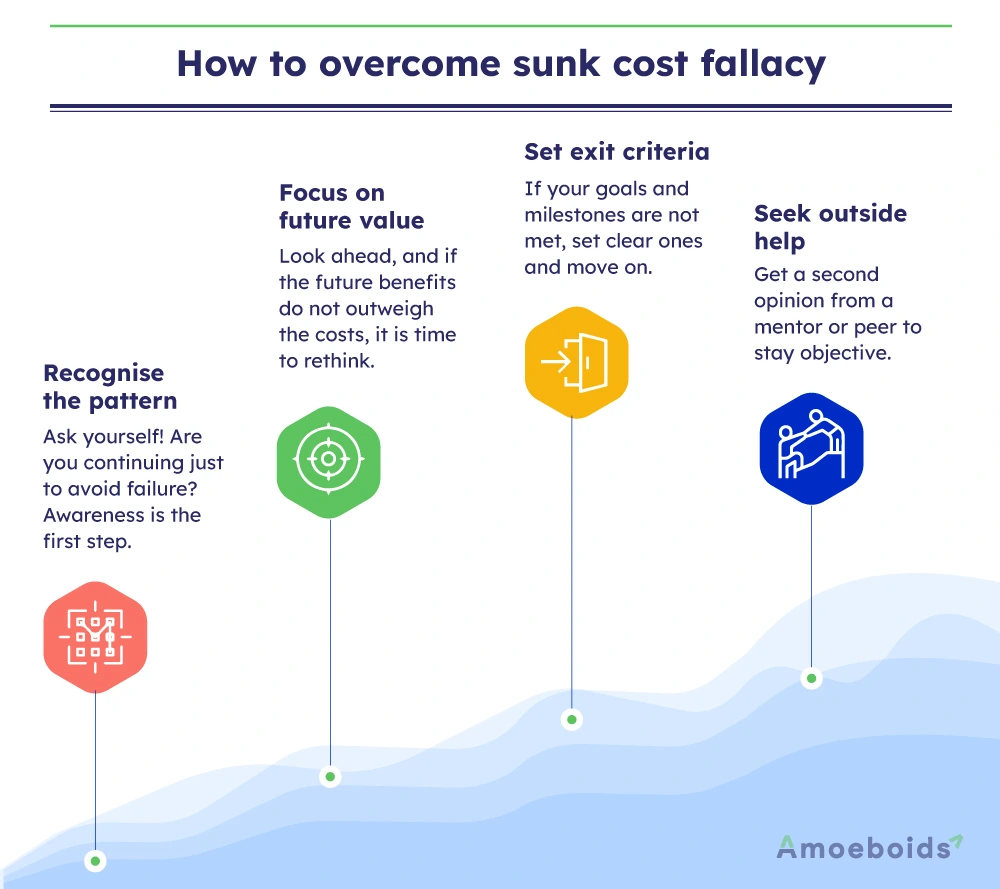
Here’s how to put those steps into practice:
- Frame the Decision Correctly: Start by asking the question from the first image: "Ignoring everything I've invested so far, and based on where I am today, what would I choose to do?" This mentally resets your decision point to the present.
- Focus on Future Value & Opportunity Cost: Shift your analysis away from the past. Ask:
- What are the likely future costs (time, money, energy) of continuing?
- What are the likely future benefits?
- What is the opportunity cost? In other words, what better things could I be doing with my time and resources if I stopped this?
- Seek an Objective Viewpoint: Our emotional attachment creates bias. Explain the situation to a trusted friend or mentor who is not emotionally invested and ask them what they would do. Often, an outside perspective can see the logical path clearly.
- Set "Exit Criteria" in Advance: For future projects, decide before you start what success and failure look like. For example: "I will work on this side project for three months. If I haven't achieved [specific milestone] by then, I will re-evaluate and be prepared to stop." This makes the decision to quit less emotional and more data-driven.
Your Turn: Apply the Technique
Let's make this practical. Think of something in your life that might be a sunk cost. It could be a book you're struggling to finish, a personal project that isn't going anywhere, or even a study method that doesn't seem to be working.
Take 5-10 minutes to analyze it using the questions from this lesson:
- Sunk Costs: What have you already invested? (e.g., "I've already read 150 pages," "I've already spent 20 hours on this.").
- Future Prospects: What are the realistic future costs and benefits of continuing? (e.g., "It will take me 10 more hours to finish this book, and I doubt the ending will be worth it.").
- Opportunity Cost: What is a better use of those future resources? (e.g., "In those 10 hours, I could read a different book that I'm actually excited about.").
- The Decisive Question: "Knowing what I know now, if I hadn't already started, would I choose to begin this today?"
Jot down your thoughts. The goal is not to force yourself to quit anything, but to practice the mental process of separating past investments from future decisions.
Conclusion
Today we've dissected the sunk cost fallacy, a powerful bias that can keep us stuck in losing ventures. By understanding its psychological roots, you can better guard against its influence and make more rational, forward-looking decisions.
Key Takeaways:
- The sunk cost fallacy is the irrational tendency to continue an endeavor because of past investments (sunk costs), rather than on an objective assessment of future prospects.
- It is driven by strong psychological forces, including loss aversion, the desire to avoid waste and justify past decisions, and cognitive dissonance.
- To counteract this fallacy, you must consciously ignore sunk costs. The most powerful tool is to ask: "If I were starting from scratch today, what would I do?"
- Practical strategies include focusing on future value and opportunity costs, seeking objective advice, and setting pre-defined exit criteria for new projects.
Preview of the Next Lesson:
We've now covered two major decision-making biases: confirmation bias and the sunk cost fallacy. In our next lesson, we will address another common cognitive trap: the overconfidence bias, which leads to a phenomenon known as the planning fallacy. You'll learn why we are chronically optimistic about how long it will take to complete tasks and what you can do to make more realistic and effective plans.