Hello! Welcome to the final lesson in our module on making smarter decisions.
In our last session, we explored how overconfidence and an "inside view" lead to the planning fallacy, causing us to create overly optimistic plans. You learned that shifting to an "outside view" by looking at past data is a key counter-strategy. Today, we move from diagnosis to a powerful, practical cure.
This lesson is dedicated to today's learning outcome: to apply a 'pre-mortem' technique to identify and mitigate risks in a future plan. You will learn what a pre-mortem is, the psychological reasons it works so effectively, and a step-by-step process for using it to make your own plans more robust and realistic. This is a cornerstone technique for turning your knowledge of cognitive biases into a direct improvement in your performance.
1. What is a Pre-Mortem?
A post-mortem analysis happens after a project has died, examining what went wrong. A pre-mortem, as the name suggests, is a hypothetical post-mortem conducted before a project even begins.
The technique was developed by psychologist Gary Klein. The process is simple: before committing to a plan, the team imagines that the project has failed completely. They then work backward to generate all the possible reasons for this disastrous outcome.
This may sound simple, but it's a profound psychological shift. To understand its power, let's hear it explained by Nobel laureate Daniel Kahneman, whose work on cognitive biases we discussed in the previous lesson.
Nobel laureate Daniel Kahneman - Premortem to eliminate thinking biases.
In this short clip, Daniel Kahneman explains the pre-mortem technique and highlights its primary benefit: it legitimizes critical thinking and makes it safe to voice doubts.
Watch the video from the beginning to 02:30. Pay close attention to Kahneman's explanation of how the pre-mortem changes the social dynamics of a team and counters the natural pressure for optimism.
As Kahneman explains, the genius of the pre-mortem is that it flips the script. Instead of the social risk associated with being a pessimist, it rewards imaginative and critical thinking. It leverages a cognitive bias we all have—hindsight bias, or the tendency to see events as more predictable after they've occurred—to our advantage. By imagining failure as a past event, it becomes much easier for our brains to explain how it could have happened.
This technique directly counteracts the planning fallacy and overconfidence bias by:
- Forcing you out of the optimistic "inside view."
- Making it psychologically safe and even productive to consider negative outcomes.
- Uncovering risks that are invisible when you're focused only on the path to success.
2. How to Conduct a Pre-Mortem
Now that you understand the "why," let's focus on the "how." While often used in teams, the pre-mortem is an incredibly valuable tool for individual planning as well. The process involves a few clear steps.
The following video provides a concise, step-by-step guide for running a pre-mortem session.
What is a Pre-mortem? ...and how do you run one?
This video from Online PM Courses provides a structured, six-step process for conducting a pre-mortem.
Watch the section from 02:53 to 05:33. As you watch, take note of the six distinct steps presented.
To complement the video, let's look at a detailed textual guide. This will reinforce the steps and add some useful practical tips for running the exercise.
Premortem Analysis: Anticipate Failure to Achieve Success
This article, 'Premortem Analysis: Anticipate Failure to Achieve Success', offers a comprehensive walkthrough of the process, including helpful tips for each stage.
Read the section titled 'The Premortem Analysis Process,' which covers five steps from preparation to revisiting the plan. Notice the emphasis on vividly imagining the disaster and generating reasons individually at first.
Based on these resources, here is a synthesized, step-by-step process for conducting a pre-mortem, whether for a team or for yourself.

The Pre-Mortem Process:
- Preparation: Clearly define the goal or plan. Be specific about what success looks like.
- Imagine Catastrophic Failure: Project yourself into the future. Assume the plan has failed utterly and completely. Don't just say it failed; visualize the consequences. What does this failure look like and feel like?
- Brainstorm Reasons for Failure (Individually): Take 5-10 minutes to write down every possible reason, internal or external, that could have led to this failure. Working alone at first prevents groupthink and allows for a wider range of ideas.
- Consolidate and Discuss: Share all the generated reasons. Group similar items together. For solo planning, this means organizing your own list into themes (e.g., motivational issues, resource issues, external roadblocks).
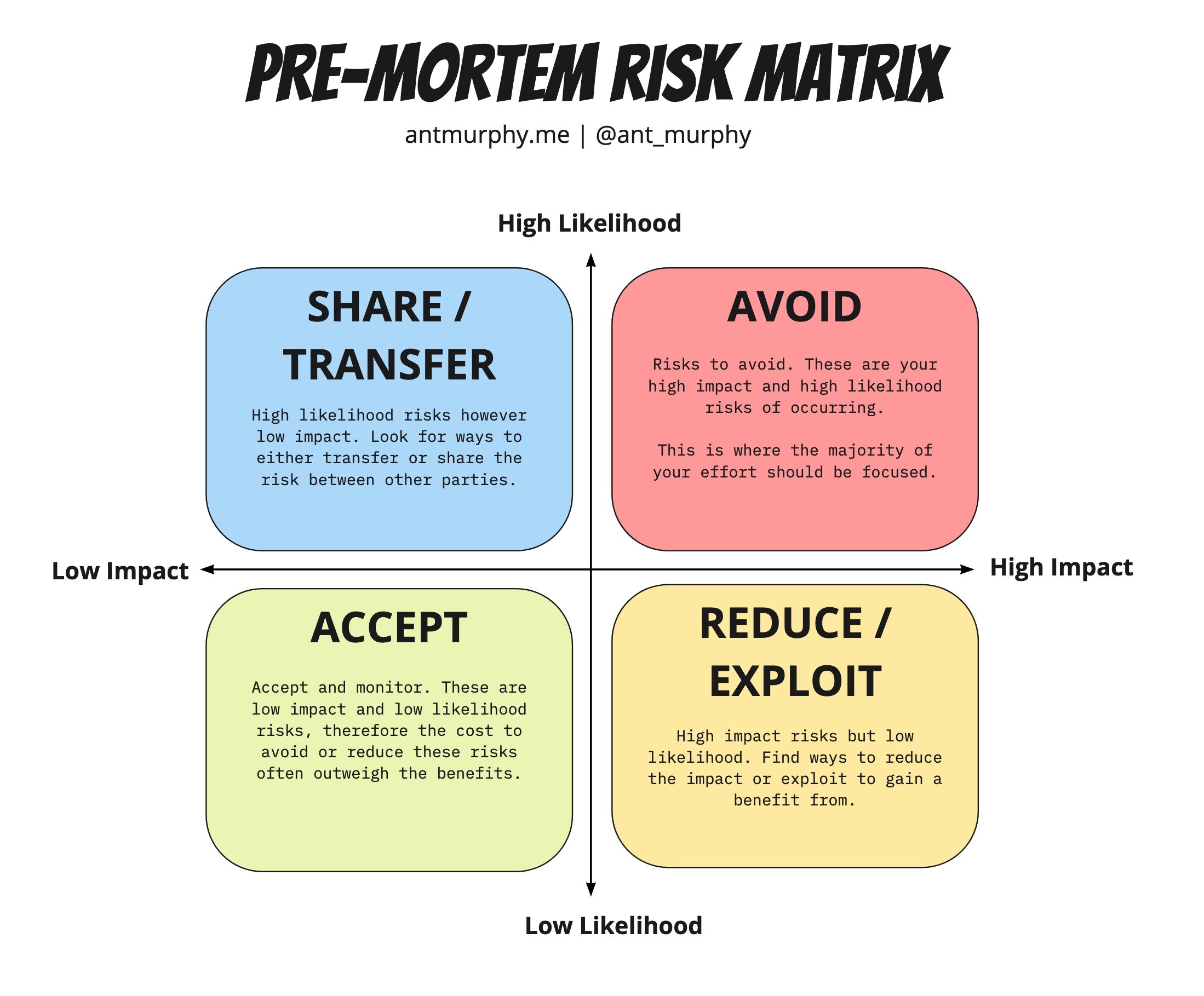
- Prioritize and Create an Action Plan: You can't fix everything. Identify the most threatening risks. A great way to do this is by using a risk matrix to plot each risk based on its likelihood and its potential impact.
- Revise and Strengthen the Plan: Use the insights from your action plan to modify your original plan. Add specific steps to mitigate the key risks you identified. Schedule regular check-ins to see if any of the predicted issues are emerging.
3. Your Turn: Apply the Pre-Mortem Technique
Now it's time to put this powerful technique into practice. Choose a significant personal goal or plan you are currently working on. This could be completing this 20-day course, a fitness goal, a learning project, or any other important endeavor.
Follow the steps below.
1. The Plan:
Write down your goal. Be specific about what successful completion looks like and when you plan to achieve it.
- Example: "My goal is to successfully complete all 20 lessons of this course in 20 consecutive days, spending about 60-90 minutes per day, to gain a solid foundation in performance psychology."
2. The Failure:
Imagine it is one month from now, and you have completely failed to achieve your goal. Write a brief, one-paragraph "history of the disaster."
- Example: "It's a month later and I only got through the first 8 lessons. I fell behind after a few days, felt overwhelmed, and then just gave up. The initial momentum is gone and I feel like I've wasted the opportunity."
3. Brainstorm the Causes:
Set a timer for 5 minutes. List every possible reason that could explain this failure. Think broadly.
- Internal factors: Loss of motivation, procrastination, underestimating the difficulty, getting distracted by other things, burnout.
- External factors: Unexpected life events, technology problems, noisy environment, lack of support.
- Planning flaws: The daily time commitment was unrealistic, I didn't have a good place to study, I didn't build in any buffer for off-days.
4. Prioritize the Risks:
Look at your list of potential causes. Now, categorize the top 3-5 most serious risks using the matrix below. For each risk, decide if its likelihood is high or low, and if its impact would be high or low.
5. Mitigate and Revise:
For each of your top risks (especially those in the 'Avoid' or 'Reduce' quadrants), brainstorm one or two specific actions you can take now to prevent or lessen its impact.
- Example Risk: "I'll lose motivation after the first week." (High Likelihood, High Impact)
- Mitigation Action 1: "I will schedule my study time in my calendar every day like a real appointment."
- Mitigation Action 2: "I will tell a friend about my 20-day goal and ask them to check in with me every few days to keep me accountable."
By completing this exercise, you have just transformed your optimistic plan into a resilient, reality-tested strategy.
Conclusion
Today you've added a powerful tool to your decision-making toolkit. The pre-mortem is more than just a risk-management exercise; it's a practical application of psychological principles to systematically de-bias your planning.
Key Takeaways:
- A pre-mortem involves imagining a plan has already failed to uncover potential risks proactively.
- It works by harnessing hindsight bias and legitimizing critical thinking, thereby overcoming the planning fallacy and optimism bias.
- The process involves preparing, imagining failure, brainstorming causes, prioritizing risks, and revising your plan.
- Using a risk matrix helps you focus your efforts on the threats that matter most: those with high likelihood and high impact.
Preview of the Next Module:
In this module, we have focused on the cognitive architecture of decision-making. Often, the risks we identify in a pre-mortem are not external but internal: lack of motivation, distraction, and, most commonly, procrastination. This provides a perfect bridge to our next module, Overcoming Procrastination. In our next lesson, we'll start by exploring the modern scientific understanding of procrastination—not as a character flaw or poor time management, but as a form of emotion regulation.