Welcome back! In our last lesson, we introduced the dual-process model of thinking, distinguishing between the fast, intuitive System 1 and the slow, deliberate System 2. We concluded that many decision-making errors occur when we over-rely on System 1's shortcuts, leading to cognitive biases.
Today, we'll dissect one of the most powerful and pervasive of these biases. Our learning outcome is to identify the confirmation bias in your own thinking and apply strategies to seek disconfirming evidence. This bias affects everyone, from scientists and investors to students and everyday decision-makers. Understanding it is a crucial step towards clearer thinking and achieving the "immense results" you're aiming for.
1. Witnessing Confirmation Bias in Action
Before we define the term, let's see if you can spot it in a puzzle. The best way to understand this bias is to experience the pull of it yourself.
The Most Common Cognitive Bias
The YouTube channel Veritasium created an excellent video demonstrating a classic experiment that reveals confirmation bias. The host presents a number sequence and asks people to discover the underlying rule.
Watch the first 3 minutes and 10 seconds. As you watch, imagine you are one of the participants. The starting sequence is 2, 4, 8. What rule do you think governs the sequence? What other three-number sequences would you test to be sure?
What did you notice? Most people immediately form a hypothesis (e.g., "each number is double the last"). Then, they test sequences that confirm this hypothesis (10, 20, 40; 100, 200, 400). They rarely try to test a sequence that would disprove it, like "1, 2, 3" or "10, 9, 8".
This powerful tendency is the heart of confirmation bias.
2. What is Confirmation Bias?
Confirmation Bias is our brain's tendency to search for, interpret, favor, and recall information in a way that confirms or supports our pre-existing beliefs or hypotheses. It's a System 1 shortcut that saves mental energy by prioritizing information that fits our existing mental models.
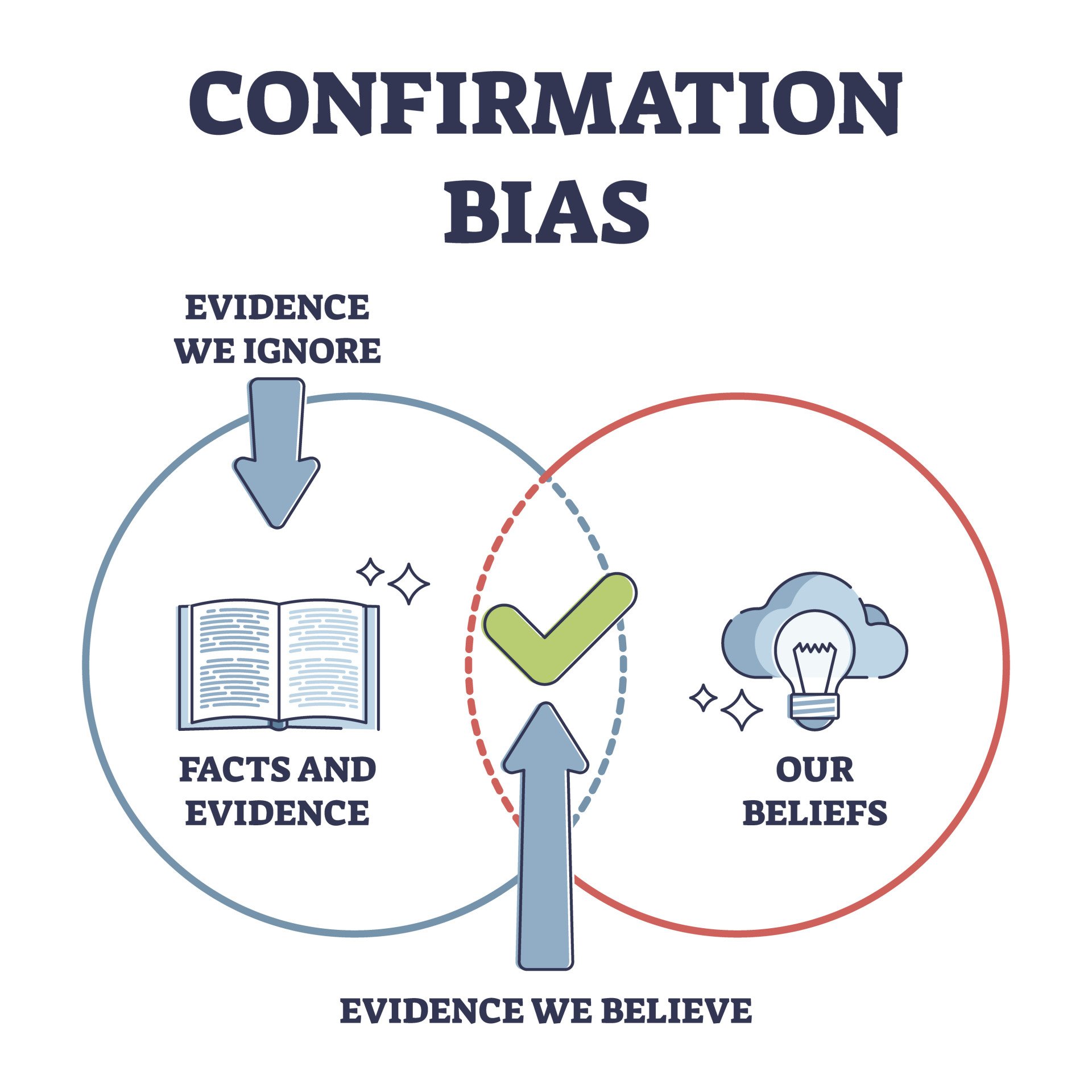
This bias doesn't just happen in one way. It can manifest through several mechanisms.

To explore these mechanisms with a clear example, let's watch another short video.
Confirmation Bias: Learn to overcome this common cognitive bias
The channel The Science Lens breaks down confirmation bias into four specific behaviors, using the memorable example of dropping buttered toast.
Watch the first 2 minutes and 41 seconds of this video. Pay attention to the four distinct ways the bias can operate: biased memory, ignoring contradictory information, failing to seek objective facts, and misinterpreting new information.
As the video explains, we might:
- Search in a biased way: We Google "reasons my study technique is the best" instead of "pros and cons of different study techniques."
- Interpret in a biased way: If we believe someone is unfriendly, we interpret their quietness as aloofness, not shyness.
- Remember in a biased way: We vividly recall the one time our horoscope was right and forget the dozens of times it was wrong.
3. The "Why": Why Are We Wired for This Bias?
Your goal is to understand the science behind performance, so let's examine why our brains are built with this seemingly irrational glitch. Confirmation bias isn't a sign of low intelligence; it serves deep-seated psychological needs.
Confirmation Bias In Psychology: Definition & Examples
The article 'Confirmation Bias In Psychology' from Simply Psychology provides a clear explanation of the psychological roots of this bias.
Read the section titled 'When Does The Confirmation Bias Occur?'. It outlines three key reasons for this bias.
As you just read, there are three main drivers:
- It's an efficient way to process information. System 2 thinking is slow and energy-intensive. It's much easier for our System 1 to use a simple heuristic: "If it fits what I already know, it's probably true." This saves a huge amount of mental effort in a world overflowing with information.
- It protects our self-esteem. Being wrong can feel like a threat to our identity or intelligence. Confirmation bias acts as a psychological shield, reinforcing our beliefs and making us feel more confident and secure in our knowledge.
- It minimizes cognitive dissonance. Cognitive dissonance is the mental discomfort we feel when holding two conflicting beliefs. To avoid this stress, we subconsciously filter out information that contradicts our worldview.
As investor Warren Buffett famously said, "What the human being is best at doing is interpreting all new information so that their prior conclusions remain intact."
4. How to Fight Back: The Power of Disconfirming Evidence
Recognizing and understanding confirmation bias is the first step, but the goal of performance psychology is to apply this knowledge. The key to overcoming this bias is to actively and consciously do the opposite of what your System 1 wants to do.
You must actively seek disconfirming evidence.
This means shifting your mindset from trying to prove yourself right to trying to prove yourself wrong. This is the same principle that underpins the scientific method.
The Most Common Cognitive Bias
Let's return to the Veritasium video, where the host explains the power of looking for 'no' answers and its connection to the scientific method.
Watch from 03:36 to 04:28. This section explains that the most informative answers are often the 'no's', because they challenge your hypothesis and force you to adjust.
Here are some practical strategies you can use to implement this scientific-style thinking in your own life.
Confirmation Bias: Learn to overcome this common cognitive bias
The Science Lens video you watched earlier also offers a concise set of strategies to combat confirmation bias, which the presenter then applies to a personal example.
Now watch from 03:20 to the end (05:35). Pay close attention to the three-step process and how the presenter uses data collection to test his belief about his dog.
To consolidate and expand on these ideas, here is a practical toolkit for seeking disconfirming evidence:
- Consider the Opposite: Before seeking evidence, take a moment and ask yourself, "What if my initial belief is wrong? What would the alternative be?" This primes your brain to be more open.
- Change Your Search Terms: Instead of searching for "Why is [my belief] true?", search for "arguments against [my belief]" or "criticism of [my belief]". This is what the Farnam Street blog calls "searching for disconfirming evidence."
- Find an Intellectual Sparring Partner: Discuss your ideas with someone you know holds a different viewpoint. Your goal isn't to win the argument, but to understand the logic and evidence behind their perspective.
- Track Your Predictions: If you believe you're good at predicting outcomes (e.g., in sports or markets), write down your predictions and the reasoning behind them. Later, review them honestly. This creates an objective record that your biased memory can't distort.
- Read Sources You Disagree With: If you have a strong opinion on a topic, make it a habit to read articles or books from credible authors who hold the opposite view.
Your Turn: Apply the Technique
Let's make this practical.
- Think of a belief you hold related to your own performance or learning (e.g., "I learn best by reading," "I am not a 'math person'," "I need 8 hours of sleep to function," "Procrastination is just laziness").
- Take 10 minutes to actively search for three distinct, credible pieces of evidence that challenge or contradict that belief. This could be a scientific study, an article by an expert, or a well-reasoned argument.
- Write down the belief and the three pieces of disconfirming evidence you found. The goal is not necessarily to change your mind, but to practice the skill of looking at your own beliefs from the outside.
Conclusion
In this lesson, we explored one of the most fundamental barriers to rational thinking: the confirmation bias. You learned how this automatic System 1 process works to protect our existing beliefs and how to consciously engage your System 2 to counteract it.
Key Takeaways:
- Confirmation Bias is the tendency to seek, interpret, and remember information that confirms our existing views, while ignoring information that contradicts them.
- It's a mental shortcut driven by our need for cognitive efficiency, self-esteem protection, and avoidance of mental discomfort (cognitive dissonance).
- The most effective strategy to overcome this bias is to actively seek disconfirming evidence—in other words, to try to prove yourself wrong.
- Practical techniques include considering the opposite, changing your search habits, and engaging with opposing viewpoints.
Preview of the Next Lesson:
Now that you're armed with a strategy to fight confirmation bias, we will turn to another powerful decision-making trap. In the next lesson, we will discuss the sunk cost fallacy. You will learn why we irrationally continue with a failing endeavor simply because we've invested time, money, or effort into it, and how to make forward-looking decisions based on future potential, not past investments.