Hello! Welcome to the first lesson in our new module, "Making Smarter Decisions."
In our last lesson, we concluded our study of focus by exploring its surprising counterpart: strategic boredom. You learned that allowing your mind to wander—what we called "scatter focus"—is a vital process for creativity and problem-solving. We ended by noting that the intuitive insights that often emerge from this state are a product of a fast, automatic mode of thinking.
Today, we'll formalize that idea. Our learning outcome is to explain the dual-process model of thinking (System 1 vs. System 2). This model, popularized by Nobel laureate Daniel Kahneman, is a cornerstone of performance psychology and behavioral economics. Understanding these two "systems" of thought is the first and most critical step toward improving your judgment, making better decisions, and avoiding the mental traps that hinder peak performance.
1. Experience Your Two Systems in Action
Before we define anything, let's start with a quick mental exercise. You've already done this many times in your life without thinking about it.
First, look at the image on the left.
A picture of a woman's face and a multiplication problem
Excerpt from 'Thinking, Fast and Slow' by Daniel Kahneman. The image of the woman elicits an immediate, intuitive reaction (System 1), while the math problem requires deliberate, effortful calculation (System 2).
You instantly recognized that the woman is angry. You didn't have to "decide" to analyze her expression; the conclusion—"she's angry" and "about to shout"—just happened to you. It was automatic, effortless, and fast.
Now, look at the problem on the right: 17 x 24.
Your reaction is completely different. You immediately recognize it's a multiplication problem that you can solve, but the answer doesn't just appear. To get it, you would need to retrieve a method from memory, apply it step-by-step, and hold information in your head. This process is deliberate, effortful, and slow.
You've just experienced your two different modes of thinking. To see this distinction explained with more examples, let's watch a short video.
Mastering Both Your Brains | System 1 vs System 2
The video 'Mastering Both Your Brains' uses simple, effective demonstrations to introduce the two modes of thinking. It refers to them colloquially as the 'lizard brain' and the 'human brain'.
Watch the first 2 minutes and 24 seconds. Notice how your reaction to the picture of the woman differs from your reaction to the math problem. This illustrates the core difference between the two systems.
2. Defining System 1 and System 2
Psychologists call these two modes of thinking System 1 and System 2.
- System 1 is the fast, automatic, intuitive thinking you used with the woman's face.
- System 2 is the slow, deliberate, analytical thinking required for the math problem.
To get the formal definitions from the source, let's turn to an excerpt from Daniel Kahneman's foundational book, Thinking, Fast and Slow.
Of 2 Minds: How Fast and Slow Thinking Shape Perception ...
This article from Scientific American is a direct excerpt from the first chapter of Kahneman's book. It provides the official definitions and characteristics of the two systems.
First, read the section titled 'TWO SYSTEMS' for the formal definitions. Then, review the bulleted lists in the following two sections to see a wide range of examples of activities attributed to each system.
To summarize and consolidate these ideas, here is a table of their key characteristics:
| Attribute | System 1 (Fast Thinking) | System 2 (Slow Thinking) |
|---|---|---|
| Operation | Automatic, quick | Deliberate, slow |
| Effort | Little to no effort | Effortful, requires attention |
| Control | Involuntary | Voluntary, involves choice |
| Process | Intuitive, associative, emotional | Logical, analytical, computational |
| Role | Generates impressions, feelings, intuitions | Makes conscious choices, solves problems |
| Example | Detecting hostility in a voice | Comparing two products for value |
3. The Division of Labor: How They Work Together
It's tempting to label System 1 as "bad" (irrational) and System 2 as "good" (rational), but that's incorrect. They are partners in a highly efficient mental arrangement. Understanding their relationship is key to understanding your own mind.
System 1 is the default operator. It runs continuously, handling thousands of perceptions and judgments every day with incredible efficiency. It generates a constant stream of suggestions for System 2: impressions, intuitions, and intentions.
Most of the time, System 2 simply accepts these suggestions. When you see a clear road and decide to cross, that's System 1 making a complex assessment of speed and distance, which your System 2 then endorses. This division of labor is extremely effective.
System 2 only gets called in when:
- System 1 encounters a problem it can't solve (like 17 x 24).
- An event violates the world model that System 1 maintains (e.g., you see a dog that barks "meow").
- You consciously decide to overrule a System 1 impulse (e.g., holding back a rude comment).
The following video provides a great analogy for this partnership.
Mastering Both Your Brains | System 1 vs System 2
Let's return to 'Mastering Both Your Brains'. This section explains the ideal collaboration between the two systems using the analogy of an experienced driver (System 1) and a navigator with Google Maps (System 2).
Watch from 05:52 to 07:18. Pay close attention to the driver and navigator analogy, as it perfectly illustrates how the two systems should ideally collaborate.
4. Why the Model Breaks Down: Overconfidence and Bias
The collaboration is efficient, but not foolproof. The main source of trouble in our decision-making comes when System 1, our fast and intuitive thinker, overconfidently handles a situation that should have been passed to the more analytical System 2.
System 1 uses mental shortcuts and past experiences to make quick judgments. While usually effective, this can lead to systematic errors, known as cognitive biases.
Let's look at a classic example of this breakdown.
Mastering Both Your Brains | System 1 vs System 2
This part of the video 'Mastering Both Your Brains' demonstrates a famous riddle that tricks System 1 into making a mistake.
Continue watching from 07:18 to 08:31. Try to answer the 'bat and ball' problem quickly yourself before the answer is revealed. Notice the pull of the intuitive, but wrong, answer. This is your System 1 jumping to a conclusion.
The bat and ball problem beautifully illustrates the core issue. The answer "10 cents" (or ₹10) feels right instantly. It's an intuitive guess from System 1. To arrive at the correct answer (5 cents, or ₹5), you have to engage the effortful, logical processing of System 2 to check the math:
- If the ball is 5 and the bat is 105 (100 more), the total is 110. Correct.
- If the ball is 10 and the bat is 110 (100 more), the total is 120. Incorrect.
This is the central challenge in making better decisions: learning to recognize situations where your intuition (System 1) is likely to be wrong and consciously activating your more deliberate, analytical mind (System 2) to check the facts. This is what we will be focusing on for the rest of this module.
A Note on Terminology: "Useful Fictions"
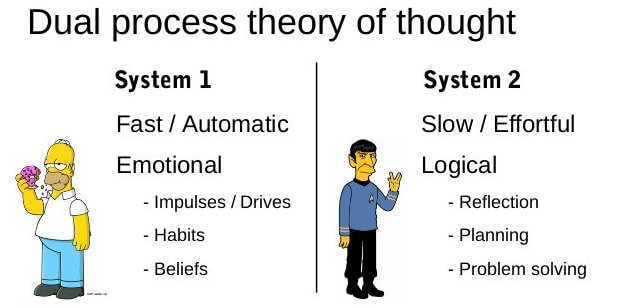
Since you're interested in the "why," it's important to be precise. System 1 and System 2 are not two separate, physical parts of your brain. There isn't a "Homer Simpson" lobe or a "Spock" cortex. They are, as Kahneman calls them, "useful fictions."
Of 2 Minds: How Fast and Slow Thinking Shape Perception ...
In this final section of the excerpt from 'Thinking, Fast and Slow', Kahneman explains why he uses the terms System 1 and System 2, clarifying that they are descriptive labels for complex processes, not literal entities in the brain.
Please read the short section titled 'USEFUL FICTIONS'. This will give you a more sophisticated understanding of what this model represents.
Treating them as characters in a story helps us understand their different functions and interactions more easily. They are a powerful conceptual model for describing how the mind works.
Conclusion
In this lesson, you've been introduced to the dual-process model of thinking, a fundamental concept for anyone serious about improving their performance.
Key Takeaways:
- Our minds operate with two systems: System 1 (fast, intuitive, automatic) and System 2 (slow, analytical, effortful).
- System 1 is the default operator, handling most of our daily tasks efficiently but relying on mental shortcuts that can lead to errors.
- System 2 requires conscious effort and attention and is responsible for complex problem-solving and overriding System 1's impulses.
- Many decision-making errors, or cognitive biases, occur when we mistakenly rely on a quick System 1 judgment for a problem that required the careful scrutiny of System 2.
Preview of the Next Lesson:
Now that you have a solid grasp of this two-system framework, we are ready to dive into the specific errors that System 1 is prone to making. In our next lesson, we will dissect one of the most pervasive and powerful cognitive biases: the confirmation bias. You will learn to identify it in your own thinking and apply practical strategies to seek out disconfirming evidence, leading to more robust and rational conclusions.