Introduction
In our last session, we dissected the fundamental HTTP request-response cycle, exploring the methods, headers, and status codes that form the language of the web. We saw how a single webpage load can trigger dozens of these exchanges. Now, we'll build on that by examining how the protocol carrying these messages has evolved to handle the ever-increasing complexity and performance demands of modern applications.
This lesson focuses on differentiating between HTTP/1.1, HTTP/2, and HTTP/3. We will trace the evolution from one version to the next, understanding the key performance bottlenecks each new version was designed to solve. As a senior engineering manager, grasping this evolution is crucial for making informed architectural decisions, optimizing user experience, and evaluating the benefits of upgrading your systems' infrastructure.
The Era of HTTP/1.1: Foundations and Frustrations
HTTP/1.1, standardized in 1997, was the workhorse of the web for nearly two decades. It introduced critical improvements over its predecessor, most notably persistent connections (keep-alive), which allowed multiple requests to be sent over a single TCP connection, avoiding the costly overhead of setting up a new connection for every single asset.
However, as websites grew from simple text documents to rich applications with hundreds of resources (images, CSS, JavaScript files), a major limitation became a significant performance bottleneck: Head-of-Line (HOL) Blocking.
In HTTP/1.1, requests over a single connection are strictly ordered. The client sends a request, waits for the full response, and only then can it process the next request in the queue. If a single large or slow request is at the front of the line, it blocks all subsequent requests behind it, even if they are small and could be processed quickly.
To understand this problem and the workarounds that defined web development for years, the following video provides an excellent animated explanation.
This segment from the ByteByteGo channel clearly illustrates the innovations of HTTP/1.1 and its primary weakness, Head-of-Line blocking.
Please watch from HTTP 1.1's introduction. Pay close attention to the concepts of persistent connections and pipelining, and especially the clear visual explanation of Head-of-Line blocking and the engineering workarounds it necessitated, such as "domain sharding" and file concatenation.
As you saw, engineers developed clever but cumbersome techniques to mitigate HOL blocking, like spreading assets across multiple subdomains to get more parallel connections. These workarounds were symptoms of a protocol struggling to keep up with the demands of the modern web.
HTTP/2: Solving HOL Blocking with Multiplexing
The primary goal of HTTP/2, standardized in 2015, was to solve the Head-of-Line blocking problem of HTTP/1.1. It did this by introducing several fundamental changes, the most important of which is multiplexing.
Instead of plain text requests and responses, HTTP/2 uses a binary framing layer. This allows a single TCP connection to be logically divided into many independent, bidirectional streams. Multiple requests and responses can be interleaved and sent in parallel over this single connection. A large file transfer no longer blocks a small CSS file; they can be downloaded concurrently.
Let's continue with the same video to see how HTTP/2 accomplishes this.
This next section of the video explains the core features of HTTP/2 that directly address the limitations of HTTP/1.1.
Watch the segment from the arrival of HTTP/2. Focus on understanding these key concepts: Binary Framing Layer: The foundation that enables everything else. Multiplexing: The solution to application-layer HOL blocking. Stream Prioritization: Allowing the browser to request critical resources first. Header Compression (HPACK): A technique to reduce redundant data transfer. Server Push: A feature allowing servers to send resources before they are requested (though its practical adoption has been limited).
HTTP/2 was a massive leap forward. By eliminating HOL blocking at the application level, it made websites faster and more efficient, rendering old hacks like domain sharding obsolete.
However, HTTP/2 revealed a new, more fundamental bottleneck. While it could multiplex many streams, it still ran over a single TCP connection. TCP guarantees reliable, in-order delivery of packets. If a single TCP packet is lost in transit, the entire connection freezes while that packet is retransmitted. This means all the multiplexed streams, regardless of which one the lost packet belonged to, are blocked. This is TCP Head-of-Line blocking.
HTTP/3: Moving Beyond TCP with QUIC
The final step in our journey is HTTP/3. Its development was driven by the realization that to truly eliminate Head-of-Line blocking, the protocol had to move off TCP. HTTP/3 achieves this by using a new transport protocol called QUIC (Quick UDP Internet Connections), which is built on top of UDP.
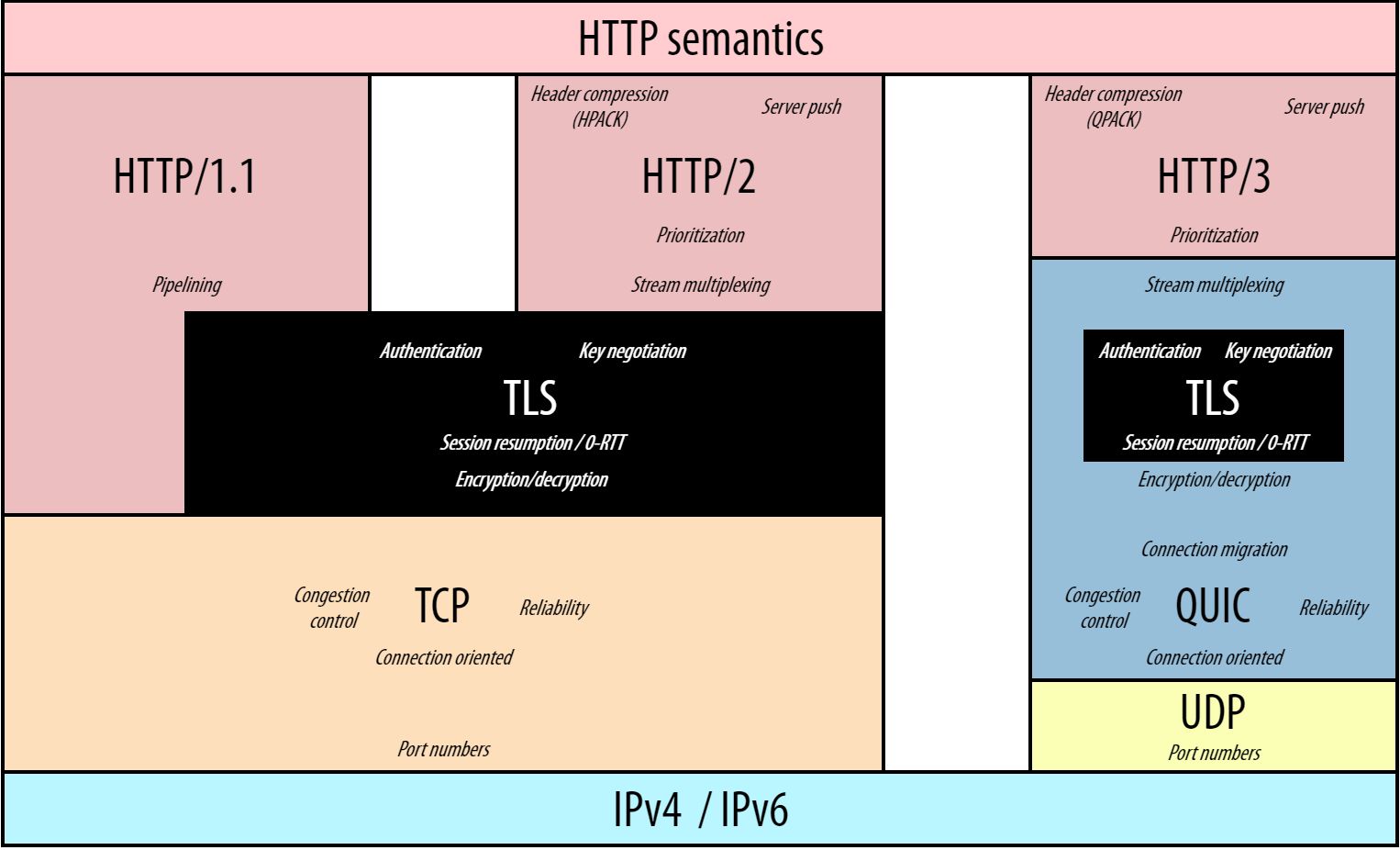
QUIC effectively re-implements the reliability features of TCP (like packet retransmission and congestion control) but does so in a way that is aware of HTTP/2's streams. With QUIC, if a packet is lost, it only blocks the specific stream to which the packet belonged. All other streams can continue processing data, thus eliminating TCP-level HOL blocking.
Beyond solving HOL blocking, QUIC introduces two other game-changing performance improvements:
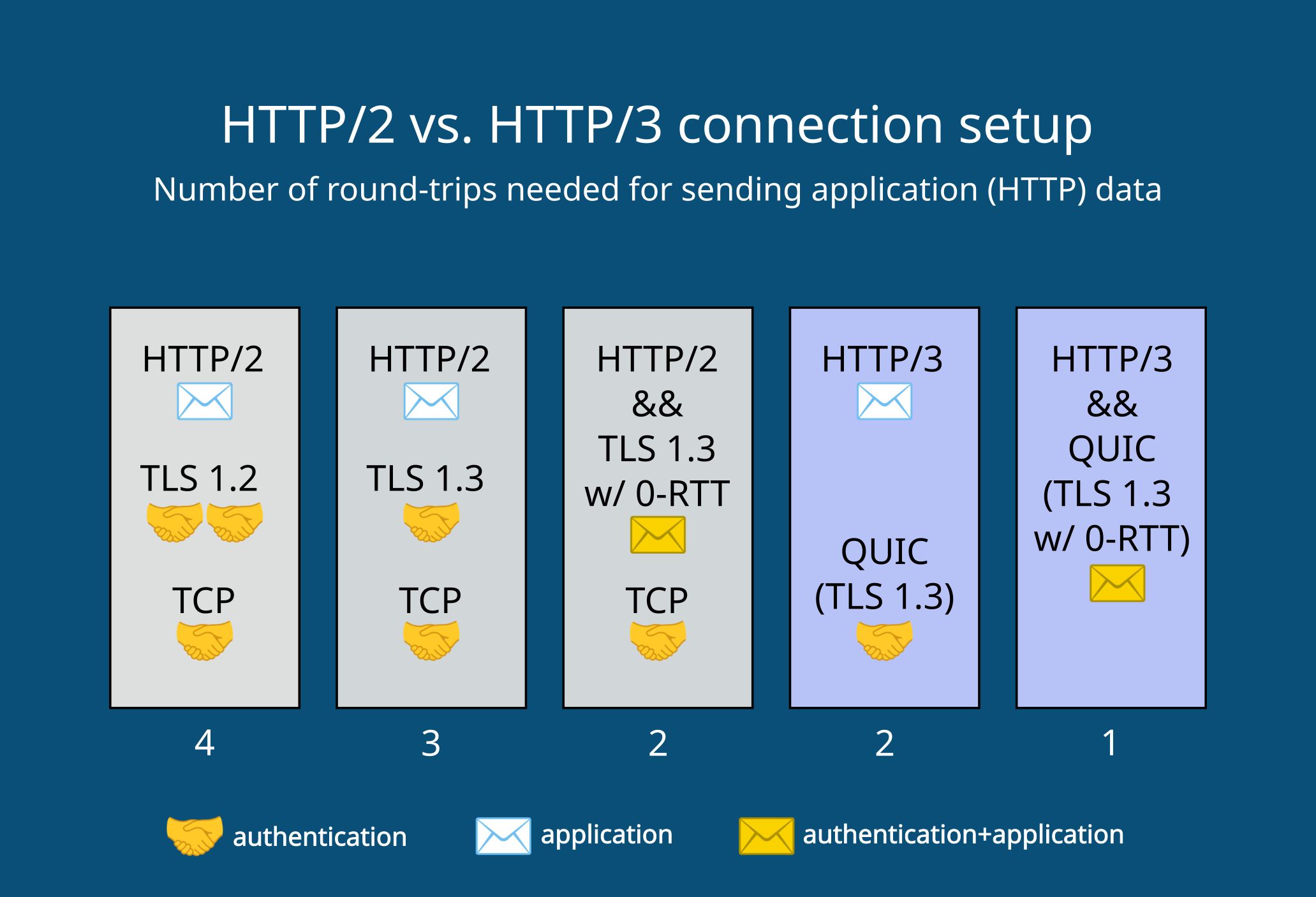
- Faster Connection Establishment (0-RTT): In HTTP/2, establishing a secure connection requires separate handshakes for TCP and TLS, costing multiple round-trips. QUIC combines these into a single handshake, reducing latency. For returning visitors, it supports a "zero round-trip" (0-RTT) connection, allowing the client to send data immediately.
- Connection Migration: TCP connections are defined by a 4-tuple (source IP, source port, destination IP, destination port). If your device switches networks (e.g., from Wi-Fi to cellular), your IP address changes, and the TCP connection breaks. QUIC uses a Connection ID to identify the connection. This ID remains the same even if the underlying IP address changes, allowing for a seamless transition without dropping the connection—a crucial feature for mobile users.
The final segment of the video summarizes these advantages.
This part explains how HTTP/3 leverages QUIC to overcome the final hurdles left by HTTP/2.
Please watch from the introduction of HTTP/3. This will solidify your understanding of how QUIC, built on UDP, provides faster handshakes, avoids TCP HOL blocking, and enables seamless connection migration.
Performance in Practice: A Side-by-Side Comparison
Theory is one thing, but the practical performance gains are what drive adoption. The following resource provides real-world measurements that quantify the benefits of each protocol version across different scenarios.
HTTP/1.1 vs. HTTP/2 vs. HTTP/3 – The Big Speed Comparison with ...
This article from NexoraHost provides an excellent breakdown of performance data, comparing the three protocols in various real-world situations. It then offers practical advice on which protocol is best suited for different types of applications.
First, read the five scenarios presented under the main heading Real Measurements. These cover: First-time connection setup Returning visitors Loading many small files Poor network connections Connection switching (e.g., WiFi to mobile) Pay attention to the tables, which clearly show the dramatic improvements with each new version, especially in adverse conditions. Next, read the section Who Benefits from Which Version?. This provides clear, actionable recommendations that are highly relevant from an engineering management perspective.
To bring all this information together, the table below provides a concise, feature-by-feature comparison.
HTTP/3 in the Wild: Why It Beats HTTP/2 Where It Matters ...
This table from The New Stack offers a comprehensive, at-a-glance summary of the key differences between the protocols.
Please review the table in its entirety, starting from the row for Transport Protocol. This is an excellent reference to consolidate your understanding of the technical differences in multiplexing, head-of-line blocking, connection setup, and ideal use cases.
Conclusion
We have traced the remarkable evolution of HTTP, seeing how each version was a direct response to the performance bottlenecks of its predecessor. This journey reflects the broader story of the web itself, from simple documents to complex, global-scale applications.
Key Takeaways:
- HTTP/1.1 established persistent connections but suffered from Head-of-Line (HOL) blocking, forcing sequential request processing on a single connection.
- HTTP/2 solved application-level HOL blocking by introducing multiplexing over a single TCP connection, allowing parallel processing of requests and responses. However, it was still vulnerable to TCP-level HOL blocking due to packet loss.
- HTTP/3 solves TCP-level HOL blocking by moving to QUIC, a new transport protocol on UDP. This brings true stream independence, faster connection setup (0-RTT), and seamless connection migration, making it especially powerful for mobile and unreliable networks.
In our next lesson, we will delve deeper into a topic central to HTTP/2 and HTTP/3: security. We will explore the fundamentals of modern encryption, including symmetric and asymmetric key pairs, and then demystify the TLS/SSL handshake that secures our web communication.