Introduction
In our last lesson, we charted the evolution of the web's primary protocol, from HTTP/1.1 to HTTP/3, noting how each new version was driven by the need for better performance. A key theme in that evolution, especially with HTTP/2 and HTTP/3, is the mandatory use of encryption to secure communication. This brings us to the core of modern network security.
This lesson delves into the foundational cryptographic methods that make secure communication possible. Our objective is to differentiate between symmetric and asymmetric encryption and describe the role of public/private key pairs. Understanding these concepts is not just theoretical; it's essential for making informed decisions about system architecture, security protocols, and performance trade-offs—all critical aspects of your role as an engineering manager.
The Two Pillars of Modern Encryption
At its heart, encryption is the process of transforming readable data (plaintext) into an unreadable format (ciphertext) using a key. Only someone with the correct key can reverse the process (decryption). Modern cryptography primarily uses two approaches for this: symmetric and asymmetric encryption.
The image below provides a high-level overview of the fundamental difference between these two methods.
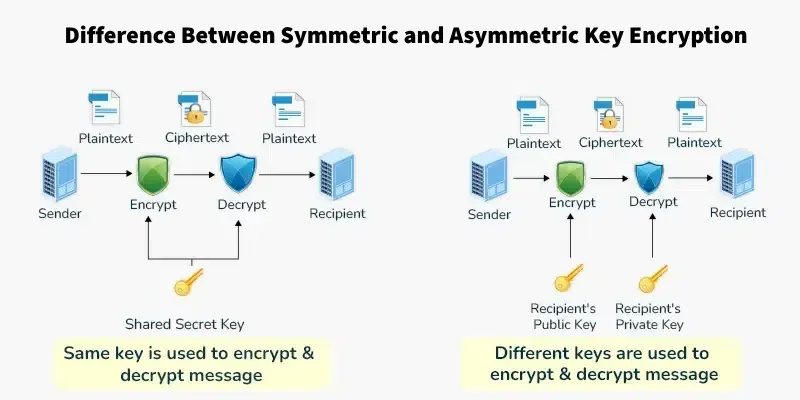
Let's explore each of these in detail.
Symmetric Encryption: The Fast Workhorse
Symmetric encryption is the older and more intuitive of the two methods. It operates on a simple principle: a single, secret key is used for both encrypting the plaintext and decrypting the ciphertext.
Imagine a physical safe box. You use a key to lock the box, and anyone who wants to open it must use the exact same key.
This process generally involves four steps:
- Key Generation: The sender and receiver must agree on a secret key.
- Encryption: The sender uses the secret key and an encryption algorithm to transform the plaintext into ciphertext.
- Transmission: The sender transmits the ciphertext to the receiver.
- Decryption: The receiver uses the same secret key and algorithm to decrypt the ciphertext back into plaintext.
The video below offers a clear, animated explanation of this process.
Encryption - Symmetric Encryption vs Asymmetric Encryption - Cryptography - Practical TLS
This video from the Practical Networking channel provides excellent, simple analogies to explain key-based encryption and then demonstrates how symmetric encryption works.
First, watch the segment on key-based encryption to understand why using a standard algorithm with a secret key is a scalable approach. Then, continue with the section explaining symmetric encryption. Pay close attention to how the same key is used to both "move forward" (encrypt) and "move backward" (decrypt).
Strengths and Weaknesses
The primary strength of symmetric encryption is its speed and efficiency. The algorithms are designed to be fast and require relatively low computational power. This makes symmetric encryption ideal for encrypting large amounts of data, such as entire files, databases, or a continuous stream of data in a communication session. The modern standard for this is the Advanced Encryption Standard (AES).
However, symmetric encryption has a significant and critical weakness: the key exchange problem. Since both parties must have the same secret key, how do you get that key from the sender to the receiver securely? If you send it over an insecure channel (like the open internet), an attacker could intercept it. Once the attacker has the key, they can decrypt all communication. This challenge makes symmetric encryption difficult to use on its own in large, open networks.
The following video powerfully illustrates this exact problem.
Symmetrical vs asymmetrical Encryption Pros and Cons by Example
In this video, Hussein Nasser uses a great safe box analogy for symmetric encryption and then clearly demonstrates why key sharing is its Achilles' heel in a networked environment.
First, watch the initial explanation of symmetric encryption and the common algorithms. Then, watch the segment that highlights the networking problem, where a third party intercepts the shared key. This is the fundamental issue that asymmetric encryption was designed to solve.
Asymmetric Encryption: Solving the Key Exchange Problem
Asymmetric encryption, also known as public-key cryptography, was invented specifically to solve the key exchange problem inherent in symmetric methods. It uses a pair of mathematically related keys: a public key and a private key.
The rules governing this pair are what make it so powerful:
- The public key can be shared freely with anyone. It is used to encrypt data.
- The private key must be kept secret by its owner. It is the only key that can decrypt data encrypted by its corresponding public key.
This creates a "one-way" relationship. Anyone can use your public key to lock a message in a box, but only you, with your secret private key, can unlock it.
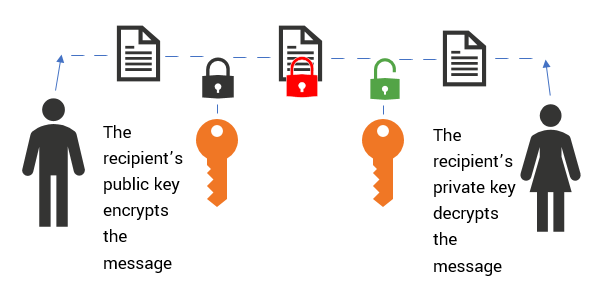
This elegant solution eliminates the need to transmit a secret key over an insecure channel. Here's the typical flow:
- Alice wants to receive a secure message. She generates her own public/private key pair.
- She keeps her private key completely secret.
- She sends her public key to Bob. She can send it over any channel, as it's not a secret.
- Bob uses Alice's public key to encrypt his message to her.
- The resulting ciphertext is sent to Alice.
- Even if an attacker intercepts the ciphertext and Alice's public key, they cannot decrypt the message.
- Only Alice can decrypt the message using her corresponding private key.
Let's return to the Practical Networking video for an animated look at how this works.
Encryption - Symmetric Encryption vs Asymmetric Encryption - Cryptography - Practical TLS
This segment explains the concept of a "trapdoor" function, which is the mathematical foundation for asymmetric encryption, and demonstrates the irreversible nature of encrypting with one key and decrypting with the other.
Watch the section on asymmetric encryption. Focus on how different keys are used for encryption and decryption, and how the public/private key pair is established. The most popular algorithm for this is RSA (Rivest-Shamir-Adleman).
Strengths and Weaknesses
The main strength of asymmetric encryption is that it solves the key distribution problem, enabling secure communication between parties who have no pre-existing trust or secure channel.
However, this security comes at a cost. Asymmetric encryption is computationally intensive and therefore much slower than symmetric encryption. The process also tends to result in larger ciphertext (a phenomenon called ciphertext expansion). This makes it impractical for encrypting large amounts of data.
Bringing It All Together: A Direct Comparison
The two methods are not competitors but rather complementary tools, each suited for different tasks. Your choice depends entirely on the trade-offs between performance and the need for secure key exchange.
Cryptographic Algorithms: Symmetric vs. Asymmetric
This article from testRigor provides a concise yet comprehensive table comparing the features of symmetric and asymmetric cryptography.
Please review the table under the heading Symmetric vs. Asymmetric Cryptography. Focus on the differences in the number of keys, speed, resource utilization, and primary use cases for data size.
To summarize the key distinctions:
| Feature | Symmetric Encryption | Asymmetric Encryption |
|---|---|---|
| Keys | One shared secret key | A pair of keys (public and private) |
| Speed | Fast and efficient | Slow and computationally expensive |
| Use Case | Ideal for bulk data encryption (files, streams) | Ideal for small data (exchanging keys, digital signatures) |
| Key Challenge | Securely distributing the shared key | Keeping the private key absolutely secret |
The Hybrid Solution: The Best of Both Worlds
Given their respective strengths and weaknesses, modern security protocols like TLS/SSL (which secures HTTPS traffic) use a hybrid approach. They combine both methods to achieve security and efficiency:
- Asymmetric encryption is used at the beginning of a session to securely exchange a secret key. For instance, a client uses the server's public key to encrypt a randomly generated session key and sends it to the server.
- The server uses its private key to decrypt this message and retrieve the session key.
- Now that both client and server securely share the same session key, they switch to symmetric encryption for the rest of the communication session, using the faster algorithm (like AES) to encrypt and decrypt the actual data being transferred.
This hybrid model brilliantly leverages the strength of asymmetric encryption for secure key exchange and the strength of symmetric encryption for high-performance bulk data transfer.
Conclusion
In this lesson, we've established the fundamental differences between the two main types of encryption that underpin modern digital security.
Key Takeaways:
- Symmetric Encryption uses a single shared key. It is very fast and efficient, making it ideal for encrypting large volumes of data. Its main weakness is the challenge of securely distributing the shared key.
- Asymmetric Encryption uses a public/private key pair. It solves the key distribution problem, but it is computationally expensive and slow. The public key encrypts, and only the corresponding private key can decrypt.
- Practical Application: In real-world systems like TLS/SSL, a hybrid approach is used. Asymmetric encryption establishes a secure channel to exchange a temporary symmetric key, and then the faster symmetric encryption is used for the actual data communication.
Now that you understand the roles of these cryptographic building blocks, our next lesson will put them into action. We will dissect the TLS/SSL handshake, step-by-step, to see exactly how a client and server use this hybrid model to establish a secure connection over the internet.