Introduction
Hello and welcome back! In our last two lessons, you learned how to define the Optimal Trade Entry (OTE) zone and how to spot the impulsive and corrective price action that creates an OTE setup. You can now identify the 62%-79% retracement zone on a valid price swing—a crucial area where institutions often re-engage with the market.
However, the OTE zone itself can still be quite broad. How can we refine our entries for greater precision and higher probability?
This lesson will teach you how to combine the OTE with two other powerful ICT concepts you've already mastered: Order Blocks (OBs) and Fair Value Gaps (FVGs). By looking for the confluence of these institutional reference points within an OTE zone, you can pinpoint specific, high-value areas for trade entries. This is where the mechanical process of drawing Fibonacci levels transforms into the art of reading the institutional narrative on a chart.
1. The Power of Confluence: Stacking Probabilities
In trading, "confluence" refers to a point on the chart where multiple analytical tools or concepts converge to give the same signal. Think of it as building a case for a trade.
- Price retracing to an OTE is one piece of evidence.
- Price tapping into a Fair Value Gap is another.
- Price reacting from an Order Block is a third.
When two or three of these events happen at the same price level, the probability of that level holding increases significantly. We move from a general "zone of interest" to a specific, high-probability Point of Interest (POI).
This article from Phidias Prop Firm highlights how these concepts work together.
ICT Trading Strategy: Complete Guide for Prop Firm Success
To understand why this works, let's review the idea of confluence. This reading explains how combining concepts like Order Blocks and FVGs creates enhanced, institutional-grade entry zones.
Read the sentences under the 'Fair Value Gaps (FVG) and Imbalances' and 'Identifying High-Probability Setups' headings that explicitly mention confluence. Notice the phrasing: 'FVG confluence with other ICT concepts like order blocks...creates even higher probability setups' and 'Order block confluence with Fair Value Gaps creates enhanced entry zones'.
2. Combining OTE with Fair Value Gaps (FVGs)
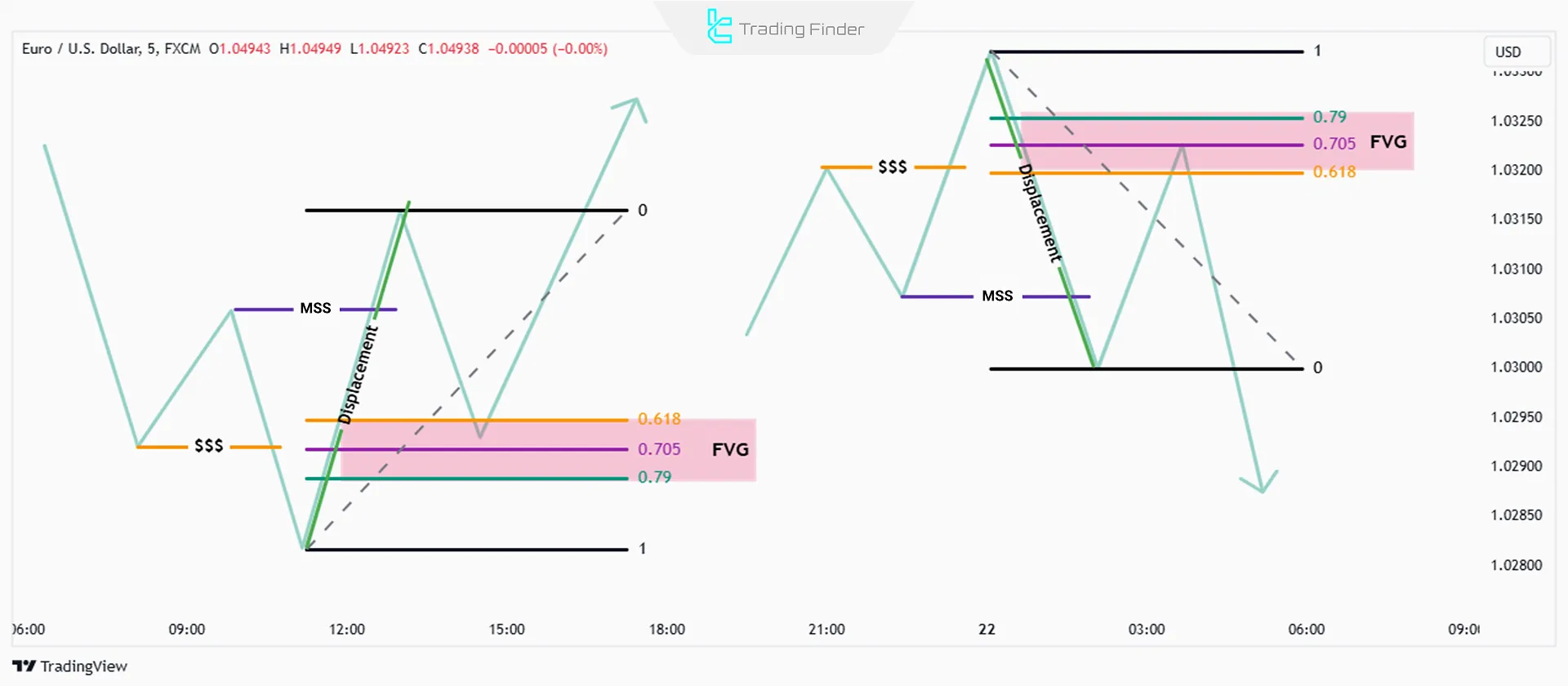
An impulsive move that creates our OTE range is often so aggressive that it leaves behind price inefficiencies, or Fair Value Gaps. When price pulls back, it is often drawn to these gaps to rebalance the market.
When an FVG lies inside an OTE zone, it presents a prime opportunity. This tells us that price is not only returning to an optimal retracement level but is also simultaneously seeking to fill an institutional imbalance.

The following video demonstrates how to spot these overlapping PD Arrays.
Optimal Trade Entry (OTE) - ICT Concepts
Let's watch a practical example of finding an FVG that aligns with an OTE zone.
Watch the segment from 03:50 to 04:59. The presenter explicitly looks to the left within the OTE zone and identifies a Fair Value Gap, noting that this creates 'overlapping confluences'.
3. Combining OTE with Order Blocks (OBs)
Similarly, an Order Block—representing a significant level of institutional supply or demand—can act as a powerful POI within an OTE zone. An OB at the beginning of the impulsive leg that created your OTE range is a particularly strong level.
When price retraces into the OTE and simultaneously tests a valid Order Block, it signals a return to both an optimal price and a key institutional footprint.
This next clip shows how to identify an Order Block that aligns with the OTE zone.
Optimal Trade Entry (OTE) - ICT Concepts
Now, let's see how an Order Block provides confluence for an OTE entry.
Watch from 04:59 to 05:53. Notice how the presenter identifies a large order block. While the opening price is not in the OTE, the mean threshold (50% level) of the order block is, providing a precise point of confluence.
4. Prioritizing Entries: FVG vs. Order Block
You will often find situations where an OTE zone contains both an FVG and an Order Block at slightly different levels. Which one do you prioritize? And how do you confirm the entry?
This is where you need to understand the "rhythm of the market" and use a hierarchy of importance.
-
Context is King: First, always apply your premium and discount analysis. In a bullish OTE setup, you are only interested in FVGs and OBs that are in the discount portion of the range (below 50%). In a bearish OTE, you only care about those in the premium (above 50%).
-
FVGs First: Generally, a Fair Value Gap is considered the first line of defense. Price will often react from an FVG before it reaches a deeper Order Block.
-
Confirmation on Lower Timeframes (LTF): The ultimate confirmation comes from price action itself. When price enters your high-timeframe POI (the FVG or OB within the OTE), you can drop to a lower timeframe (e.g., from 1-hour to 5-minute) and look for a Change of Character (CHoCH) or Market Structure Shift (MSS). This LTF confirmation provides strong evidence that the HTF level is holding.
The following video provides an excellent, in-depth explanation of this entire thought process.
How To Select The Best Between Orderblock and a Fair Value Gap for Trade Entry
This video is crucial for understanding how to select the best entry between an FVG and an OB. It covers premium/discount, the priority of FVGs, and using lower timeframes for confirmation.
This is a longer but very important segment. Watch from 02:47 to 19:00. Focus on these key ideas: Premium & Discount (02:47 - 06:29): How to use the Fibonacci tool to ignore any POIs that aren't in the correct zone (discount for buys, premium for sells). Priority and Definitions (06:29 - 09:16): The presenter states that an FVG comes first in priority before an Order Block. The Rhythm of the Market (09:16 onwards): The core of the video. He demonstrates dropping down to lower timeframes (1H -> 15m -> 5m) to find a change of character that confirms the entry at the higher timeframe FVG.
5. A Complete Top-Down Walkthrough
Let's solidify this with a step-by-step example that ties all these concepts together, from the high-level daily chart down to an hourly entry.
The process generally looks like this:
- Daily Chart: Identify the overall trend and a daily OTE range. Find any major daily PD arrays (like an order block or breaker block) that align with this OTE.
- Hourly Chart: Drop down to the hourly chart as price enters the daily OTE zone. Look for confirmation, such as a Market Structure Shift (MSS).
- Entry Refinement: Once you have the MSS, you can use a more refined entry technique, such as entering on a retracement to a new FVG created by the MSS move.
This article provides a superb text and chart-based example of this exact process.
Optimal Trade Entry in ICT - What Is It and How Does It Work?
This article provides a clear, documented example of combining OTE with other ICT concepts in a top-down analysis.
Read the section titled 'Combining the OTE With Other ICT Concepts'. Study the charts and the accompanying text carefully. Note how they start with a daily OTE confluent with a breaker and order block, then use an hourly Market Structure Shift and FVG for the final entry.
Conclusion
Today you've made a significant leap from simply identifying a zone to pinpointing a precise entry point. By demanding confluence between an OTE and an FVG or Order Block, you dramatically increase the odds of your analysis being correct. This layering of concepts is fundamental to the ICT methodology.
Key Takeaways:
- Confluence is Key: A high-probability setup occurs when an OTE overlaps with another institutional reference point like an FVG or an Order Block.
- Always Use Premium/Discount: Filter your potential entries by ensuring they are in the appropriate part of the range (premium for shorts, discount for longs).
- Prioritize and Confirm: Treat FVGs as the first potential reaction point. Use lower timeframe market structure shifts to confirm that your higher timeframe POI is being respected before entering.
- Top-Down Approach: This method works best when you start on a higher timeframe to find your OTE and context, then drill down to lower timeframes for precision entry.
Preview of the Next Lesson:
You now have a powerful method for identifying high-probability entry points. But where do you place your stop loss? A well-placed stop loss is just as important as a good entry. In the next lesson, we will cover how to determine logical stop loss placement using ICT concepts to protect your capital while giving your trade idea enough room to play out.