Introduction
Hello and welcome back. In our last lesson, we focused on increasing the precision of your trade entries by combining the Optimal Trade Entry (OTE) zone with the confluence of Order Blocks (OBs) and Fair Value Gaps (FVGs). You now have a robust framework for identifying high-probability points of interest where institutions are likely to engage with the market.
However, a high-probability entry is only one part of a complete trade plan. Equally important is knowing precisely where your trade idea is invalidated. This lesson focuses on the other side of the trade: determining logical stop loss placement using ICT concepts.
A stop loss is not just a mechanism to prevent catastrophic loss; in the ICT methodology, it represents the specific price level that, if breached, proves your initial analysis and trade thesis wrong. We will explore how to place stops based on the very structure and PD arrays that inform your entry, ensuring your risk is defined by logic, not by arbitrary percentages or monetary values.
1. The Core Principle: Invalidation, Not Hope
Before we dive into specific techniques, it's crucial to adopt the institutional mindset toward stop losses. A stop loss is your pre-defined invalidation point. If you enter a long trade based on a bullish order block, you are hypothesizing that this level will act as support. If price trades cleanly through the low of that order block, your hypothesis is wrong. Your stop loss should be placed there to exit the trade mechanically, without emotion.
The goal is to place your stop at a logical point that gives your trade idea room to work but exits you as soon as the premise is broken.
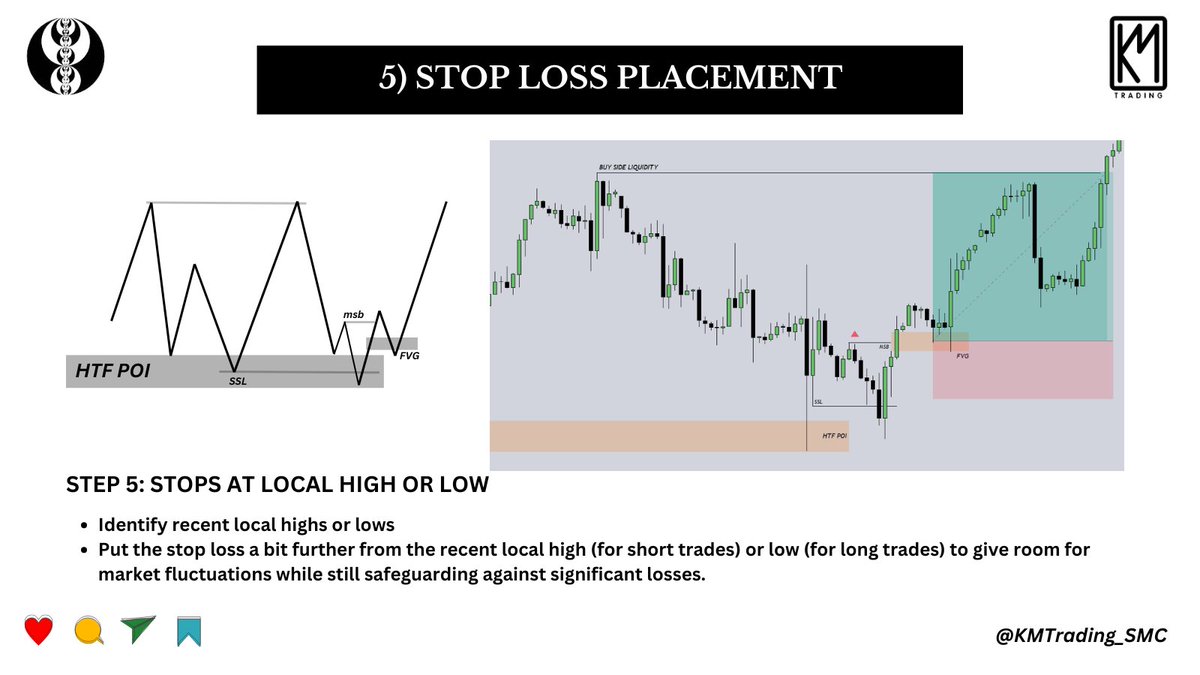
2. Placing Stops with Protected Swings
One of the most robust ways to place a stop loss is by identifying a protected swing. A protected swing high or low is a pivot in the market that, according to market structure theory, should not be violated if the current trend is to continue.
- In a bullish trend, a protected low is formed after price sweeps liquidity or reacts from a discount PD array and then displaces higher, creating a break in market structure. The stop loss for a long trade goes below this protected low.
- In a bearish trend, a protected high is formed after a liquidity sweep or a reaction from a premium PD array, followed by a displacement lower. The stop loss for a short trade goes above this protected high.
The following video provides an excellent and comprehensive guide to identifying protected swings and using them to define your invalidation point.
Stop Losses in Trading: Know When You're Wrong
This video from TTrades, titled 'Stop Losses in Trading: Know When You're Wrong,' will be our primary guide for this section. It explains how a protected swing serves as your trade's invalidation point and walks through several real-chart examples.
Please watch the entire video (approximately 16 minutes). Pay close attention to: The Definition (00:00 - 02:19): Understand the criteria for a swing to be considered 'protected.' Notice the link between a protected swing and your trade invalidation. Long Example (02:19 - 06:33): Observe how a protected low is identified and used for stop placement in both reversal and continuation entries. Refining for R:R (08:15): The presenter discusses waiting for a continuation entry because the initial stop placement offered poor risk-to-reward. This is a key professional consideration. Short Example (10:15 - 12:53): See how the same logic applies to a short trade, using a protected high. V-Shape Reversals (15:50): Note the discussion on placing a tighter stop on aggressive V-shape reversals, accepting more risk of being wicked out for a better R:R.
3. Stop Placement Relative to Your Entry PD Array
While a protected swing gives you the overall invalidation for the structural leg, you can often refine your stop placement by anchoring it to the specific PD array you used for your entry (e.g., an Order Block or FVG).
This is especially useful when your entry is a precise tap of an OB or FVG that is located within a larger price swing.
Stop Losses for Order Blocks
The article below details three common methods for placing a stop when your entry is based on an Order Block.
Order Block Explained - Alchemy Markets
The 'Order Block Explained' article from Alchemy Markets offers a concise breakdown of risk management specific to order block trading. Let's focus on its section about stop losses.
Read the section titled 'Risk Management When Trading Order Blocks'. It outlines three distinct methods for stop placement. Understand the 'why' behind each one: Outside the Order Block: The most conservative and common approach. Beyond the Consequent Encroachment: A tighter stop used with precision entries at the 50% level. FOLS Method (Fear of Liquidity Sweep): A more advanced technique to avoid being stopped out by common stop hunts.
Stop Losses for Fair Value Gaps
When you enter on a Fair Value Gap, your stop loss logic is similar. You believe the imbalance will be respected.
Stop Losses, Placement & Trailing - ICT Concepts
This short clip explains the two primary options for placing a stop when entering from an FVG within a market structure shift model.
Watch from 00:17 to 01:27. The presenter outlines two choices: Place the stop above/below the candle that created the FVG. Place the stop above/below the short-term high/low. The second option is more conservative and often aligns with the protected swing high/low.
4. An Introduction to Trailing Stops
Initial stop placement is about defining where you are wrong. Trailing stops, on the other hand, are about protecting your profit and managing the trade once you are right.
The basic ICT-aligned method for trailing a stop loss is based on market structure.
- Enter the trade with your initial stop loss set at the invalidation level.
- Wait for price to move in your favor and create a new, clear break of structure.
- Once this occurs, you can move your stop loss to a logical new location, such as breakeven or just behind the new swing that broke structure.
This transforms your trade from having risk to being "risk-free" (in terms of original capital) and allows you to capture more of a large, trending move.
Stop Losses, Placement & Trailing - ICT Concepts
Let's return to the TTrades video 'Stop Losses, Placement & Trailing' to see how this works in practice.
Watch from 01:27 to 04:32. Focus on the core rule presented: Only move your stop once structure is broken. Observe how the stop is moved progressively behind the newly formed (and now protected) swing points.
This concept of dynamic risk management is also highlighted in the "Understanding ICT Trading Fundamentals" text, framing it as a professional protocol. Moving your stop to breakeven after the trade has moved a certain amount is a key step in capital preservation.
Conclusion
You have now learned the logical framework for defining risk in an ICT context. A well-placed stop loss is not a sign of fear, but a mark of professional discipline. It is your commitment to a trading plan and the acknowledgement that no single trade idea is guaranteed.
Key Takeaways:
- Invalidation is Key: Your stop loss must be placed at the price level that logically invalidates your trade thesis.
- Use Protected Swings: The most robust invalidation points are the protected swing highs and lows that define the current market structure.
- Anchor to Your PD Array: For more precision, place your stop just beyond the specific Order Block or FVG that you used for your entry.
- Balance Risk and Probability: A wider, more conservative stop (e.g., below the full swing low) has a higher probability of not being hit by noise, but a worse risk-to-reward ratio. A tighter stop improves R:R but increases the chance of being stopped out by a liquidity-seeking wick.
- Trail for Management: Once a trade is confirmed by a new break of structure, trail your stop loss to protect capital and lock in profits.
Preview of the Next Lesson:
With a logical entry and a logical stop loss defined, one crucial question remains: How much should you trade? The distance between your entry and your stop loss is a critical input for calculating your trade size. In the next lesson, we will cover how to calculate position size based on defined risk parameters, bringing all the elements of trade execution together.