Introduction
Welcome back! In our previous lesson, we defined the ICT Turtle Soup pattern, breaking down its components and the market context that makes it a high-probability setup. You learned that it's a strategic false breakout pattern designed to capitalize on liquidity sweeps, confirmed by a reversal and a market structure shift.
Today, we move from theory to practice. This lesson is entirely focused on the "how" of trading this pattern. Our goal is to equip you to execute trades using the Turtle Soup pattern, including defining your entry, stop loss, and profit targets. We will build on the foundation of the previous lesson and integrate concepts like Market Structure Shift (MSS) and Fair Value Gaps (FVG) to create a clear, actionable trading plan.
1. The Core Execution Logic: From Sweep to Entry
As we discussed, a Turtle Soup isn't just a sweep of a high or low; it's the reaction afterward that provides the trade. The core logic involves waiting for confirmation that the liquidity grab was indeed false and that the market's intent has shifted.
The most fundamental confirmation is the Market Structure Shift (MSS) that you learned about in Module 2.
Here is the basic sequence for execution:
- Identify a Higher Timeframe (HTF) Liquidity Pool: Mark a significant swing high (buy-side liquidity) or swing low (sell-side liquidity) on a chart like the 4-hour or Daily.
- Wait for the Liquidity Sweep: Observe price trading through this level.
- Wait for Confirmation (MSS): After the sweep, watch for price to reverse and break the swing point that was created just before the sweep. This is your MSS.
- Execute the Trade: Enter on a retracement after the MSS has occurred.
The article from FluxCharts, which you read in the last lesson, provides a concise summary of these rules.
ICT Turtle Soup Strategy Explained: How to Identify and Trade It
Let's quickly review the specific trade execution rules from the FluxCharts article. This will serve as our foundational framework.
Read the section titled 'How to Trade the ICT Turtle Soup'. Note the direct relationship it describes between the MSS, entry, stop loss placement (beyond the liquidity level), and the target (opposing liquidity).
This image perfectly illustrates the concept. The 'Turtle Soup' is the initial sweep, but the entry is taken only after the Market Structure Break (MSB/MSS) confirms the reversal of intent.

2. A Concrete Model: The Asian Session Turtle Soup
To make this practical, let's examine a very specific and popular application of the Turtle Soup strategy that uses the Asian session range. This model provides clear, non-negotiable rules for identifying liquidity and setting a daily bias.
The following video from Trading Neighbor provides a complete, step-by-step guide to this specific model. It's an excellent example of a rule-based system.
ICT Turtle Soup Explained & Backtested (Real Data)
This video breaks down a powerful Turtle Soup variation. We will watch it in segments to understand the rules for both bullish and bearish scenarios.
Please watch the following parts: 00:53 - 01:26: Understand how to define the Asian session range, which serves as our initial liquidity pool. 01:26 - 03:50: Pay close attention to the bearish scenario. Notice the sequence: Asia low is swept first, setting a bearish bias. Then, the entry is framed only after the Asia high is swept. 03:50 - 05:12: Watch the bullish scenario, which is the mirror opposite. Asia high is swept first (bullish bias), then the entry is framed after the Asia low is swept. Focus on the two entry models presented: one based on a Market Structure Shift, and the other on a 'double purge' pattern.
Let's summarize the key execution rules from the video:
The Setup (15-Minute Chart):
- Mark the high and low of the Asian Session (defined as 8 PM - Midnight New York time).
Execution Logic (Bearish Example):
- Set Bias: Price sweeps the Asian session low first. Your bias for the day is now bearish. You are anticipating a move lower.
- Wait for Manipulation: Do not trade yet. Wait for price to rally up and sweep the Asian session high. This is the manipulation move, the Turtle Soup against the Asian high.
- Confirm & Enter: After the Asian high is swept, look for one of two confirmations to enter a short trade:
- MSS Confirmation: A swing low is broken (MSS), and you enter on a retracement back to the Asian high level.
- Double Purge Confirmation: Price forms another small high above the Asian high and sweeps it, then a candle closes back inside the Asian range. You enter on a retracement to the Asian high level.
- Stop Loss: Place your stop loss above the high created during the manipulation move.
- Target: Your primary target is the swing low that was formed after the initial sweep of the Asian low.
The bullish scenario is the exact opposite. This model provides a clear "if-then" process for determining bias and timing your entry.
3. Refining Your Execution
The models above give you a solid framework. Now, let's refine the three key elements—entry, stop loss, and target—using other concepts you've learned.
Entry Refinement
The Asian Range model suggests entering on a retest of the high/low level itself. While effective, you can often find more precise entries inside the displacement leg that caused the MSS. Look for:
- Fair Value Gaps (FVGs): A powerful displacement will often leave an FVG. Entering as price retraces into this FVG can offer a high-precision entry.
- Order Blocks: The last opposing candle before the displacement is a bullish or bearish Order Block that can serve as a sensitive entry point.
This chart shows a bearish Turtle Soup where the entry could be taken at the retest of the swept high, but an even better entry might be found at the bearish order block created just after the sweep.
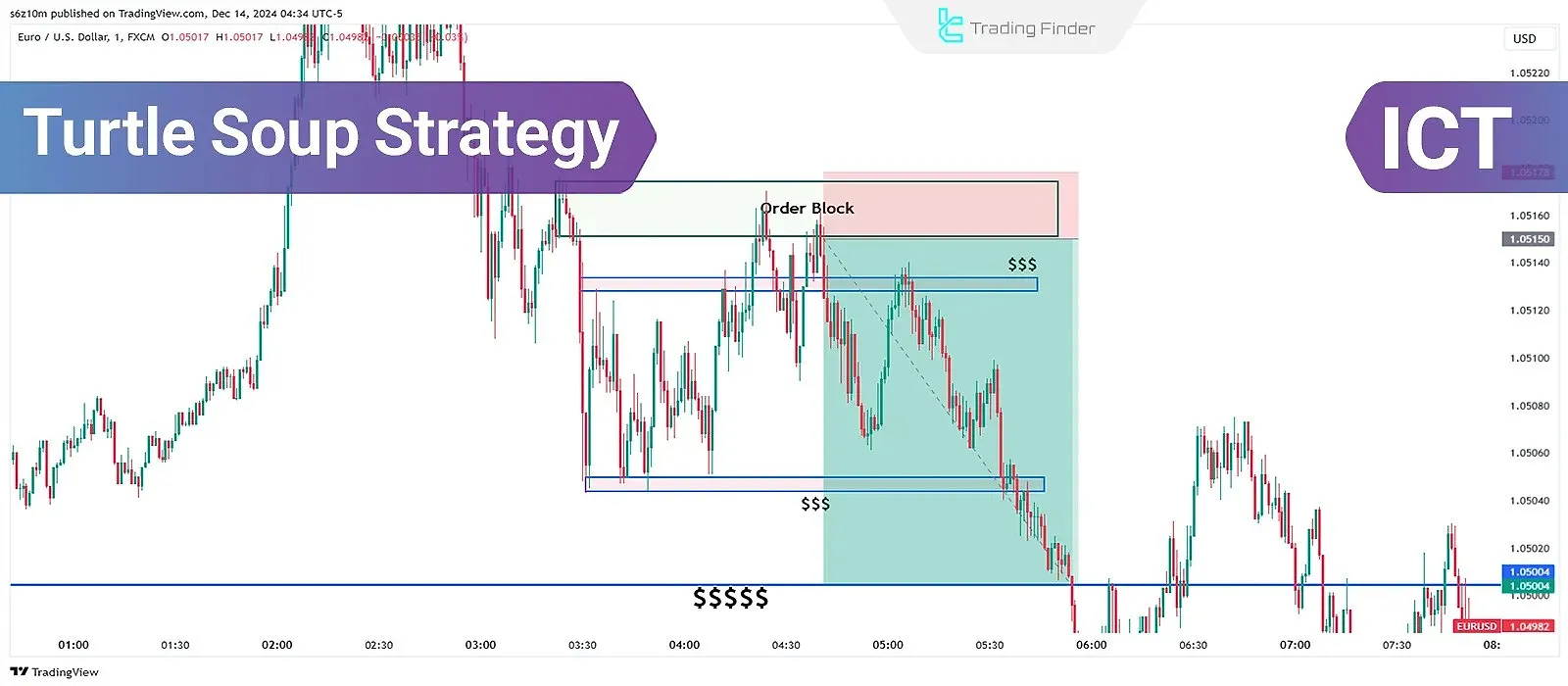
Stop Loss Refinement
Your stop loss should always go beyond the liquidity sweep high/low. However, sometimes that swing point is very far away, leading to a large stop and poor risk-to-reward ratio.
ICT Turtle Soup Explained & Backtested (Real Data)
Let's revisit the Trading Neighbor video to see a practical example of how to manage this problem.
Watch the clip from 09:01 to 11:46. The narrator encounters a setup where the swing low is too far for a good stop loss. Notice how he uses a Fair Value Gap and an Order Block as a 'protective' barrier, allowing him to place a much tighter stop loss.
This is a critical skill. By identifying other ICT arrays between your entry and the swing high/low, you can place a more logical and efficient stop loss, improving your potential return on risk.
Target Refinement
The primary profit target for a Turtle Soup is the opposing significant liquidity pool.
- For a bullish Turtle Soup (sweeping a low), target a significant buy-side liquidity pool above.
- For a bearish Turtle Soup (sweeping a high), target a significant sell-side liquidity pool below.
In addition to this primary target, consider:
- Taking Partials: You can take partial profits at logical levels, such as the 50% equilibrium of the price leg.
- Moving to Breakeven: As the Trading Neighbor video mentions, once the trade moves in your favor (e.g., by a 1:1 risk-to-reward ratio), moving your stop loss to your entry price removes risk from the trade. We will cover this trade management technique in detail in Module 12.
4. A Trade Execution Checklist
To bring everything together, here is a step-by-step checklist to use when looking to execute a Turtle Soup trade.
-
Context Check:
- What is the Higher Timeframe (4H/Daily) directional bias? Are you trading in alignment with it?
- Is price trading at a Premium (for shorts) or Discount (for longs) of the current dealing range?
- Are you in a high-probability Killzone (London or New York)?
-
Setup Identification:
- Have you marked a clear and obvious pool of buy-side or sell-side liquidity on the HTF chart?
-
Trigger:
- Has price swept this liquidity level? Was it a clean wick, or a full body closure? (Wicks are preferred).
-
Confirmation:
- Did price aggressively reverse away from the sweep, creating displacement?
- Has price created a Market Structure Shift (MSS) on your entry timeframe (e.g., 15-min)?
-
Execution Plan:
- Entry: Identify your entry point within the retracement. Will you enter at the swept level, an FVG, or an Order Block?
- Stop Loss: Place your stop loss logically beyond the high/low of the sweep. Can it be refined?
- Target: Define your primary profit target at the opposing liquidity pool.
By systematically answering these questions, you move from just seeing a pattern to executing a well-reasoned, high-probability trade.
Conclusion
You now have a complete framework for executing one of ICT's core reversal patterns. You've learned how to move from identifying the context to pulling the trigger with a clear plan for entry, risk, and profit.
Key Takeaways:
- Execution Sequence: The core execution model is: HTF Liquidity Sweep -> Confirmation via Market Structure Shift -> Entry on Retracement.
- Entry Points: Entries can be taken on a retest of the swept level itself, or more precisely at PD arrays like Fair Value Gaps or Order Blocks created during the reversal.
- Stop Loss Placement: The default placement is beyond the high/low of the sweep, but it can be tightened by using protective PD arrays.
- Profit Targets: The primary objective is always the opposing pool of liquidity.
Preview of the Next Lesson:
The Turtle Soup pattern is a foundational model. In our next lesson, we will learn the ICT 2022 Mentorship Model. You will see how it uses the same core ingredients—a liquidity sweep and a market structure shift—but arranges them in a specific sequence to create another powerful entry template.