Introduction
Welcome to the next lesson in our exploration of foundational ICT trading models. In the previous two lessons, we thoroughly examined the "Turtle Soup" pattern, understanding it as a reversal strategy that capitalizes on false breakouts at key liquidity levels. You learned to identify the pattern and, crucially, how to execute a trade based on it by waiting for a Market Structure Shift (MSS) as confirmation.
Today, we will dive into what is arguably the most popular and versatile ICT strategy of recent years: the ICT 2022 Mentorship Model. The learning outcome for this lesson is to be able to outline the sequential steps of this model.
You will find that the 2022 model uses the exact same ingredients we've already mastered: a liquidity sweep, a market structure shift, and a retracement to a price imbalance like a Fair Value Gap (FVG). However, it arranges them in a specific, highly structured sequence to frame a high-probability trade. Think of it as a precise recipe built from familiar components. Understanding this sequence is the key to adding this powerful tool to your trading arsenal.
1. The Core Sequence: The Three Essential Steps
At its heart, the ICT 2022 Model is a three-step process that confirms a potential shift in order flow. It begins with an action (the liquidity sweep) and looks for a specific reaction (the MSS and displacement) to validate a trade idea.
The following video provides an exceptionally clear and concise breakdown of this core logic.
How to Trade the ICT 2022 Model • ICT Concepts
Let's start by watching this short clip from DanDowdTrading. It perfectly explains the fundamental three-step sequence for both bullish and bearish scenarios. Pay close attention to the specific order of events.
Watch the segment from 00:07 to 01:33. Focus on memorizing the three key components and their order: Run on Liquidity: Sweeping a significant low (for a bullish setup) or high (for a bearish setup). Market Structure Shift (MSS): Breaking a short-term swing point in the opposite direction. Fair Value Gap (FVG): The creation of a three-candle imbalance within the price leg that causes the MSS.
To summarize this core logic:
-
Bullish 2022 Model:
- Price takes out sell-side liquidity (sweeps a significant low).
- Price energetically displaces higher, causing a Market Structure Shift by breaking a recent swing high.
- This displacement creates a Fair Value Gap, which becomes the point of interest for a long entry.
-
Bearish 2022 Model:
- Price takes out buy-side liquidity (sweeps a significant high).
- Price energetically displaces lower, causing a Market Structure Shift by breaking a recent swing low.
- This displacement creates a Fair Value Gap, which becomes the point of interest for a short entry.
This sequence confirms that institutional order flow (the "smart money") has likely engineered liquidity and is now repricing the market in a new direction. The FVG is their footprint.
2. The Prerequisite: Establishing Directional Bias
Having the three-step pattern is not enough. Applying it without understanding the broader market direction is like having a map without knowing your destination. This is where daily bias comes in—a concept we introduced in Module 8.
Before you even begin looking for the 2022 model, you must have a hypothesis for where the market is likely to draw to on a higher timeframe. Is it targeting a major weekly high? Or an old daily low?
How to Trade the ICT 2022 Model • ICT Concepts
Let's hear from DanDowdTrading again on why bias is the non-negotiable first step. This separates mechanical pattern recognition from professional, context-driven trading.
Watch from 01:33 to 02:11. The key message is that the 2022 model is not a standalone pattern; it is a confirmation tool that you hunt for after you have established a directional bias.
Therefore, the true first step of the ICT 2022 Model is:
Step 0: Determine the higher timeframe Draw on Liquidity and establish your daily bias.
If you have a bullish bias, you will be looking for bullish 2022 models to form at discount price levels. If you have a bearish bias, you will look for bearish 2022 models at premium levels.
3. A Complete Trading Checklist
Now, let's combine the core logic and the prerequisite of bias into a comprehensive, step-by-step checklist. This provides a structured process that you can follow from session open to trade execution.
ICT 2022 Mentorship – The Ultimate Guide to ICT Trading Strategies
The following article from TradingFinder provides a very well-structured, written guide to the 2022 model. We'll focus on their step-by-step process for the London Session, which serves as a perfect template.
First, read the section titled 'London Session Trading Strategy (Step-by-Step Process)'. This provides a clear, 7-step sequence. Then, in the FAQs at the bottom, read the answer to 'How Does the ICT 2022 Strategy Work?' for a concise summary.
Based on this and other resources, here is a consolidated checklist outlining the sequential steps of the model:
-
Define Context (Time & Price):
- Time: Are you in a high-probability Killzone (London or New York)?
- Price: Mark out key higher timeframe liquidity levels (e.g., previous day's high/low, session highs/lows). This is your potential "Draw on Liquidity" (your target) and the levels that might be swept to initiate a move.
-
Wait for the Liquidity Sweep:
- Patiently observe as price attacks one of the key liquidity levels you identified. For example, during the London Killzone, you might wait for price to sweep the high or low of the preceding Asian session.
-
Confirm with a Market Structure Shift (MSS):
- After the sweep, drop to a lower timeframe (e.g., 1-minute to 5-minute).
- Wait for price to reverse and break a short-term swing point against the direction of the sweep. Crucially, this break must be energetic, creating a displacement.
-
Identify the Point of Interest (POI):
- Look within the price leg that caused the MSS. Identify a clean Fair Value Gap (FVG). This FVG is your high-probability entry zone. Other PD Arrays like an Order Block or Breaker Block can also be used.
-
Frame the Trade:
- Wait for price to retrace back into the identified FVG. This is where the entry order would be placed. (We will cover the specifics of execution in the next lesson).
4. Visualizing the Sequence: The 2022 Model Flowcharts
For someone with a business background, flowcharts are an excellent way to visualize a process. The following images map out the entire decision-making logic for the ICT 2022 Model.
Bullish (Buy) Model Flowchart
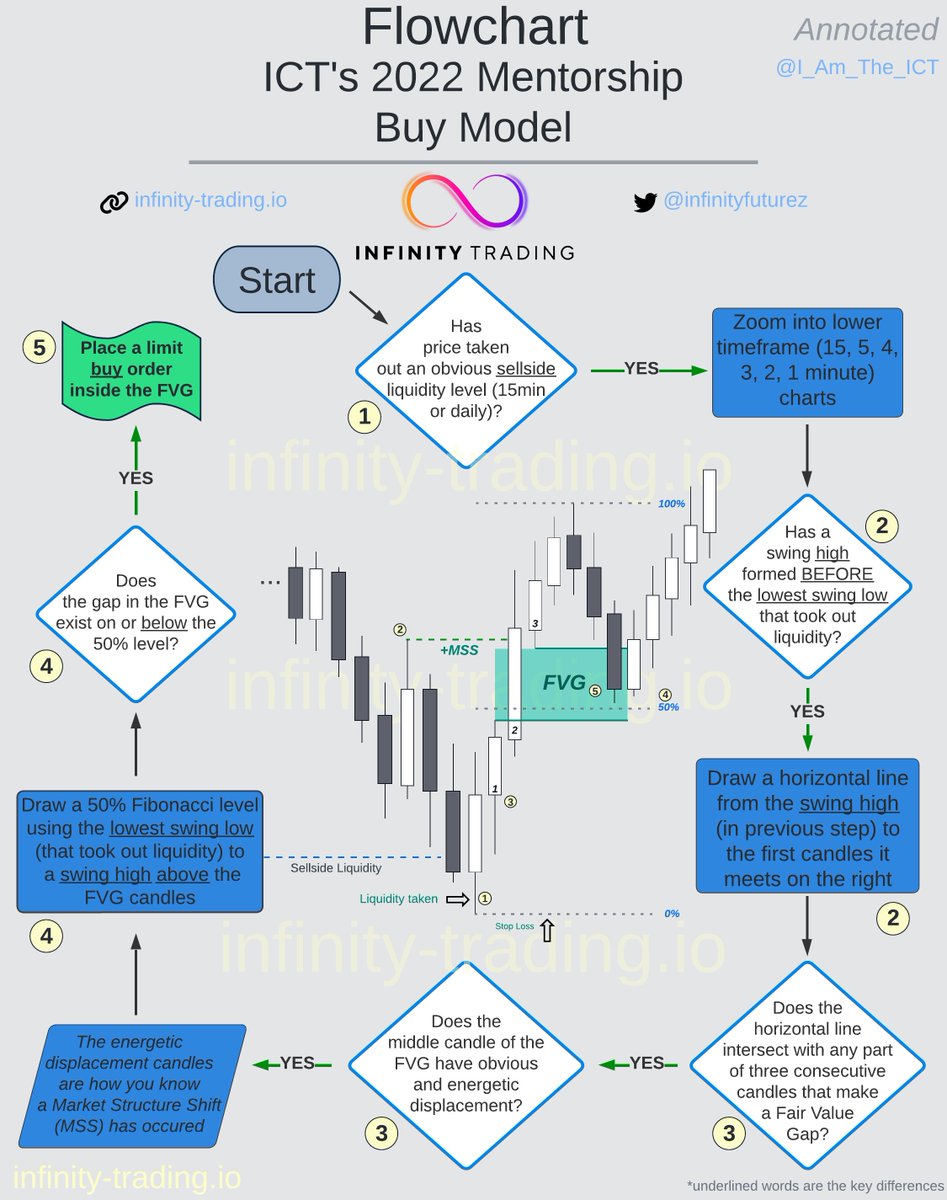
Let's walk through it:
- "Obvious Sellside Liquidity Pool Taken?" -> This is our Step 2: Liquidity Sweep.
- "Identify Swing High before the lowest Swing Low" and "Draw a horizontal line" -> This is part of identifying the swing point for the Step 3: Market Structure Shift.
- "Does middle candle of FVG have energetic displacement?" -> This confirms the "D" in MSS + D (Market Structure Shift with Displacement) and validates the Step 4: Identify POI.
- "Place a limit BUY order inside the FVG" -> This is Step 5: Frame the Trade.
Bearish (Sell) Model Flowchart

These flowcharts are powerful tools. They transform the model from a loose concept into a rigorous, repeatable process, which is essential for consistent trading.
Conclusion
Today you have learned the specific, sequential recipe for one of ICT's most effective trading models. By breaking it down into a clear checklist and visualizing it with flowcharts, you can see how it's a logical process of action and confirmation.
Key Takeaways:
- The Core Sequence: The model is defined by a specific order of events:
- A higher timeframe Liquidity Sweep.
- A lower timeframe Market Structure Shift with Displacement.
- A retracement into the Fair Value Gap created by that displacement.
- Bias is Step Zero: The model should only be used to enter in the direction of your pre-determined higher timeframe bias. It is a confirmation tool, not a crystal ball.
- Time and Price are Key: The model is most effective when applied at specific times (Killzones) and at specific price levels (session highs/lows, daily highs/lows).
Preview of the Next Lesson:
Now that you can outline the steps of the model, the next lesson will focus on action. We will learn how to execute a 2022 Model entry as price retraces into a displacement-created Fair Value Gap, covering precise entry techniques, logical stop loss placement, and how to define profit targets.