Introduction
Welcome to the final lesson in our module on Optimal Trade Entry and Execution. In our last sessions, we assembled the critical components of a trade plan: you know how to identify a high-probability entry using Optimal Trade Entry (OTE), how to set a logical stop loss to define your risk, and how to calculate the correct position size to control that risk. There's just one piece missing: knowing when and where to exit for a profit.
This lesson is dedicated to that final step: setting profit targets using opposing liquidity levels and price action arrays. Once you master this, you will have a complete framework for defining a trade from start to finish, allowing you to calculate your risk-to-reward ratio and execute with clarity and discipline. We will explore how price is algorithmically drawn towards specific levels and how you can use this understanding to select logical take-profit points.
1. The Draw on Liquidity: The Market's Destination
In the ICT framework, price does not move randomly. It is delivered by an algorithm that seeks liquidity. The entire basis for selecting a profit target is to identify where the market is most likely headed next. This destination is called the Draw on Liquidity (DOL).
Your job as a trader is to anticipate this draw. Once you have a trade entry, your profit target is simply the next logical DOL in the direction of your trade. These draws on liquidity can be categorized into two main types:
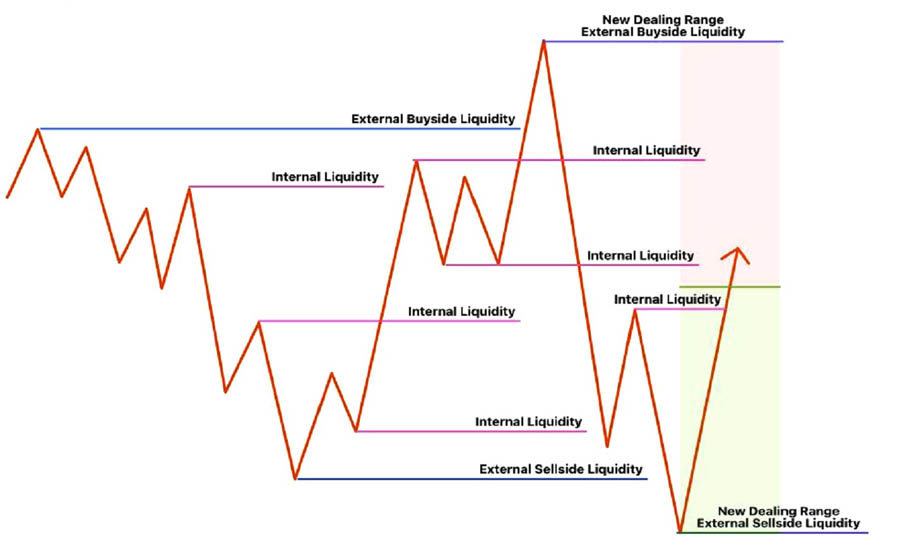
- External Range Liquidity: Pools of resting orders that exist outside the current trading range. These are found above old swing highs (buy-side liquidity) and below old swing lows (sell-side liquidity).
- Internal Range Liquidity: Pockets of inefficiency that exist inside the current trading range. These are ICT price action arrays like Fair Value Gaps (FVGs), Order Blocks, and Volume Imbalances.
To start, let's get a clear definition of these concepts.
Draw on Liquidity (DOL) - ICT Concepts
The video 'Draw on Liquidity (DOL) - ICT Concepts' by TTrades provides a concise overview of the types of liquidity that price seeks out. This will form the foundation for our targeting strategy.
Watch the segment from 00:51 to 01:24. The narrator clearly lists the key forms of external and internal liquidity that serve as targets. Keep a mental list of these as we will be exploring them throughout the lesson.
The image below provides a great visual distinction between these two types of liquidity. Price will often clear out internal liquidity before making a move toward external liquidity, or vice versa.
2. Targeting External Liquidity: The Obvious Target
The most straightforward and common profit targets are pools of external liquidity.
- If you are in a long position, your logical target is an old swing high or a set of equal highs. This is where breakout traders have their buy-stop entry orders and where short-sellers have their protective buy-stop loss orders.
- If you are in a short position, your logical target is an old swing low or a set of equal lows, where sell-side liquidity rests.
When you exit your trade at these levels, you are "unloading" your position to other participants. If you are long, you are selling to the buyers who are entering on the "breakout" above the old high.
ICT Mentorship Core Content - Month 04 - Liquidity Pools
The founder of ICT, Michael Huddleston, explains this concept clearly in his mentorship content. He details how to think about where other traders' orders are resting and how to use that to your advantage.
Watch from 03:14 to 07:04. Focus on his explanation of where buy-stops and sell-stops are located. Understand that when we target an 'old high,' we are really targeting this pool of buy-stop orders.
Let's look at a practical example where a trade is entered after a run on sell-side liquidity and the profit target is set at the opposing buy-side liquidity.
ICT Mentorship Core Content - Month 04 - Liquidity Pools
This clip from the same ICT video demonstrates a complete trade idea, from entry to exit, based on targeting opposing liquidity pools.
Watch the example on the CAD/USD pair from 12:48 to 16:13. Notice how the entry is taken below an old low (raiding sell-stops) and the profit target is explicitly set at an old swing high 'where buy stocks would be resting.' This is the core principle in action.
3. Targeting Internal Liquidity and PD Arrays
Sometimes, the most logical first target is not an external high or low. Price may need to rebalance an inefficiency within the current range first. These inefficiencies are the ICT Price Delivery (PD) Arrays you have learned about.
Common internal liquidity targets include:
- Fair Value Gaps (FVGs) or Imbalances
- Order Blocks (Bullish or Bearish)
- Breaker Blocks
- Mitigation Blocks
- Volume Imbalances
The image below shows the "menu" of PD arrays that can act as support, resistance, or a draw on liquidity. When price is moving towards one of these arrays, it can be considered a valid, high-probability target.

Let's see this applied in a real chart analysis.
Draw on Liquidity (DOL) - ICT Concepts
Let's return to the TTrades video. He provides an excellent walkthrough of reading price action and anticipating the next draw, which is often an internal PD array.
Watch from 01:24 to 05:45. Pay attention to how he identifies displacement and then targets the next logical level. Notice that his targets aren't always old highs/lows; he frequently targets Fair Value Gaps and other internal points as the draw on liquidity.
4. Framing Targets with Premium & Discount
To increase the probability of your target being met, you should frame it within the context of Premium and Discount zones. As you learned in Module 4, the market seeks to reprice from overvalued (premium) to undervalued (discount) levels, and vice versa.
This gives us a simple but powerful rule for targeting:
- If you buy in a Discount zone, you should target an array in the Premium zone.
- If you sell in a Premium zone, you should target an array in the Discount zone.
This ensures you are capturing the most probable swing in price as it moves from one state of valuation to another.
Premium and Discount Zones in ICT PD Array Trading
This article from 'Forexfactory' on Premium and Discount zones explicitly mentions their use as take-profit levels.
Read the section 'What Are Premium and Discount Zones?'. The key takeaway is the direct statement that Premium Zones 'indicate take-profit levels for buyers,' and Discount Zones 'indicate take-profit levels for sellers.' This confirms the logic of buying low and selling high.
5. Setting Final and Partial Profit Targets
You don't have to choose only one target. A professional trade management approach often involves taking partial profits. This means closing a portion of your position at an intermediate target and letting the remainder of the position run to a final target.
- Intermediate Target (Partial Profit): Often an internal PD array, like a significant Fair Value Gap or Order Block.
- Final Target: Typically a major external liquidity level, like a clear daily high or low.
This approach allows you to secure profit and reduce risk while still participating in a larger potential move.
Liquidity Sweep Trading Strategy: Complete ICT Guide 2025
The article 'Liquidity Sweep Trading Strategy' has a fantastic section that perfectly summarizes this concept of using both intermediate and final targets.
Find the subheading 'Advanced Entry Techniques For Trade Execution' and read the paragraph immediately following it. It succinctly explains that while the 'obvious target is the opposing liquidity level,' you should consider taking partial profits at intermediate FVGs or order blocks. This is a key trade management skill.
Here is a hypothetical example from the same article that shows a full trade plan, including an explicit take-profit target based on this logic.
Liquidity Sweep Trading Strategy: Complete ICT Guide 2025
Review this trading example to see how a target is defined within a complete trade structure.
Read 'Example 1' under the 'Hypothetical Trading Examples' section. Notice the clean structure: an entry after a liquidity sweep, a defined stop loss, and a 'Take profit' set at 'the nearest opposing liquidity pool above.' This is the template you should aim to create for every trade.
Conclusion
You have now learned the final component required to build a complete trade plan. By identifying the draw on liquidity, you can move beyond guessing where to take profit and start setting objective, high-probability targets based on the market's own logic.
Key Takeaways:
- Your Target is the Draw on Liquidity (DOL): Price moves algorithmically from one liquidity pool to another. Your profit target should be the next logical DOL.
- Identify Your Target Type: Targets can be external (old highs/lows, equal highs/lows) or internal (FVGs, Order Blocks, and other PD arrays).
- Frame with Premium & Discount: For long positions taken in a discount, target arrays in the premium. For short positions taken in a premium, target arrays in the discount.
- Plan for Partials: Use prominent internal arrays (like a clean FVG) for taking partial profits, and use major external liquidity for your final target. This secures profit while allowing for larger gains.
Preview of the Next Lesson:
With a complete framework for defining a trade—Entry, Stop Loss, Position Size, and Take Profit—we are now ready to move into Module 10 and study specific, repeatable ICT Trading Models. We will begin with a classic reversal pattern known as the 'Turtle Soup', which is built directly on the concept of raiding external liquidity.