Introduction
Welcome to the next lesson in our exploration of foundational ICT models. In the previous lessons, you've mastered the ICT 2022 Mentorship Model, learning how to identify a higher timeframe liquidity sweep, confirm it with a lower timeframe Market Structure Shift, and execute a trade upon a retracement to a Fair Value Gap (FVG).
Today, we will focus on a highly specific, time-based strategy developed by ICT known as the 'Silver Bullet'. While it utilizes many of the concepts you're already familiar with—like liquidity and Fair Value Gaps—its primary characteristic is that it occurs only within three distinct one-hour windows each trading day.
Your goal in this lesson is to learn the fundamental characteristics of the Silver Bullet strategy and, most importantly, to identify the precise time windows when these opportunities appear. This will lay the groundwork for the next lesson, where we'll cover the execution details.
1. Defining the ICT Silver Bullet
The Silver Bullet is a time-based trading model. ICT refers to it as an "algorithmic" model not because you need to code a bot, but because price action tends to follow a repeatable, predictable pattern at specific times of the day. It's designed to be a high-probability scalping strategy that targets short-term moves towards liquidity.
Let's hear the definition from the source. The following video by The Inner Circle Trader introduces the model and its core requirements.
2023 ICT Mentorship - ICT Silver Bullet Time Based Trading Model
In '2023 ICT Mentorship - ICT Silver Bullet Time Based Trading Model', Michael Huddleston (ICT) introduces the strategy. As you watch, pay attention to how he defines it as a 'time-based algorithmic trading model' and the minimum 'framework' or potential profit he looks for in different asset classes.
Watch the first 3 minutes and 47 seconds of the video (00:06 - 03:47). Focus on understanding the concept of a minimum trade framework and the relationship between 'handles' in indices and 'pips' in Forex.
As ICT explained, the strategy is built on a simple premise: at certain times, the market is highly likely to make a move towards a pool of liquidity. Our job is to identify that "draw on liquidity" and find an entry.
2. The Core Components: Liquidity and Fair Value Gaps
Like the 2022 Model, the Silver Bullet strategy revolves around two concepts you've already mastered:
- A Draw on Liquidity: The setup begins with a clear reason for price to move. The algorithm is seeking liquidity, and this gives our trade a logical target.
- A Fair Value Gap (FVG): The entry mechanism is a Fair Value Gap. After price makes an initial move towards liquidity, it will often leave an FVG. A retracement into this gap provides the entry point.
The types of liquidity the Silver Bullet targets are the same ones we've discussed throughout this course.
2023 ICT Mentorship - ICT Silver Bullet Time Based Trading Model
In the same video, ICT lists the various types of liquidity pools that can serve as the target for a Silver Bullet setup. This will be a good review of the concepts from Module 3.
Watch the segment from 03:47 to 07:54. Notice how he lists previous day/session highs/lows and inefficiencies (like other FVGs) as potential targets.
The key is to combine these price concepts with the most important filter of all: time.
3. The Silver Bullet Time Windows
The defining characteristic of the Silver Bullet strategy is that setups are only valid if they form within one of three specific one-hour windows. Any setup that looks like a Silver Bullet but occurs outside these times is not a valid setup according to the model's rules.
All times must be synchronized to New York Local Time (EST/EDT). This is a non-negotiable rule to ensure you are watching the market at the correct moments.
The three Silver Bullet windows are:
- London Open Silver Bullet: 3:00 AM - 4:00 AM NY Time
- New York AM Session Silver Bullet: 10:00 AM - 11:00 AM NY Time
- New York PM Session Silver Bullet: 2:00 PM - 3:00 PM NY Time
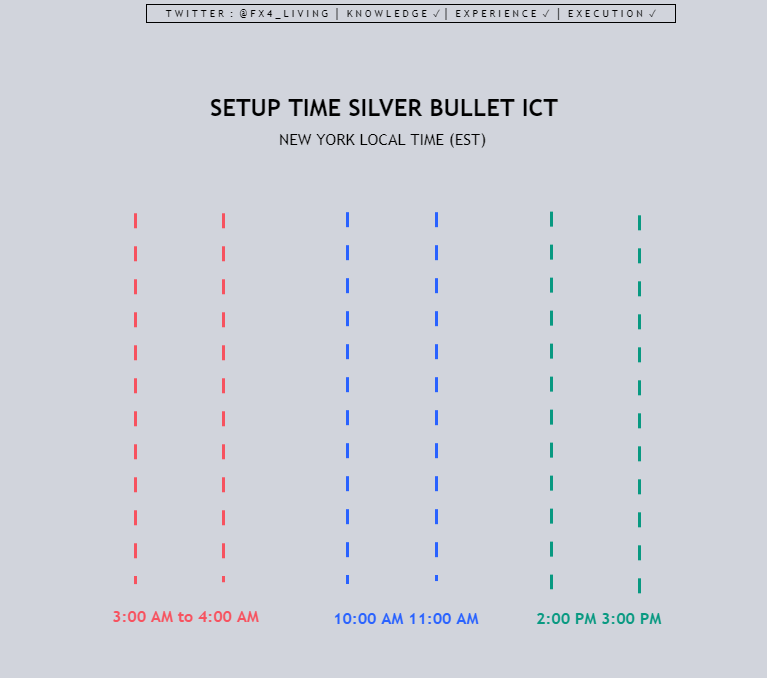
To solidify your understanding, let's watch ICT walk through each of these windows with chart examples.
2023 ICT Mentorship - ICT Silver Bullet Time Based Trading Model
Continuing with the same mentorship video, ICT now details each of the three time windows. He shows an example for each, explaining how a Fair Value Gap forms within the specified hour, providing a potential trade setup.
Watch the video from 07:54 to 16:04. For each of the three setups (London, AM, PM), take note of the specific 60-minute window and how he identifies the FVG that forms within it. Notice that the trade may last longer than the one-hour window, but the setup itself must form during that time.
A Note on Daylight Saving Time
You may wonder how Daylight Saving Time (DST) affects these windows. The rule is simple: always follow New York local time. Whether New York is on Eastern Standard Time (EST) or Eastern Daylight Time (EDT), the windows remain 3-4 AM, 10-11 AM, and 2-3 PM in that time zone. Your charting platform should be set to UTC-4 or UTC-5 (America/New_York) to avoid any confusion.
Master ICT Silver Bullet Strategy – Step by Step Guide for 2025
The article 'Master ICT Silver Bullet Strategy' provides a helpful explanation of this and a clear table summarizing the time windows. This will serve as a great text-based reference.
First, review the table under the heading 'ICT Silver Bullet Times' to see a clear layout of the three sessions. Then, read the section 'How does Daylight Saving Time Affect ICT Silver Bullet Times?' to reinforce the importance of always syncing to New York's local time.
4. The Basic Framework
Now, let's put these pieces together into a simple framework. How do the characteristics of time, liquidity, and imbalances combine into a potential setup?
- Timing: Be at your charts during one of the three Silver Bullet hours.
- Liquidity: Identify a recent sweep of a key liquidity pool (e.g., the high or low of the previous session).
- FVG Formation: Look for a Fair Value Gap to be created within the one-hour window that shows a willingness to move away from the liquidity just taken.
The following video provides a very clear, beginner-friendly checklist that simplifies this process.
ICT Silver Bullet Strategy Simplified For Beginners (FULL TRADING PLAN)
The video 'ICT Silver Bullet Strategy Simplified For Beginners' breaks down the strategy into a simple checklist. This will help you understand the logical flow from one step to the next.
Watch from the beginning to 03:00. Pay close attention to the simple rules: prepare at 9:30 AM, check if a session high/low has been taken, and then wait for a 5-minute FVG to form within the 10-11 AM or 2-3 PM window. This simplifies the core logic.
Here is a chart that visualizes these components working together during the AM session.

Conclusion
In this lesson, you have learned the defining characteristics of the ICT Silver Bullet strategy. It is not just another entry pattern but a time-sensitive model that requires discipline and precision. By focusing your attention on these specific one-hour windows, you can filter out market noise and concentrate on high-probability moments when the market algorithm is likely to act.
Key Takeaways:
- The ICT Silver Bullet is a time-based scalping strategy designed to capture short-term moves.
- The core components are a draw on liquidity (the target) and a Fair Value Gap (the entry mechanism).
- Setups are only valid if they form within one of three specific one-hour windows, based on New York local time:
- London Open: 3:00 AM - 4:00 AM
- New York AM: 10:00 AM - 11:00 AM
- New York PM: 2:00 PM - 3:00 PM
Preview of the Next Lesson:
Now that you know what the Silver Bullet is and when to look for it, the next step is to learn how to trade it. In our next lesson, we will focus on the practical execution: how to enter the trade, where to place your stop loss for protection, and how to set logical profit targets.