Introduction
Welcome back! In our previous lessons on the ICT 2022 Mentorship Model, we've pieced together the opening moves of this powerful setup. First, you learned to spot the initial trigger: a higher timeframe liquidity sweep. Then, you learned to identify the confirmation: a lower timeframe Market Structure Shift (MSS) driven by clear displacement.
Today, we complete the sequence. We'll focus on the final and most crucial step: executing the trade. You will learn precisely how to enter the market as price retraces into the Fair Value Gap (FVG) that was created by the displacement move. This lesson brings together concepts from market structure, liquidity, premium/discount, and imbalances into a single, actionable entry model. By the end of our session, you'll understand the complete "A to Z" process of a 2022 Model entry.
1. The Entry Point: The Displacement-Created FVG
Let's recap the sequence so far:
- Price raids a significant liquidity pool (e.g., a previous day's high).
- It then reverses direction and breaks a recent swing point with displacement (the MSS).
This aggressive displacement move is the signature of institutional intent. It is so one-sided that it leaves behind inefficiencies in the market. As you learned in Module 6, the most important of these is the Fair Value Gap (FVG). This FVG, born from the displacement that confirmed our MSS, becomes our high-probability point of interest (POI) for trade entry.
The core idea is simple: we wait for the market to retrace back into this FVG to "rebalance" the price action before continuing in the new direction. This retracement is our opportunity to join the move.
2. Refining the Entry Zone: The Role of Premium & Discount
While the FVG tells us where to look for an entry, the concepts of Premium and Discount (from Module 4) tell us which FVGs are valid. This is a critical filter that significantly increases the probability of success.
- For a short (sell) trade, we only want to enter if the FVG is located in a Premium market (above the 50% equilibrium level of the displacement move). Selling at a high price is a better deal.
- For a long (buy) trade, we only want to enter if the FVG is located in a Discount market (below the 50% equilibrium level of the displacement move). Buying at a low price is a better deal.
To determine this, we use the Fibonacci tool, drawing it from the start to the end of the displacement leg that caused the Market Structure Shift.
The following resource provides a clear, step-by-step guide for both bullish and bearish setups, emphasizing this exact point.
2022 Model ICT Entry Strategy [TradingFinder] One Setup For Life
The TradingView post titled '2022 Model ICT Entry Strategy' provides an excellent textual breakdown of how to execute both bullish and bearish setups. It clearly explains the role of the FVG in conjunction with Premium and Discount zones.
Please read the two sections: 'Bullish ICT 2022 Model Setup' and 'Bearish ICT 2022 Model Setup'. Pay close attention to how they describe waiting for price to retrace into an FVG that is located within the Discount Zone (for buys) or the Premium Zone (for sells).
3. Execution: Entry, Stop Loss, and Take Profit
Once you've identified a valid FVG in the correct Premium/Discount zone, it's time to execute the trade. This involves three components:
-
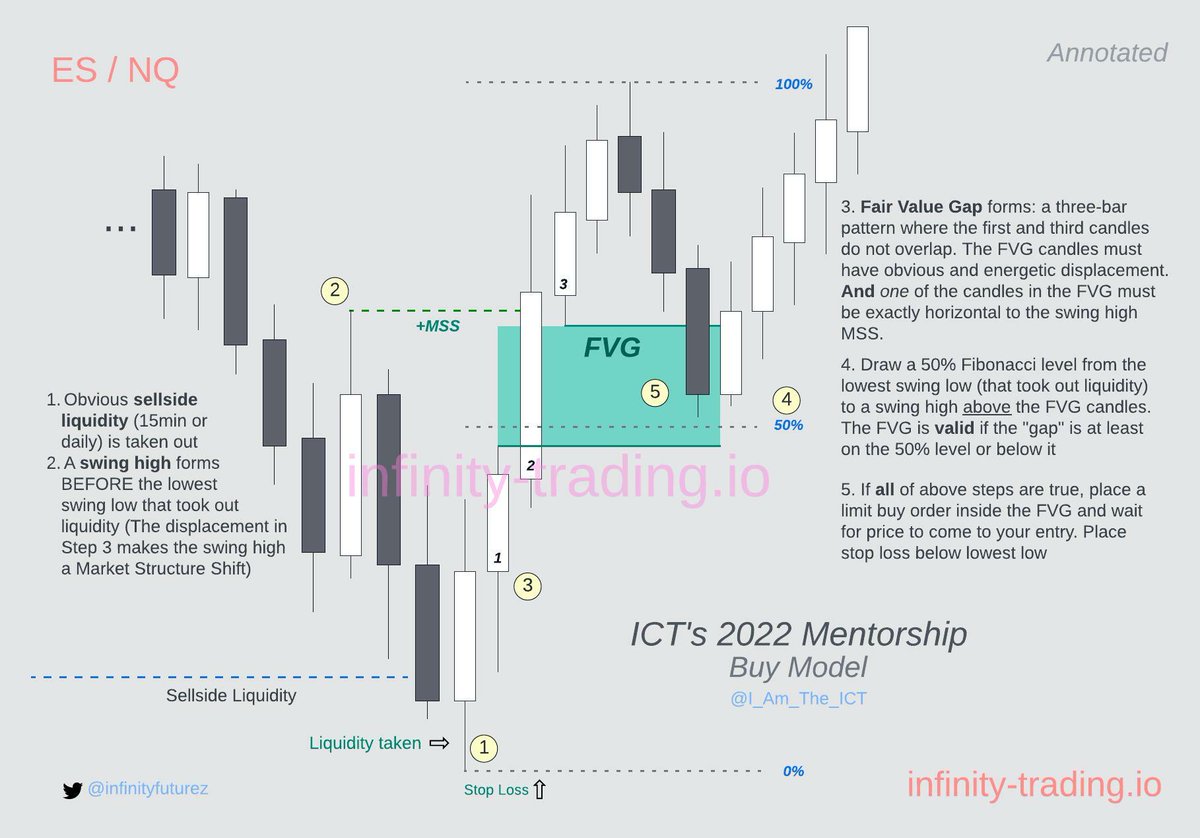
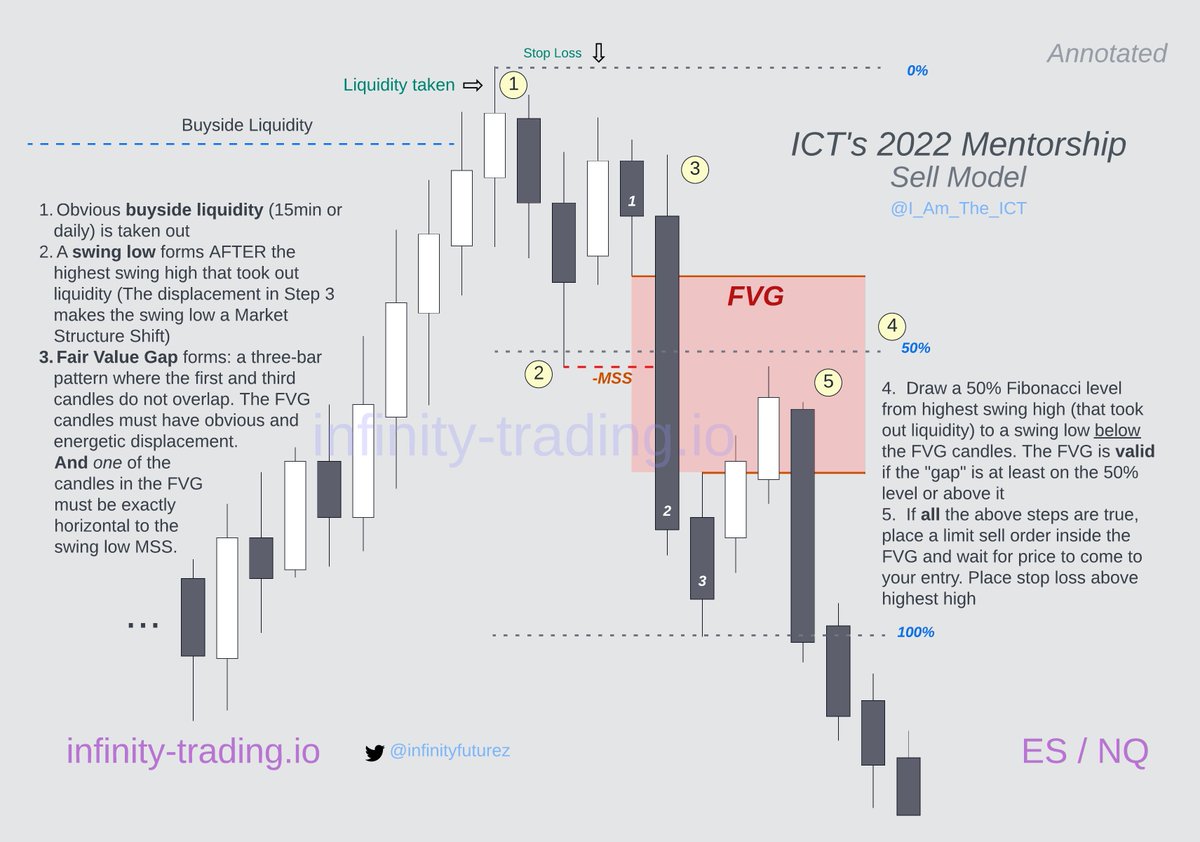
Entry: The most common method is to place a limit order at the edge of the FVG closest to the current price. For a more precise entry, some traders aim for the FVG's Consequent Encroachment (the 50% level of the gap), but entering at the beginning of the FVG ensures you don't miss the trade if the retracement is shallow.
-
Stop Loss: Your stop loss must be placed at a logical structural point that invalidates the trade idea.
- For a buy trade, the stop loss goes below the swing low that performed the liquidity sweep.
- For a sell trade, the stop loss goes above the swing high that performed the liquidity sweep.
Placing it anywhere else (e.g., just below the FVG) exposes you to being stopped out by a deeper retracement before the real move begins.
-
Take Profit: Your target should be a significant, opposing liquidity pool. This is the "draw on liquidity" that is pulling price in the first place.
- After a buy entry, you would target a clear buy-side liquidity pool (e.g., an old high).
- After a sell entry, you would target a clear sell-side liquidity pool (e.g., an old low).
The following images provide a perfect visual summary of these rules for both buy and sell models.
4. Video Walkthroughs
Reading about a model is one thing; seeing it applied on a chart is another. The following video demonstrates the complete process, from identifying the liquidity grab to executing the entry within the FVG, for both long and short trades.
A+ ICT Entry Checklist - ICT Concepts
The video 'A+ ICT Entry Checklist' by TTrades provides excellent, concise examples of the 2022 model in action. It perfectly demonstrates how to use the Fibonacci tool to confirm the premium/discount context before entering on the FVG.
Please watch the two examples from 00:26 to 03:40. In the first example (short), notice how he draws the Fib from the high to the low of the displacement leg and identifies the FVG in the premium. In the second example (long), he does the opposite, finding an FVG in the discount. Observe his placement of the entry, stop loss, and profit targets in both cases.
For another perspective and reinforcement of these rules, this next video also provides a great explanation.
Struggling with Entries?? | Master ICT 2022 Entry Model
In 'Master ICT 2022 Entry Model', KessioTrades clearly explains the logic behind stop loss and take profit placement, which will solidify your understanding.
Watch the section from 01:44 to 03:47. Focus on the explanation of where to place the stop loss (above/below the high/low that created the sweep) and where to set the take profit (using higher timeframe liquidity levels). This reinforces the logic of the model's risk management.
Conclusion
You have now learned the complete sequence for executing a trade using the foundational ICT 2022 Mentorship Model. By waiting for price to retrace into a displacement-created Fair Value Gap, you are entering on a pullback in alignment with the newly established institutional order flow. This method provides a clear, rule-based framework for high-probability trading.
Key Takeaways:
- The entry point for the 2022 Model is the Fair Value Gap (FVG) created by the displacement move that caused the Market Structure Shift.
- The entry must be contextualized using Premium and Discount. You only buy from an FVG in a discount zone and sell from an FVG in a premium zone.
- Stop Loss is placed logically beyond the swing point that swept the initial liquidity, protecting you from deeper retracements.
- Take Profit is targeted at opposing liquidity pools, which provides a logical objective for the trade.
- The full sequence is: HTF Sweep -> LTF MSS with Displacement -> Retracement to FVG in Premium/Discount -> Execute Trade.
Preview of the Next Lesson:
Now that you have mastered the foundational 2022 Model, we will explore a more specific, time-based variation. In the next lesson, we will define the characteristics and time windows for the 'Silver Bullet' strategy, which applies these same principles within very specific one-hour windows during the New York session for short-term opportunities.