Introduction
Welcome to the next step in mastering the ICT 2022 Mentorship Model. In our last lesson, we focused on the trigger for the entire setup: identifying a valid higher timeframe liquidity sweep. You learned to mark key levels like the previous day's high or low and watch for price to raid that liquidity, not as a breakout, but as a precursor to a reversal.
Today, we'll build directly on that by focusing on the second critical step in the sequence: recognizing the lower timeframe market structure shift (MSS) required for the 2022 Model.
If the liquidity sweep is the question ("Is the market about to reverse?"), the Market Structure Shift is the answer. It's the confirmation that the reversal has begun and provides the first tangible sign that smart money is shifting the market's direction. Mastering this step is essential to avoid "jumping the gun" and to validate that the liquidity sweep was genuine.
1. What is a Market Structure Shift?
In the context of the 2022 model, a Market Structure Shift (MSS) is the moment price breaks a recent, significant swing point on a lower timeframe (like the 1, 3, or 5-minute chart) after the higher timeframe liquidity sweep has occurred.
- After a bullish liquidity sweep (taking sell-side liquidity below a low), the MSS is a break of a recent swing high.
- After a bearish liquidity sweep (taking buy-side liquidity above a high), the MSS is a break of a recent swing low.
This concept is the cornerstone of confirming a change in direction. Let's start with a formal definition.
ICT Market Structure Shift Explained
The article 'ICT Market Structure Shift Explained' provides clear definitions for the key components of an MSS. Understanding these building blocks is the first step.
Please read the sections 'What is ICT Market Structure Shift in Trading?', 'How to Identify an ICT MSS?', and 'ICT MSS Types'. Pay close attention to the definitions of a Swing High, Swing Low, and especially the 'Displacement Move'.
As you just read, the break of a swing point alone isn't enough. The character of that break is what separates a true shift from a false signal. This brings us to the most important concept of this lesson.
2. The Key Ingredient: Displacement
The single most critical element of a valid MSS is displacement.
Displacement is a strong, energetic, one-sided move in price. It's characterized by large-bodied candles that leave behind an imbalance or a Fair Value Gap (FVG). This signifies that institutional order flow has entered the market aggressively, leaving little room for opposition. A weak, hesitant break of a swing point is not an MSS; it's just noise. A break with displacement is a clear signal.
The following video provides an excellent explanation of what displacement looks like on a chart.
Market Structure Shift - ICT Concepts
The video 'Market Structure Shift - ICT Concepts' by TTrades does a great job of defining and showing examples of displacement as the engine behind a market structure shift.
Watch the first two sections of the video (00:21 - 02:50). Focus on how the narrator defines displacement as an 'aggressive move with full-bodied candles' and how it's used to identify the MSS. Notice the strong link he makes between displacement and the formation of Fair Value Gaps.
To put it simply: No displacement, no valid Market Structure Shift. This is the primary filter you will use.
Let's look at a complete picture. The chart below shows the sequence: the liquidity sweep (from our last lesson) followed by a clear MSS with displacement.
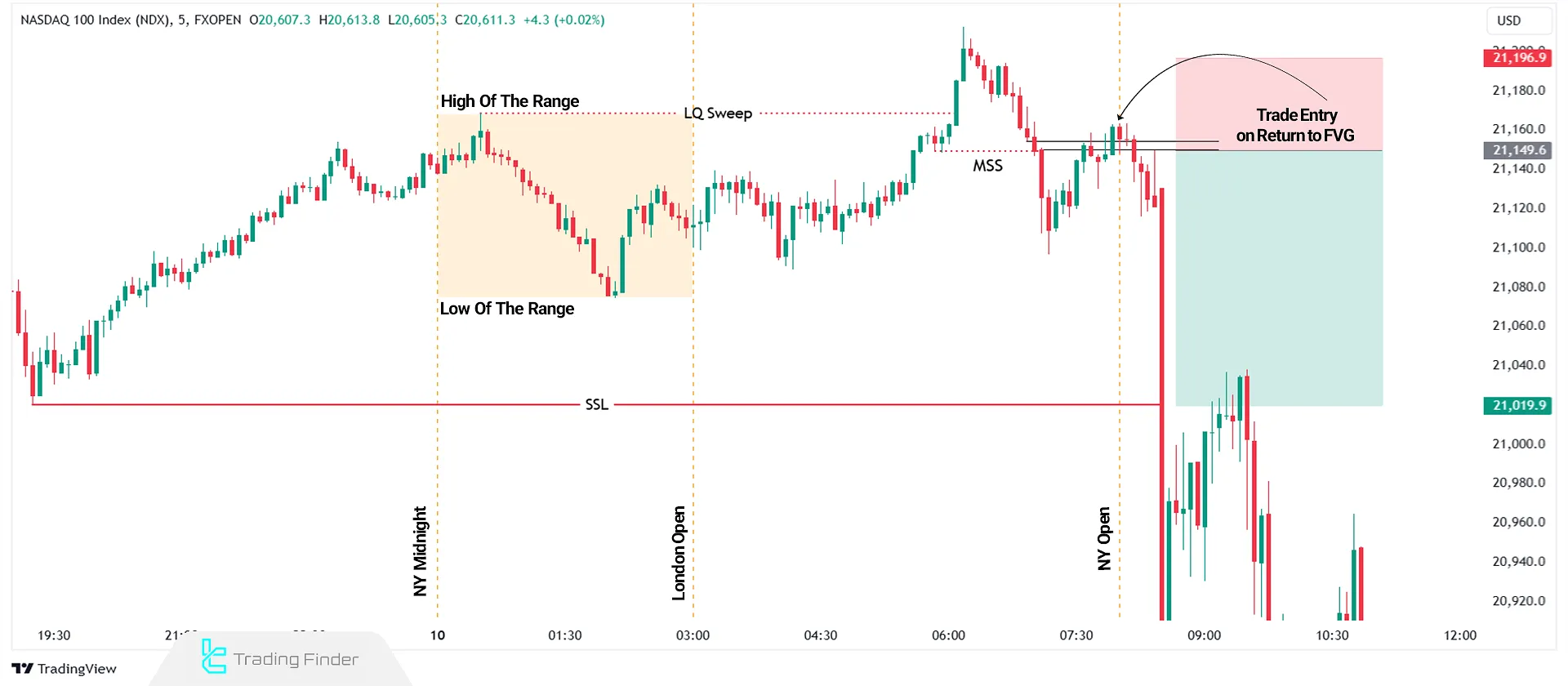
3. How to Spot a Valid MSS in Real-Time
Now, let's get practical. How do you identify this on your chart as it's happening? The process follows the flowchart of the 2022 model.
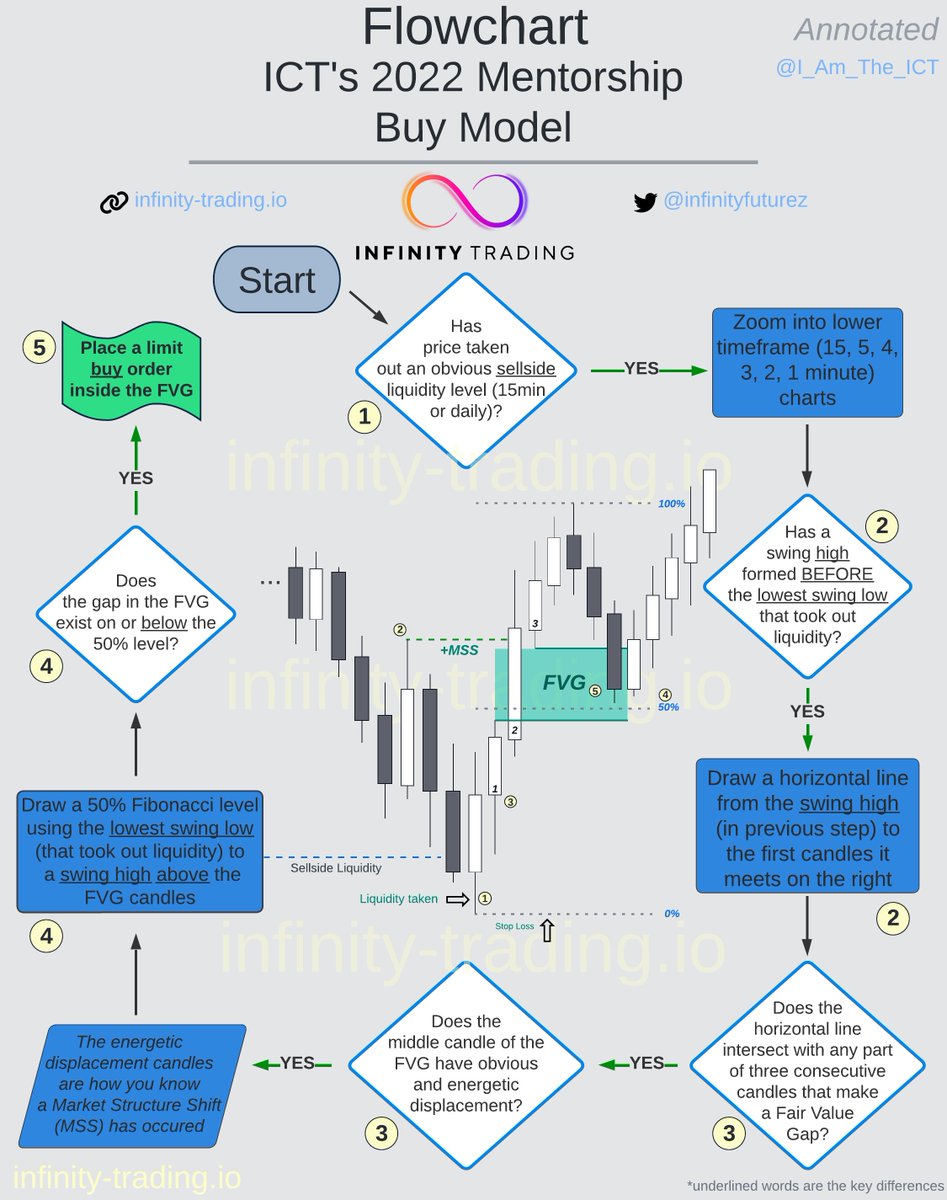
The following video is an excellent guide to distinguishing valid shifts from false ones. It's crucial to watch this carefully to train your eye for what matters.
Spotting VALID Market Structure Shifts (ICT)
The video 'Spotting VALID Market Structure Shifts (ICT)' from the Trade for Opportunity channel is dedicated to this exact topic. It will show you multiple examples of valid shifts and, just as importantly, examples of what a false shift looks like.
Please watch from the beginning to 03:49. Pay close attention to: The Definition (0:00 - 0:35): Note the emphasis on a 'quick' and 'energetic' move. Valid Bullish MSS Examples (0:35 - 1:42): See how price takes sell-side liquidity, then moves energetically above an old high, leaving behind Fair Value Gaps. Valid Bearish MSS Example (1:42 - 2:46): Observe the rapid move lower after a high is taken, again creating imbalances. False MSS Examples (2:46 - 3:49): This is a critical section. Notice the lack of energy, the small candle bodies, and the absence of clear displacement. The narrator correctly points out these are not valid signals.
The Process Summarized:
- Wait for the HTF Liquidity Sweep: This is your context. Let's say price sweeps the previous day's high during the London Killzone.
- Drop to a Lower Timeframe: Switch to your execution timeframe (e.g., 1M, 3M, or 5M). Resource LINK under "Key Timeframes" confirms these are the correct charts for spotting the MSS.
- Identify the Swing Point: Mark the most recent, clear swing low that formed just before or during the sweep of the high.
- Watch for Displacement: Wait for price to break below that swing low with large, energetic candles.
- Confirm with an FVG: A true displacement move will almost always leave a Fair Value Gap in its wake. This FVG becomes our point of interest for entry, which we will cover in the next lesson.
Conclusion
You have now learned to identify the second and arguably most important part of the 2022 Model's entry sequence. The Market Structure Shift is your confirmation that institutional sponsorship is likely behind the reversal you are anticipating. Without this confirmation, a liquidity sweep is just a sweep, not a trade setup.
Key Takeaways:
- An MSS is a break of a recent lower-timeframe swing point that occurs after a higher-timeframe liquidity sweep.
- The non-negotiable ingredient for a valid MSS is displacement—an energetic, aggressive price move.
- Displacement is visually identified by large-bodied candles and the creation of a Fair Value Gap (FVG).
- A weak or slow break of a swing point is an invalid MSS and should be ignored, as it could be simple inducement rather than a true reversal.
- The sequence is always: 1. HTF Sweep -> 2. LTF MSS with Displacement.
Preview of the Next Lesson:
We have our trigger (the sweep) and our confirmation (the MSS). The displacement that created the MSS also left behind a high-probability entry zone. In our next lesson, we will focus on the final step of the entry model: how to execute a 2022 Model entry as price retraces into the displacement-created Fair Value Gap.