Introduction
Welcome back! In our previous lesson, we defined the ICT Silver Bullet strategy, establishing it as a time-based model focused on three specific one-hour windows each day. You learned what the Silver Bullet is and, crucially, when to look for it. We identified the core components: a draw on liquidity and a Fair Value Gap (FVG) for entry.
Today, we transition from theory to practice. This lesson is all about execution. You will learn the step-by-step process for trading the Silver Bullet model, from identifying a valid setup in real-time to managing the trade. By the end of this lesson, you will be able to execute the Silver Bullet strategy by targeting short-term liquidity within its designated one-hour window.
1. The Silver Bullet Execution Framework
Executing the Silver Bullet strategy requires a systematic, rule-based approach. While the context can vary, the sequence of events you look for is consistent. Let's break it down into a repeatable checklist.
The Five-Step Execution Checklist:
- Time: Be at your charts during one of the three Silver Bullet windows (3-4 AM, 10-11 AM, or 2-3 PM, all NY local time).
- Liquidity Range: Identify a clear, short-term liquidity range. A very practical method, especially for the 10-11 AM window, is to mark the high and low of the previous hour's candle (the 9:00 AM candle). This creates your immediate buy-side and sell-side liquidity levels.
- Liquidity Sweep: Wait for the price to sweep, or "raid," one side of this range. For a bullish setup, you want to see the low of the range taken (a sell-side sweep). For a bearish setup, you want to see the high taken (a buy-side sweep).
- Market Structure Shift (MSS): After the sweep, look for a confirmation of a reversal on a lower timeframe (e.g., 1-minute, 3-minute, or 5-minute). This confirmation comes as a displacement that causes a Market Structure Shift and creates a Fair Value Gap (FVG).
- Entry: Execute your trade when the price retraces back into this newly created FVG. The entry must be taken within the one-hour Silver Bullet window.
This process is explained very clearly in the following reading.
ICT Silver Bullet Strategy Explained: How to Identify and Trade It
The article 'ICT Silver Bullet Strategy Explained' provides a concise breakdown of this execution process. It reinforces the idea of identifying liquidity, waiting for a sweep, and then entering on an FVG.
Read the section 'How To Identify and Trade the ICT Silver Bullet', which details the time periods and the sequence of a liquidity sweep followed by an FVG. Also, review the short section 'What is the best timeframe to trade the ICT Silver Bullet?' to confirm the use of lower timeframes for execution.
2. Trade Parameters: Entry, Stop Loss, and Take Profit
Knowing the sequence is one thing; defining your precise risk is another. Let's establish clear rules for your trade parameters.
Entry
Your entry is placed within the FVG that forms after the liquidity sweep and Market Structure Shift. The setup is only valid if this entire sequence and your entry occur within the one-hour Silver Bullet window.
Stop Loss (SL)
You have two primary, logical options for placing your stop loss:
- Tighter Stop: For a long position, place the SL just below the low of the FVG. For a short, place it just above the high of the FVG. This offers a better risk-to-reward ratio but is more susceptible to being stopped out if price wicks deeper.
- Wider Stop: For a long position, place the SL below the low of the liquidity sweep. For a short, place it above the high of the liquidity sweep. This gives the trade more room to breathe but results in a lower risk-to-reward ratio.
Take Profit (TP)
Your profit target should be a logical draw on liquidity.
- Primary Target: The opposing liquidity level from your initial range. If you entered long after a sweep of the 9 AM low, your primary target is the 9 AM high.
- Minimum Framework: As a guideline, ICT suggests a minimum potential move of 10 points for indices (like NASDAQ) or 15 pips for Forex pairs for a setup to be considered high-probability. This helps you gauge if the distance to the opposing liquidity is worth the risk.
The article from the previous section also gives excellent, clear guidance on risk management.
ICT Silver Bullet Strategy Explained: How to Identify and Trade It
Let's revisit the 'ICT Silver Bullet Strategy Explained' article to focus specifically on its risk management section.
Read the 'Risk Management' section, which clearly outlines the two stop-loss methods and the two take-profit methods. Then, review the 'Long Trade Example' and 'Short Trade Example' to see these rules applied visually.
3. A Visual Walkthrough
Let's look at a chart and apply the execution steps.
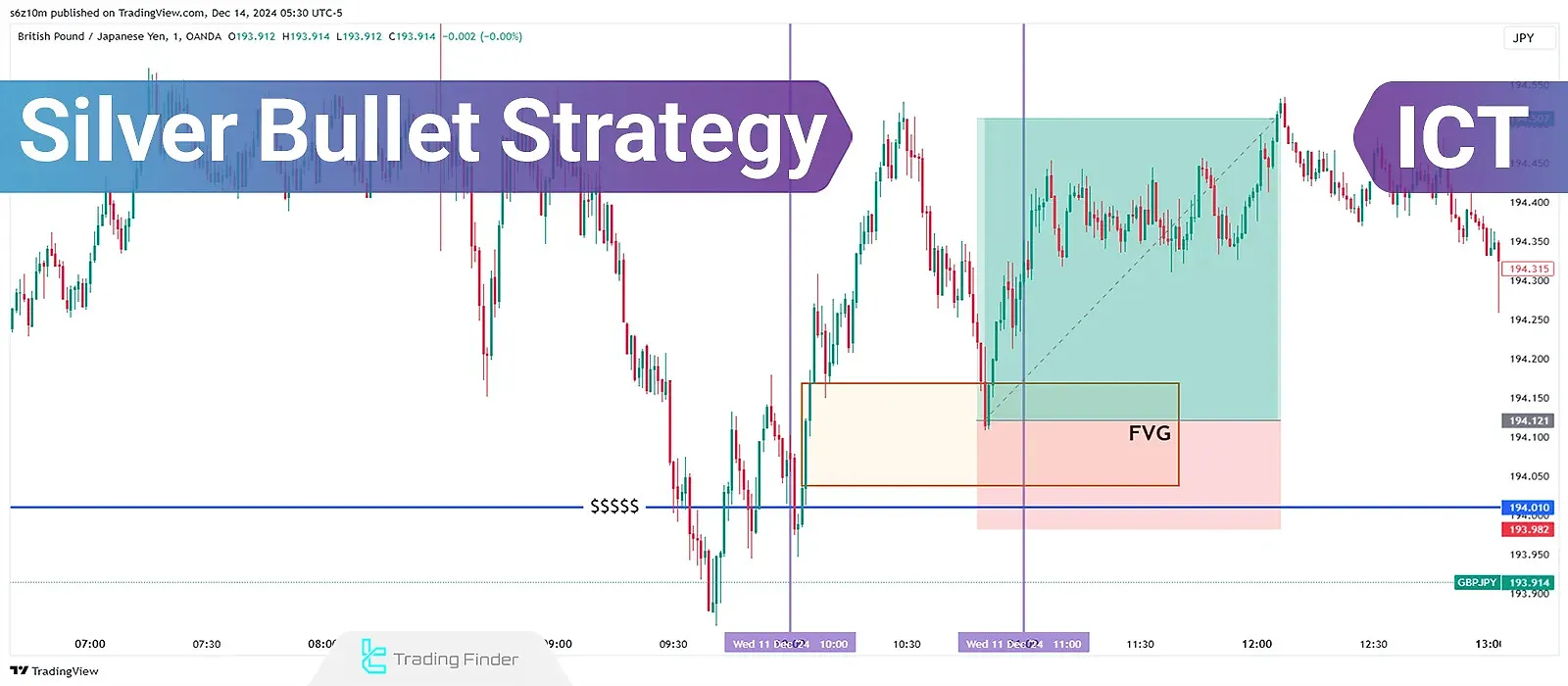
- Time: The setup occurs within one of the valid 1-hour windows.
- Liquidity Range: A short-term low is established, creating a pool of sell-side liquidity (marked
$$$$$). - Liquidity Sweep: Price trades down and sweeps this liquidity.
- Market Structure Shift: Price aggressively displaces higher, breaking a recent swing high (confirming a Market Structure Shift) and creating a clear Fair Value Gap (FVG).
- Entry: The long entry is taken as price retraces into the FVG. The stop loss is placed below the low of the FVG, and the take profit targets a higher liquidity level, offering a good risk-to-reward ratio.
4. Backtesting in Action
Watching the strategy applied over multiple days is the best way to internalize the process, including how to handle wins, losses, and days with no setup. The following video provides a fantastic, practical demonstration. The presenter uses the 9 AM hourly range as the framework for the AM Session Silver Bullet.
ICT Silver Bullet Strategy - No Daily Bias | With Backtest!
In 'ICT Silver Bullet Strategy - No Daily Bias | With Backtest!', the presenter from TTrades demonstrates a very clear, rule-based approach to trading the AM session. He then backtests it for over a month.
First, watch the 'Framework' section (00:37 - 01:26) to understand how he uses the 9 AM candle's high and low. Then, watch the 'Examples' (01:26 - 03:41). Most importantly, watch the first part of the backtesting session (03:41 - 09:20). Observe how he identifies the setup, executes trades, manages the stop loss (moving to break-even at 3R), and deals with missed entries. Watching the full backtest is highly recommended to build your pattern recognition skills, but this first segment is essential.
This backtesting session is invaluable. It shows that the strategy isn't about winning every trade. It's about having a statistical edge and applying a consistent process with discipline. You see days where no setup forms, days with losses, and days with clean winners. This is the reality of trading.
5. Reviewing the Rules with ICT
To bring it all together, let's hear from ICT himself as he reviews the high-level rules and the consistency of the pattern.
2023 ICT Mentorship - ICT Silver Bullet Time Based Trading Model
Let's conclude with the final thoughts from ICT's original 'ICT Silver Bullet' video. He emphasizes the high-probability nature of the model when all conditions are met and the importance of discipline.
Watch the 'Closing Thoughts' section from 15:50 to 19:15. Pay attention to his emphasis on backtesting, focusing on one market, and trusting the process. This reinforces the professional mindset required to trade this model.
Conclusion
In this lesson, you have moved from theory to a practical, executable trading plan for the ICT Silver Bullet. You now have a step-by-step framework for identifying, entering, and managing these time-based trades.
Key Takeaways:
- The Execution Framework: A five-step process: identify the Time window and Liquidity Range, wait for a Liquidity Sweep, confirm with a lower timeframe Market Structure Shift + FVG, and then Enter within the one-hour window.
- Risk Management is Key: Place your stop loss logically (either below the FVG or the sweep low) and set your take profit at the opposing liquidity pool.
- Consistency over Perfection: As the backtesting session demonstrated, the goal is not to win every trade but to consistently apply a rule-based model that has a positive expectancy over time.
- Discipline is Required: The model will not set up every day in your chosen market. The discipline to wait for all the rules to align is what separates successful application from random entries.
Preview of the Next Lesson:
The entry pattern we often see within a Silver Bullet setup—a Market Structure Shift followed immediately by an FVG that price retraces to—is a powerful model in itself. In our next lesson, we will dive deeper into this specific pattern, known as the 'Unicorn' model. You will learn how to use it as a high-precision entry technique within the broader context of your trade analysis.