Hello! Welcome back to our course.
In the last lesson, you developed the essential skill of identifying Fair Value Gaps (FVGs) on your charts. You learned the three-candle rule for both bullish (Bisi) and bearish (Sibi) imbalances and how to handle exceptions like the inside bar.
Today, we take the next logical step. It's not enough to simply see an FVG; we need to understand how price is likely to interact with it. This lesson focuses on a specific, high-precision level within every FVG: Consequent Encroachment. You will learn what it is, why it's arguably more important than the FVG's boundaries, and how it reveals the market's true intentions. Mastering this concept is key to refining your trade entries and reading the strength of a price move.
1. Defining Consequent Encroachment (CE)
At its simplest, Consequent Encroachment (CE) is the 50% midpoint of a Fair Value Gap. You may also hear ICT refer to it as the Mean Threshold, especially when discussing order blocks, but for FVGs, CE is the standard term.
While the FVG itself represents an imbalance, the CE marks the level where the price delivery algorithm can consider the inefficiency to be "half-repaired" or sufficiently rebalanced. This single line often acts as a powerful magnet and reaction point for price.
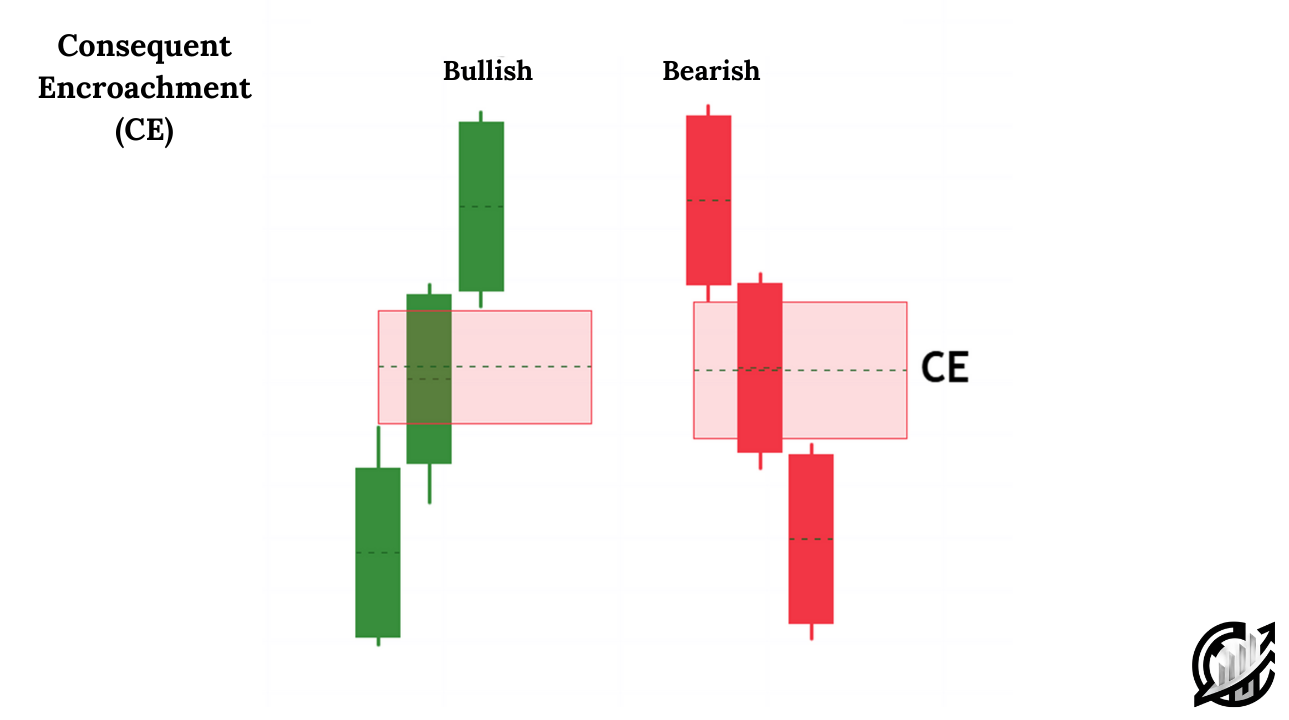
To grasp the full logic behind this concept, let's dive into a detailed explanation.
Consequent Encroachment (CE) — Precision FVG Midpoint Guide ...
The following article, 'Consequent Encroachment (CE) — Precision FVG Midpoint Guide', provides an excellent introduction to what CE is and the logic behind it. It frames CE as the 'heartbeat' inside an FVG, a critical level for algorithmic rebalancing.
Please read the following sections: 'Introduction — What Consequent Encroachment (CE) Really Is' 'The Core Concept: The Logic Behind Consequent Encroachment (CE)' The short 'FAQ' section at the end of the article. Focus on understanding why the algorithm often only needs to rebalance to the midpoint, not the full gap.
2. Why CE is a More Reliable Level
A common pitfall for developing traders is waiting for an FVG to be filled completely, only to see price touch the middle of the gap and reverse aggressively, leaving them behind. This happens because the algorithm prioritizes efficiency. In a strong trend, it has no reason to retrace fully; it only needs to mitigate to the minimum required level—the Consequent Encroachment.
Consequent Encroachment (CE) — Precision FVG Midpoint Guide ...
Let's return to the same article to explore why CE is often a higher probability reaction level than the boundaries of the FVG itself.
Now, read the sections titled 'Why CE Is More Reliable Than the Full FVG' and 'Consequent Encroachment in Algo Theory (Why It Works)'. Pay close attention to the table comparing the reliability of a full fill versus a CE tap.
3. How to Mark and Analyze Consequent Encroachment
Marking CE is a simple and mechanical process using the Fibonacci retracement tool.
Steps to Mark CE:
- Identify a clear, valid Fair Value Gap.
- Select the Fibonacci Retracement tool on your charting platform.
- For a bearish FVG (Sibi), draw the tool from the high of the gap (the low of candle 1) to the low of the gap (the high of candle 3).
- For a bullish FVG (Bisi), draw the tool from the low of the gap (the high of candle 1) to the high of the gap (the low of candle 3).
- The 0.5 level of the Fibonacci tool is your Consequent Encroachment.
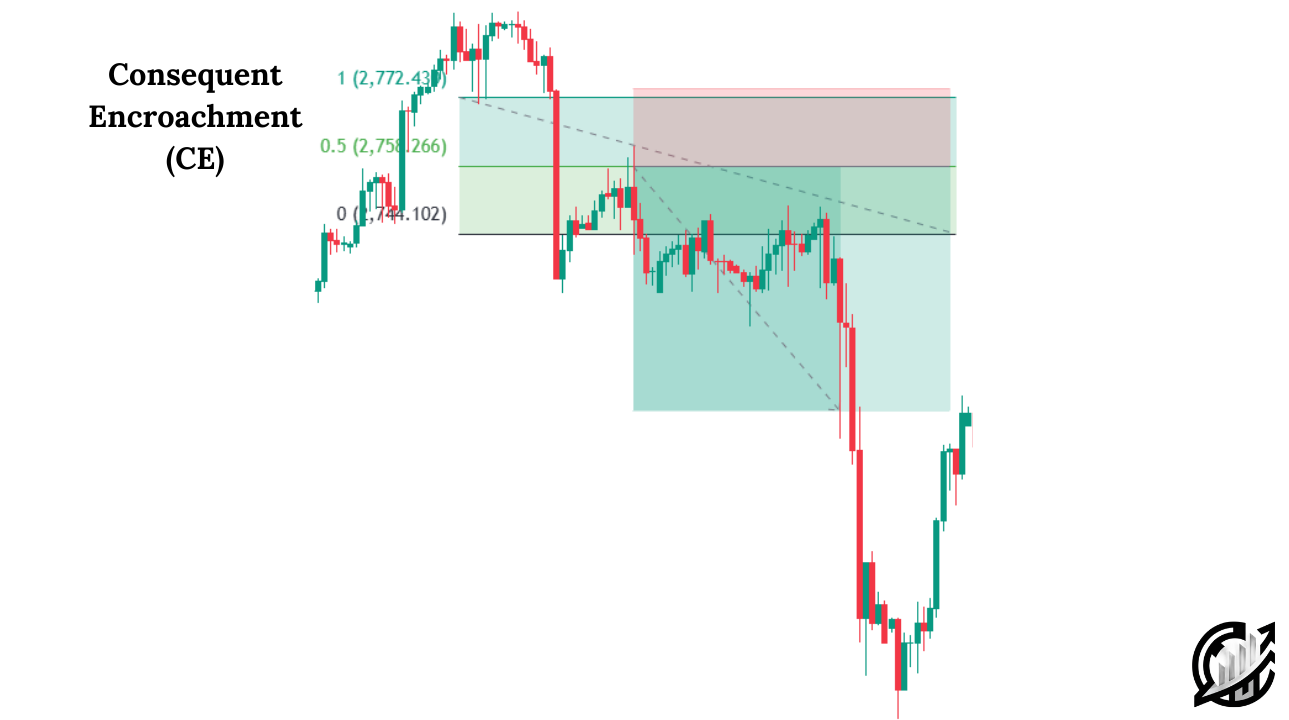
Now that you can mark it, the next step is to analyze the price action around this level. CE acts as a powerful diagnostic tool.
Understanding Fair Value Gaps (FVG) - ICT Concepts
This video from TTrades demonstrates how to interpret price action at the CE level to validate or invalidate a Fair Value Gap.
Watch from 03:52 to 06:00. The key takeaway is the difference between price respecting the CE (tapping it and closing outside) versus violating it (closing through it). A close through the CE suggests the FVG is weak and unlikely to hold.
As you can see, CE is not just a line; it’s a decision point. Let's watch another video that expands on this, showing how CE can be used to refine entries and even help determine daily bias.
How to Use Consequent Encroachment and Mean Threshold from ICT Mentorship
This video by DodgysDD shows the practical application of CE for improving risk-to-reward and analyzing larger gaps like the 'new day opening gap'.
Please watch the following segments: 04:51 - 06:57: This part shows how waiting for a retracement to CE can significantly improve your risk-reward ratio compared to entering as soon as price touches the FVG. 06:57 - 09:31: This segment explains how to use the CE of a major daily gap to form a market bias. Notice the emphasis on waiting for a 5-minute candle to close above or below the CE as confirmation.
4. Practice and Observation
Theory is important, but internalizing this concept requires screen time. Your task is to build on the exercise from our previous lesson.
Your Task (20-25 minutes):
- Open your charting platform and pull up the charts where you previously identified 5 bullish and 5 bearish FVGs.
- For each FVG, use the Fibonacci tool to mark its Consequent Encroachment (0.5 level).
- Now, carefully observe what happened when price returned to that FVG.
- Did price tap the CE and reverse?
- Did price ignore the CE and fill the entire FVG?
- Did price slice through the CE and the entire FVG with little reaction, invalidating it?
- Make a mental note or a physical one in a journal about the character of the reaction at each CE level. The goal is to build your internal catalog of how price behaves at this critical level.
This exercise will train your eyes to see FVGs not just as gaps, but as zones with a highly sensitive midpoint that communicates valuable information about order flow.
Conclusion
Excellent work today. You've moved beyond simply identifying inefficiencies and have started to dissect them with precision. Understanding Consequent Encroachment elevates your analysis by providing a specific, high-probability level to watch within every FVG.
Key Takeaways:
- Consequent Encroachment (CE) is the 50% midpoint of a Fair Value Gap.
- It represents the minimum rebalancing level required by the price delivery algorithm, making it a highly reliable reaction point.
- In strong trends, price often respects CE and reverses, without needing to fill the entire FVG.
- The reaction at CE is a diagnostic tool: a strong rejection confirms institutional intent, while a violation signals weakness.
Preview of the Next Lesson:
You now have two powerful concepts: FVGs and their Consequent Encroachment. However, not all FVGs are created equal. Their location is paramount. In the next lesson, we will introduce Premium and Discount arrays. You will learn how to analyze a price range to determine if an FVG is located in a "premium" (expensive) or "discount" (cheap) zone, which is the final filter you need to decide if an FVG is a high-probability point of interest worth trading from.