Hello! Welcome to the next lesson in our journey to master ICT concepts.
In our last session, we honed in on the precision of Fair Value Gaps by identifying and understanding Consequent Encroachment (CE), the 50% midpoint. You learned that this level often acts as a critical reaction point, signaling the market's true intentions.
Today, we add another essential layer of context. As you've probably noticed, FVGs appear frequently on the chart. How do we filter out the noise and focus only on the ones that matter? The answer lies in their location. This lesson will teach you how to apply premium and discount context to assess whether an FVG is likely to hold or be invalidated. This is a fundamental ICT principle that formalizes the timeless trading wisdom of "buy low, sell high."
1. The Foundation: Defining Premium and Discount
Before we can apply this filter to FVGs, we first need to understand the zones themselves. In any given price leg or trading range, "smart money" is looking to buy at a perceived discount (cheap prices) and sell at a premium (expensive prices). Our job is to align our actions with this logic.
We define these zones using a simple Fibonacci tool:
- Trading Range: A clear, impulsive move from a swing low to a swing high (for bullish scenarios) or a swing high to a swing low (for bearish scenarios).
- Equilibrium (EQ): The 50% level of that trading range. This is the "fair price."
- Discount Zone: The area below the 50% equilibrium level. In an uptrend, this is where we look for buying opportunities.
- Premium Zone: The area above the 50% equilibrium level. In a downtrend, this is where we look for selling opportunities.
The following short video provides a clear visual breakdown of how to mark these zones and, importantly, explains why this improves your trading from a risk-to-reward perspective—a concept that should be familiar from your marketing background where evaluating return on investment is key.
Discount & Premium - ICT Concepts
This video from TTrades, titled 'Discount & Premium - ICT Concepts', will introduce you to the core idea of dividing a price range and the risk-to-reward benefits of trading from the correct zone.
Watch from the beginning to 02:33. Focus on how the Fibonacci tool is used to define the range and how entering a long trade deeper in the discount zone improves the potential risk-to-reward ratio.
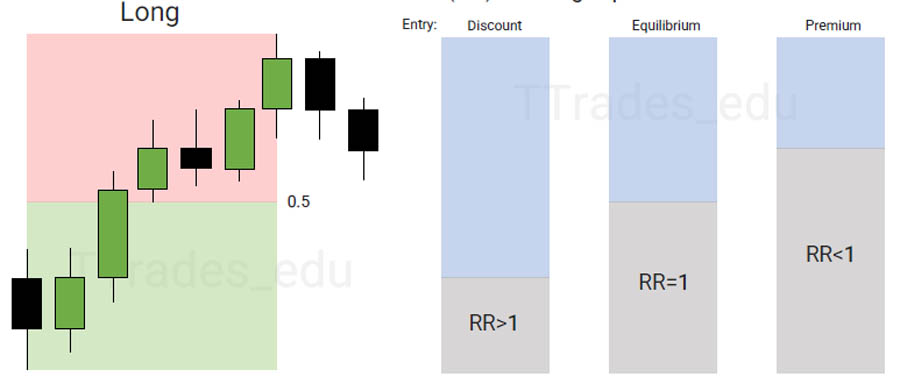
To solidify these definitions, the article below offers a concise explanation.
What Is a PD Array in ICT, and How Can You Use It in Trading?
Let's read a quick definition from a TradingView community post, 'What Is a PD Array in ICT, and How Can You Use It in Trading?'. This will reinforce the key terms.
Please read the first two sections: 'What Is a PD Array?' and 'Premium and Discount Zones of a PD Array'. This will take only a few minutes and will help cement the definitions in your mind.
2. The Rule: Applying the Filter to Fair Value Gaps
Now we can connect this concept directly to our study of Fair Value Gaps. The rule is simple but incredibly powerful:
- For Buy Setups (Bullish): We only consider FVGs that are located in the discount zone of a valid trading range. An FVG in the premium zone is a low-probability entry for a long position and is likely to be ignored or traded through.
- For Sell Setups (Bearish): We only consider FVGs that are located in the premium zone of a valid trading range. An FVG in the discount zone is a poor location to initiate a short.
This single rule acts as one of the most effective filters in the entire ICT methodology.
Fair Value Gaps (FVGs): The Only Guide You'll Ever Need
The article 'Fair Value Gaps (FVGs): The Only Guide You'll Ever Need' neatly summarizes this as 'Rule 3'. Reading this section will frame the concept as a non-negotiable step in your analysis.
Please read the section titled 'Rule 3: Use Premium vs Discount as a Filter'. Pay attention to how it forces you to avoid chasing price and improves your risk management.
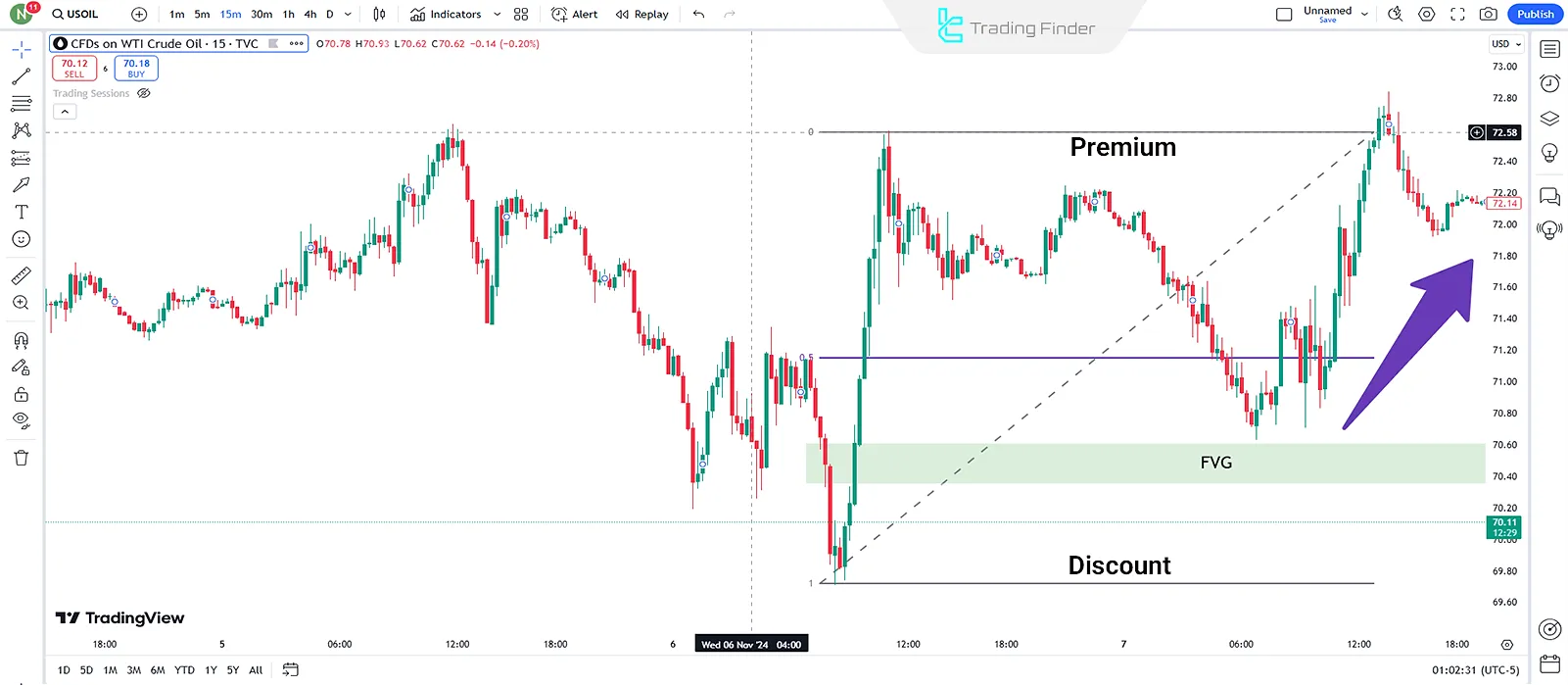
3. Integrated Analysis: Putting It All Together
Knowing the rule is one thing; seeing it play out in live price action is another. It's time to see how this concept works in conjunction with other tools you've learned, like market structure and liquidity.
The following video is an excellent deep dive that demonstrates how a trader uses premium and discount context in real-time to decide which FVGs to trust and which to ignore.
How To Know Which Fair Value Gaps Will Work
The video 'How To Know Which Fair Value Gaps Will Work' by Justin Werlein is a masterclass in applying this concept. It will show you not just what the rule is, but why it works in the context of liquidity and higher timeframe bias.
Please watch the following key segments carefully: 00:34 - 01:55: This introduces the core idea of preferring the FVG in the discount zone when you have multiple FVGs in a range. 01:55 - 04:15: This is a critical segment. It links premium/discount to the concept of liquidity sweeps (Module 3). Notice how sweeping sell-side liquidity makes the trader only interested in bullish FVGs that form in a discount. 04:15 - 08:28: This section elevates the analysis by incorporating higher timeframe context. It demonstrates why a seemingly good setup on a lower timeframe might be invalid if it doesn't align with the premium/discount objectives of a larger range. The rest of the video contains many more examples which you can review later for additional practice.
4. Practice and Final Checks
You now have a robust filter to apply to your FVG analysis. To ensure you internalize this process, let's refer back to the checklist from the dailypriceaction.com article.
Before considering a trade based on an FVG, you should be able to answer "yes" to this question:
Is price returning to the FVG from premium (downtrend) or discount (uptrend)?
Ignoring this step is listed as one of the most common mistakes traders make with FVGs, as it leads to buying high and selling low—the opposite of our goal.
Your Task (15-20 minutes):
- Go back to the charts you've been studying.
- Identify the most recent clear, impulsive price leg on the 1-hour or 4-hour chart.
- Use your Fibonacci tool to mark the range from the swing low to swing high (or vice-versa) and identify the premium, discount, and equilibrium levels.
- Now, look for any FVGs that formed during the retracement of that leg.
- Assess them: Are the bullish FVGs in the discount zone? Are the bearish FVGs in the premium zone? Observe how price reacts to the FVGs that meet this criterion versus those that don't.
Conclusion
Congratulations on completing this pivotal lesson. You've added a crucial analytical filter that will dramatically increase the probability of your FVG-based trade ideas. By waiting for price to enter a logical zone—discount for buys, premium for sells—you align yourself with institutional order flow and avoid the common trap of chasing price.
Key Takeaways:
- A trading range is divided into a Premium zone (above 50%) and a Discount zone (below 50%) by the Equilibrium level.
- High-probability bullish FVGs are found in the discount zone of a bullish price leg.
- High-probability bearish FVGs are found in the premium zone of a bearish price leg.
- This framework provides a logical filter, improves risk-to-reward, and prevents you from "buying high" or "selling low."
Preview of the Next Lesson:
We have now established what an FVG is, the importance of its midpoint (CE), and how to qualify it using premium/discount context. In the next lesson, "Identify potential trade entries using Fair Value Gaps as points of interest," we will synthesize these elements to begin formulating actual trade ideas. We'll explore how to use a high-probability FVG as a concrete Point of Interest (POI) to anticipate entries.