Hello! Welcome back to your ICT trading course.
In our last lesson, we established a crucial rule for filtering Fair Value Gaps: we only look for buy setups in FVGs located in a discount zone, and sell setups in FVGs within a premium zone. This filter is essential for aligning with institutional logic and improving your risk-to-reward ratio.
Today, we transition from qualifying an FVG to acting on it. This lesson directly addresses the learning outcome: Identify potential trade entries using Fair Value Gaps as points of interest. We will move from analysis to the practical steps of trade execution, outlining specific entry models and techniques that form the bedrock of many ICT strategies.
1. The Core FVG Entry Model: From Analysis to Action
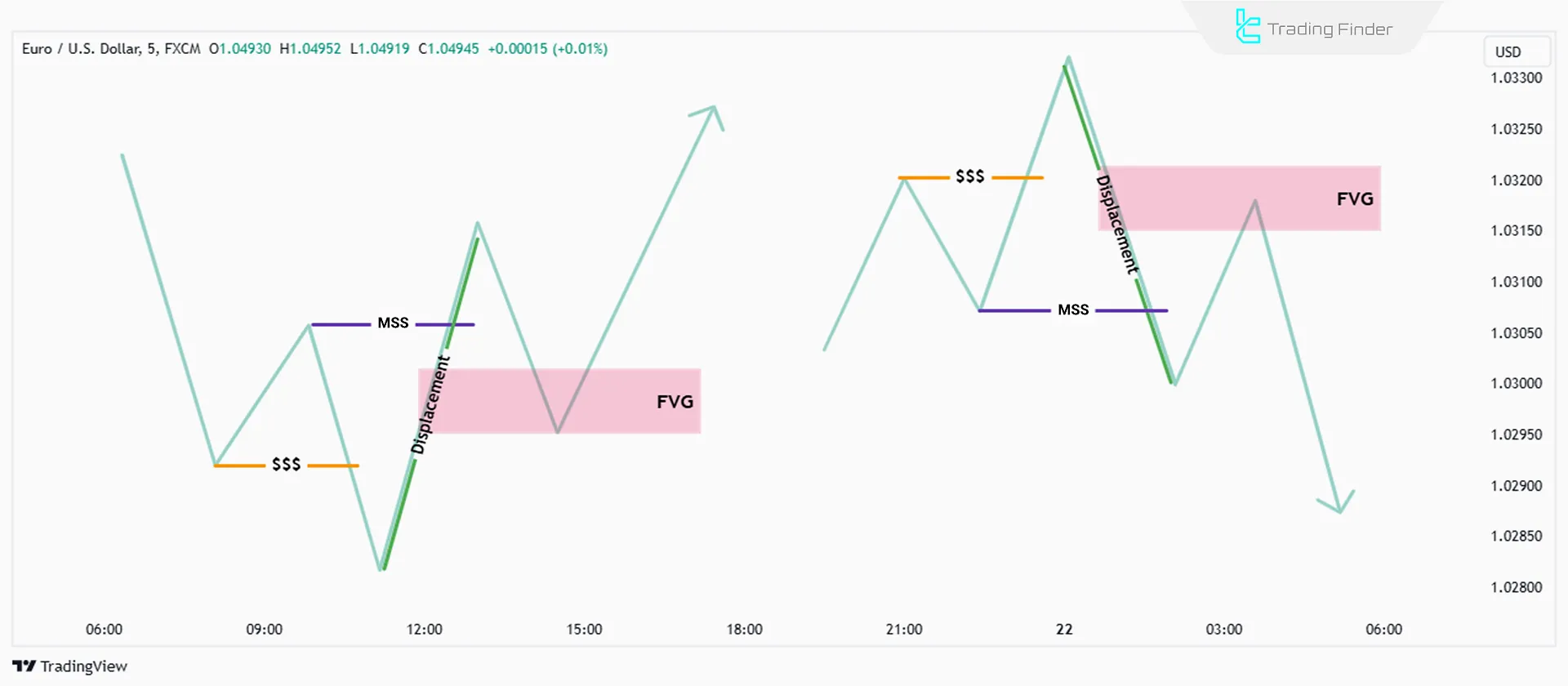
The most fundamental ICT entry model involving an FVG is not just about price returning to a gap. It's about a specific sequence of events that signals a high-probability reversal. This sequence acts as a narrative for what the market is doing.
The sequence is as follows:
- Liquidity Grab: Price first moves to take out a key liquidity pool, such as a previous swing high or swing low.
- Displacement & Market Structure Shift (MSS): After grabbing liquidity, price aggressively reverses, breaking market structure with a strong, energetic move called displacement. This move shows institutional intent.
- FVG Creation: This powerful displacement move leaves behind a Fair Value Gap. This FVG is significant because it was born from a high-momentum shift in direction.
- Return to the POI: Price then retraces back towards the FVG. This FVG is now our Point of Interest (POI) for a potential trade entry.
The following article explains this core model clearly. Pay close attention to how displacement is the catalyst that validates the FVG as a potential entry zone.
Build an ICT Entry Model; Select the Timeframe and Kill Zone
The article 'Build an ICT Entry Model' from tradingfinder.com provides an excellent breakdown of this foundational sequence. We will focus on the first entry model it describes.
Please read the following sections: Start with 'Entry Based on Fair Value Gap (FVG)'. Focus on the three-step process described: Liquidity Grab -> Displacement -> Return to FVG. Next, read 'Price Displacement as the Activation Condition for the Entry Model'. This short section is critical—it explains why an FVG without displacement is not a valid POI. Finally, review the 'Common Mistakes in Designing an ICT Entry Model' to understand the pitfalls, such as using an FVG without a valid Break of Structure (BOS) or MSS.
This sequence provides the context, or the "story," for our trade. The image below illustrates this narrative perfectly.
2. Entry Techniques: How to Engage with the FVG
Once you've identified a valid FVG within the correct context (Premium/Discount and after an MSS), the next question is: how do you physically enter the trade? There are a few primary methods, each with its own trade-offs between precision and the risk of missing the move.
The article "Fair Value Gap (FVG) Explained" gives a great summary of these techniques.
Fair Value Gap (FVG) Explained: The Complete Guide for 2025
Let's read a section from the 'Fair Value Gap (FVG) Explained' article by eplanetbrokers.com. It neatly categorizes the different ways you can enter a trade at an FVG.
Please read the subsection titled 'Entry Strategies'. It outlines four methods. We will focus on three archetypes: Retracement, Aggressive, and Confirmation.
Let's break these down:
-
Aggressive Entry (Limit Order at the Edge): This involves placing a limit order right at the beginning of the FVG (e.g., the high of the first candle in a bullish FVG).
- Pro: Ensures you get into the trade if price only barely touches the FVG.
- Con: Offers a tighter stop-loss but may be more prone to being stopped out if price probes deeper into the gap.
-
Refined Entry (Limit Order at Consequent Encroachment): A more patient approach where you place your limit order at the 50% mark of the FVG (Consequent Encroachment).
- Pro: Provides a better risk-to-reward ratio and enters at a more significant level within the gap.
- Con: You might miss the trade entirely if price reacts from the edge of the FVG and doesn't retrace to the 50% level.
-
Confirmation Entry (Market Order): This involves waiting for price to enter the FVG and then watching for a specific candle pattern that confirms rejection (e.g., a bullish engulfing candle, a pin bar). You would then enter with a market order after that candle closes.
- Pro: Provides the highest degree of confirmation that the FVG is holding, increasing the trade's win probability.
- Con: You will get the worst entry price of the three methods, and you risk missing the move if it's very fast.
The choice between these depends on market conditions and your risk appetite. A fast-moving market might favor a limit order, while a slower one may give you time to wait for confirmation.
3. Stacking Confluences for A+ Setups
A good FVG entry setup is strong. An A+ setup occurs when the FVG aligns with other ICT concepts at the same price level. This alignment is called confluence.
The following video explores three powerful strategies, two of which are excellent examples of confluence.
ICT Fair Value Gaps Simplified: 3 Proven Trading Strategies for Consistent Profits
The video 'ICT Fair Value Gaps Simplified' by Pro Trading School demonstrates how to combine FVGs with other concepts like Order Blocks and Fibonacci levels to build a more robust trade thesis.
Watch the following two strategy segments: Fibonacci Confluence Strategy (08:00 - 10:08): This will show you how to find FVGs that align with key Fibonacci levels, creating a 'golden zone' for entries. This builds directly on our use of the Fib tool for premium/discount. Fair Value Gap and Order Block Strategy (10:08 - 12:10): This is a classic ICT confluence. An FVG that forms directly above a bullish order block (or below a bearish one) is an extremely high-probability POI.
Let's summarize these powerful confluences:
- FVG + Order Block: When a displacement move creates an FVG and originates from a clear Order Block, the combination of the two becomes a powerful POI.
- FVG + Optimal Trade Entry (OTE): The OTE is the "sweet spot" of a retracement, typically between the 62% and 79% Fibonacci levels. An FVG located inside this OTE zone is considered a very high-probability entry point. We will dedicate an entire lesson to OTE later, but for now, recognize it as a key zone of confluence.

4. Advanced Entry Models: Inversion and Liquidity Sweeps
Now let's look at two slightly more advanced but highly effective entry models.
1. The Inversion FVG: What happens when a "high-probability" FVG fails? In ICT, this is not just a lost trade; it's new information. When price trades straight through an FVG, it can "invert" its polarity. A bullish FVG that was once support becomes resistance, and a bearish FVG that was resistance becomes support.
2. Liquidity Sweep into FVG: This model involves price sweeping liquidity just before tapping into the FVG. This action clears out stop-loss orders from impatient traders, effectively fueling the reversal from the FVG.
The next video does an exceptional job of explaining these two advanced models with clear, practical examples.
Fair Value Gap + Liquidity = Profit | Best Fair Value Gap Trading Plan in 2025!
This video, 'Fair Value Gap + Liquidity = Profit' from Smart Risk, will walk you through two sophisticated entry models that you will see time and time again in the market.
Please watch these two key sections: Classic FVG with Liquidity Sweep (11:42 - 14:45): Focus on the psychology explained here. The sweep removes stop losses right before the FVG is filled, clearing the path for a strong move. Inversed FVG with Liquidity Sweep (14:35 - 17:35): This section shows how a failed FVG becomes a new entry point. Notice how it's combined with a Market Structure Shift for extra confirmation.
Conclusion
You have now moved from simply identifying imbalances to pinpointing actionable entry opportunities. By combining the core entry model with specific execution techniques and the power of confluence, you can construct a robust, rules-based approach to trading with Fair Value Gaps.
Key Takeaways:
- The core FVG entry model follows a sequence: Liquidity Grab → Displacement (creating an MSS) → FVG Formation → Retracement to FVG for Entry.
- You can enter a trade using an aggressive limit order at the edge, a refined limit order at the 50% level (CE), or a confirmation entry after a confirming candle pattern.
- The highest probability setups occur at points of confluence, where an FVG aligns with other concepts like an Order Block or the Optimal Trade Entry (OTE) zone.
- Advanced models like the Inversion FVG and Liquidity Sweep into FVG provide additional, powerful entry patterns.
Preview of the Next Lesson:
We've now covered how to qualify an FVG and how to use it for an entry. The final piece of the puzzle is knowing where to take profit. In our next lesson, we will learn how to identify potential profit targets using Fair Value Gaps as draws on liquidity. This will complete our understanding of how to trade from one FVG to the next.