Introduction
Hello! In our previous lesson, you learned the step-by-step process for executing the New York session continuation model, which builds directly on the price action from the London session. You now have a solid understanding of several key ICT models: the Turtle Soup, the 2022 Mentorship Model, the Silver Bullet, and the London/NY session plays.
The crucial question that follows is: How do you know which model to use on any given day?
This lesson answers that question. Our goal is to compare the market contexts suitable for each learned ICT model. We will explore the three fundamental market environments—expansion, reversal, and retracement—and learn to identify which one is currently active. By understanding the "personality" of the market on a given day, you can select the trading model that is most likely to succeed. This skill is the bridge between knowing the models and applying them effectively.
1. The Four Phases of Price Delivery
Before matching models to contexts, we must first define those contexts. ICT teaches that price delivery is not random; it moves through four distinct, cyclical phases.

These four phases form the blueprint for all market movement. Understanding which phase the market is in is the first step to building a high-probability trade idea.
Let's watch a video that breaks down these phases and, more importantly, how they transition from one to the next.
The Phases of Price Action: A Blueprint for Market Movement
The video 'The Phases of Price Action' by TTrades offers a clear framework for understanding market cycles. It introduces a flowchart that is incredibly useful for anticipating what might happen next.
Watch from the beginning until 03:37. Pay close attention to the definitions of expansion, retracement, consolidation, and reversal. Focus on the flowchart presented around 01:28; it visualizes how these phases logically connect to one another, signaling either continuation or reversal.
Based on the video, let's establish our working definitions:
- Consolidation (or Accumulation): Price moves sideways in a defined range. There is no clear directional momentum. This is a period where large institutions are often building positions.
- Expansion (or Distribution): Price moves decisively and quickly in one direction, often with large-bodied candles (displacement). This is the "trend" or the main leg of a move.
- Retracement: A temporary, shallower pullback against the direction of the main expansion. This is a healthy correction within a trend, not a change in trend.
- Reversal: A complete change in the direction of price, typically characterized by a strong expansionary move in the opposite direction of the previous trend. This often happens after a key liquidity level has been taken.
Your job as a trader is not to trade in every phase, but to identify the current phase and use the ICT model best suited for it.
2. Matching ICT Models to Market Context
Now we'll connect the dots. Each ICT model you've learned is designed to capitalize on a specific market context.
Context: Reversal
This context is about anticipating or confirming a turn in the market. You are looking for signs that the current trend is ending and a new one is beginning.
-
Turtle Soup:
- When to Use: When price is approaching a significant higher-timeframe (HTF) swing high or low.
- Logic: Instead of breaking out, you anticipate price will raid the liquidity resting above/below that level and then sharply reverse. The setup is the failure of a breakout. It's a pure reversal play at key liquidity points.
-
Power of 3 (AMD):
- When to Use: Following a clear period of Consolidation (Accumulation), typically the Asian session range.
- Logic: You anticipate a Manipulation phase (e.g., a Judas Swing) that sweeps liquidity on one side of the range, only to reverse and begin the true Distribution (Expansion) phase in the opposite direction. The entry capitalizes on the reversal after the manipulative move.
-
2022 Mentorship Model (The Setup):
- When to Use: When you have a clear HTF draw on liquidity and you are waiting for the market to align with it.
- Logic: The model begins with a reversal. It requires a sweep of a significant liquidity level, followed by a Market Structure Shift (MSS) on a lower timeframe. That MSS is the reversal confirmation that sets up the rest of the trade.
Context: Retracement (Pro-Trend Continuation)
This is the most common context for trade entries. A trend has already been established by an expansionary move, and you are looking for a low-risk entry point to join it.
-
Optimal Trade Entry (OTE):
- When to Use: After a clear, energetic Expansion leg.
- Logic: You are waiting for a Retracement back into the 62%-79% Fibonacci zone (the "sweet spot"). This is the classic method for joining a trend at a discount (in an uptrend) or a premium (in a downtrend).
-
2022 Mentorship Model / Unicorn Entry (The Entry):
- When to Use: Immediately following the Market Structure Shift (reversal confirmation) of the 2022 model.
- Logic: The aggressive displacement that causes the MSS leaves behind a Fair Value Gap (FVG). The entry occurs when price retraces back into this FVG. You are entering on a pullback to join the newly established trend direction.
-
New York Session Continuation:
- When to Use: When the London session has already engineered a major reversal and created a strong Expansion.
- Logic: You anticipate a shallow Retracement during the early New York hours back into a key PD Array (like an FVG or Breaker Block) that was created during the London move. This provides the entry to ride the continuation of the trend for the rest of the day.
Context: Expansion
This is the phase you want to be in, but it's rarely where you want to enter.
- Logic: Entering in the middle of a strong expansionary move is chasing price. The risk is high because the move may be exhausted, and your stop loss will be poorly defined. Instead, you should view expansion as the phase that creates future opportunities. An expansionary move creates the displacement that forms new Order Blocks, Fair Value Gaps, and Market Structure Shifts. You then wait for a retracement back to these levels to enter.
- The Exception - Silver Bullet: This model is designed to capture a very specific, short-term Expansion. It's used within a tight time window (e.g., 10-11 AM EST) and targets an obvious, nearby pool of liquidity. The context is a brief, high-probability burst of momentum, not a major trend leg.
3. The Deciding Factor: Higher-Timeframe Context
A 5-minute setup might look perfect, but it is doomed to fail if it goes against the narrative on the 4-hour or Daily chart. The HTF context is the ultimate arbiter of which model to apply.
This is arguably the biggest hurdle for developing traders. Let's watch a video that powerfully illustrates this exact point.
This is why ICT/SMC silver bullet and the 2022 model is not working for you
The video 'This is why ICT/SMC silver bullet and the 2022 model is not working for you' by Strange ICT explains a common failure point: trading patterns without context.
Watch from 00:33 to 13:15. The creator shows a 'perfect' 15-minute 2022 model setup that fails. He then zooms out to the Daily and 1-Hour charts to reveal a completely opposite and more powerful narrative. This is a critical lesson in letting the higher timeframe dictate your lower-timeframe actions.
The key takeaway is that you must build a narrative. Don't just hunt for patterns. Ask yourself:
- What is the overall story on the Daily and 4-Hour charts? Are we in an expansion, or are we retracing into a major HTF PD Array?
- Where is the next major draw on liquidity?
- Based on that HTF narrative, am I expecting a reversal, or should I be looking for pro-trend continuation entries?
Only after answering these questions can you drop to a lower timeframe and select the appropriate model. For example, if the daily chart is bullish and has just started an expansionary move away from a key level, you should be looking for retracement models (like OTE or 2022 Model entries) on the 15-minute chart, not reversal models.
To reinforce this crucial point, let's review a short text on the Power of 3.
Mastering the ICT Power of 3 concept - How to use it in trading!
The article 'Mastering the ICT Power of 3 concept' has a very important tip about this.
Please read Tip #2, 'Analyse multiple timeframes'. It succinctly explains why what looks like accumulation on a LTF might just be a retracement on a HTF, highlighting the importance of context.
4. Tying It All Together: The Daily Cycle
These phases and contexts often align with the different trading sessions, creating a predictable daily rhythm.
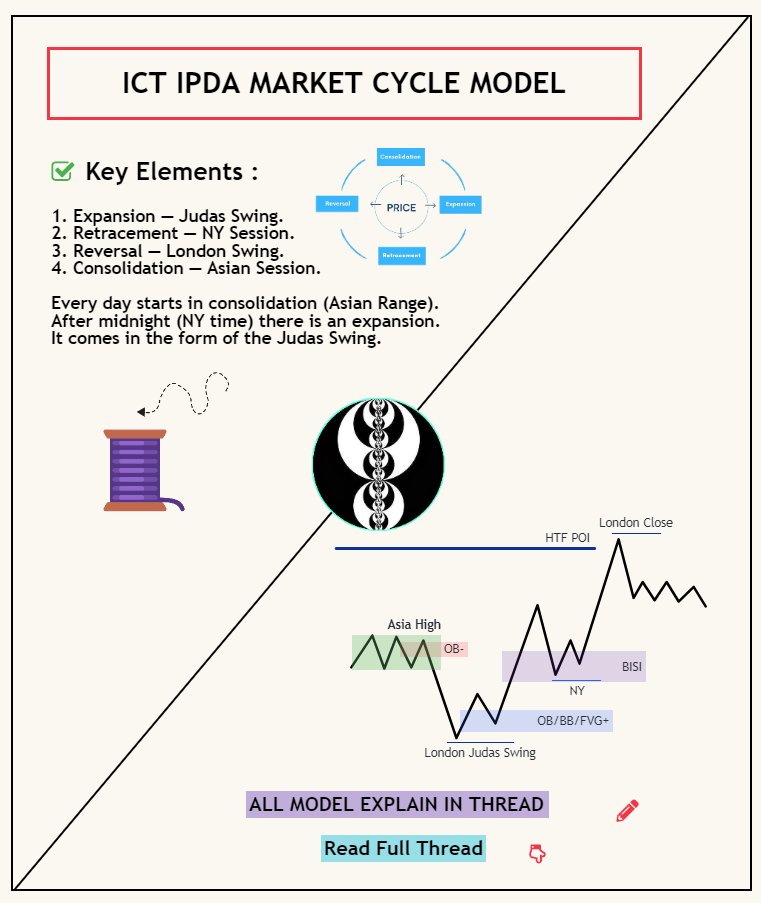
This model gives you a daily template:
- Consolidation: The Asian session often provides this, creating clear highs and lows.
- Reversal: The London session often engineers a manipulation (Judas Swing) to sweep the Asian range liquidity and establish the day's true direction. This is where you might look for a Turtle Soup or the initial sweep for a 2022 Model.
- Expansion & Retracement: The move out of the London reversal is the day's initial expansion. The New York session often begins with a retracement back into a PD Array formed by the London move, offering a NY Continuation entry to ride the main expansionary move of the day.
By understanding this template, you can start your day with a clear hypothesis about which market phase is most likely to unfold.
Conclusion
You now have a framework for selecting the right tool for the job. Instead of randomly searching for setups, you can now analyze the market's current state and choose the ICT model designed for that specific context.
Key Takeaways:
- Price moves in four phases: Consolidation, Expansion, Retracement, and Reversal.
- Each ICT model is designed for a specific context:
- Reversal: Turtle Soup, Power of 3 (Manipulation), 2022 Model (Setup).
- Retracement/Continuation: OTE, 2022 Model (Entry), NY Continuation.
- Expansion: The goal is to be in this phase, typically entering during a prior retracement.
- Higher-timeframe analysis is non-negotiable. The HTF narrative determines which models are valid on the lower timeframes. A setup without HTF confirmation is just a pattern, not a high-probability trade.
Preview of the Next Lesson:
We have established the "what" and "why." In the next lesson, we will focus on the "how." We will take today's concepts and forge them into a practical, repeatable routine. You will learn how to build a pre-session checklist to select the highest probability model for the day, turning this theoretical knowledge into a daily action plan.