Hello! Welcome to the fourth lesson in our "Thinking Through Writing" module.
In our last lesson, you practiced a crucial skill: summarizing a complex philosophical concept in your own words using the Feynman Technique. You learned that true understanding comes from being able to explain an idea simply and clearly, as if teaching it to someone new. This gave you a solid, well-understood abstract idea to work with.
Today, we will make that abstract idea resonate. Our goal is to connect an abstract philosophical idea to a concrete, everyday example. If summarizing is about achieving intellectual clarity, today's lesson is about giving that clarity life and impact. Big ideas can feel distant; concrete examples act as a bridge, making your writing more memorable, persuasive, and engaging for a reader. This skill is at the heart of the creative, philosophical style you admire.
1. The Ladder of Abstraction: Moving Between Worlds
Great writing doesn't just stay in the clouds of abstract thought, nor does it get stuck in the mud of disconnected facts. It moves gracefully between them. A powerful mental model for this is the "Ladder of Abstraction."
Imagine a ladder.
- At the top are high-level, abstract concepts: "justice," "freedom," "love," "existential dread." These give your writing meaning and universal significance.
- At the bottom are concrete, specific details: "the cracked pavement," "a cup of chai steaming in the morning," "the specific algorithm sorting a playlist." These give your writing vividness, clarity, and emotional weight.
Effective writing constantly travels up and down this ladder. It makes a universal claim (top of the ladder) and immediately illustrates it with a specific story or image (bottom of the ladder).
To understand this dynamic, let's watch a video that explains it with some great examples.
The Ladder of Abstraction: Make Your Writing Memorable
This video, 'The Ladder of Abstraction' from InkwellMedia, provides an excellent introduction to this concept and why it's so vital for compelling writing.
Please watch from 01:04 to 06:37. As you watch, focus on: How the narrator defines the ladder. The example of the river rafter, McDougal, and how the story moves from a specific person to the abstract idea of 'all human beings'. The core idea that good writing 'constantly ascends and descends' the ladder. Why moving down the ladder (giving concrete examples) is essential for making complex ideas understandable.
As the video explains, climbing up the ladder allows you to find universal lessons that appeal to a wide audience. Descending the ladder provides the concrete, sensory details that make your ideas understandable and prevent your writing from becoming dry or boring. The magic happens in the movement.
2. Tools for Descending the Ladder: Examples and Analogies
So, how do you actually travel down the ladder of abstraction? The most powerful tools are examples, analogies, and metaphors. They anchor your abstract claims in the familiar, tangible world.
This is especially critical for the kind of video essays you're interested in creating. Big philosophical topics need to be made digestible and engaging for an online audience.
The YouTuber Zoe Bee, in her video 'How to Write Video Essays,' offers practical advice on this. She directly addresses how to handle big, abstract concepts for this medium.
Please watch two key segments: From 02:53 to 06:44. Notice her advice to take a big concept and 'make it smaller and more manageable' by applying it to 'specific concrete everyday things.' From 17:58 to 20:31. Here, she discusses analogies and examples as tools to make your ideas 'easier to get.' Pay attention to her metaphors of analogies as 'salt' and examples as 'Food Network recipes.'
Zoe Bee's advice highlights a key principle: don't just talk about "capitalism" or "free will" in the abstract. Talk about it through the lens of a specific event, a personal story, or a concrete object.
Analogies and metaphors are particularly potent tools.
- A metaphor makes a direct comparison, saying something is something else (e.g., "Argument is war").
- An analogy explains something complex by comparing it to something simpler and more familiar, often explaining how they are similar (e.g., explaining the structure of an atom by comparing it to the solar system).
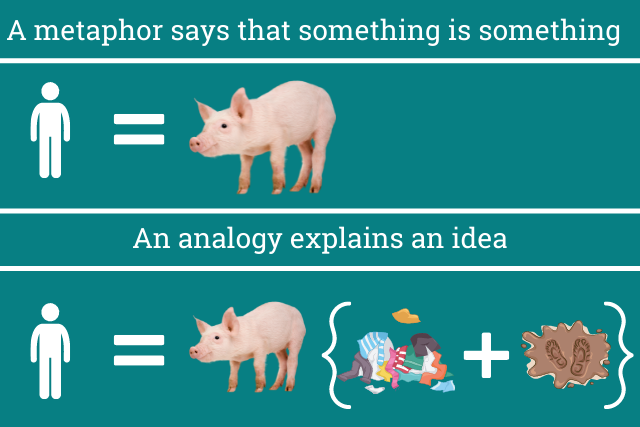
The best analogies often come from a field you know well. Given your background, you could explain a philosophical concept using an analogy from physics, mathematics, or computer science. For example, you might compare the philosophical concept of determinism to a computer program where every output is strictly determined by its inputs and initial state.
The Power of Metaphors to Help Us Learn, Change, and Grow
This article, 'The Power of Metaphors,' explores how personalized metaphors can make complex ideas click. It gives some excellent, simple examples.
Read the short sections 'The power of metaphor… as seen in a silly movie,' '“Untying the bad knot” as a metaphor for healing from Anxiety,' and 'Helping an adolescent to see himself in a different light with metaphor.' Notice how each example connects a complex, abstract feeling or idea (ancient philosophy, anxiety, self-perception) to a concrete, familiar activity (pro wrestling, untying a knot, creating a video game character).
The key is to find a connection that illuminates the abstract idea in a new and memorable way.
3. Your Turn: Build the Bridge
Now, let's put this into practice. You're going to take the philosophical concept you summarized in the previous lesson and build a bridge from its abstract definition to a concrete example.
Step 1: Revisit Your Concept (1 minute)
Look at the 100-150 word summary you wrote for the previous lesson's exercise. Remind yourself of the abstract idea you're working with (e.g., Utilitarianism, Existentialism, Determinism, etc.).
Step 2: Brainstorm Connections (5-7 minutes)
Think of 3-5 concrete examples, stories, or analogies that could illustrate your concept. Don't censor yourself—just generate ideas. Use these prompts to help:
- Can you think of a small, personal decision you (or a friend) made that reflects this big idea? (e.g., choosing what to study, deciding whether to tell a white lie).
- When have you seen this idea play out in a movie, book, or video game?
- Can you connect it to a recent news event or a historical one?
- Leverage your background: Is there a concept from mathematics, physics, or computer science that works as an analogy? (e.g., Is free will like a random number generator in a deterministic system? Is epistemology like verifying a proof?)
Step 3: Write Your Paragraph (15 minutes)
Choose the most promising connection from your brainstorm. Now, write a paragraph (around 150 words) that connects the abstract to the concrete.
Your paragraph should have two parts:
- The Abstract Statement: Start by clearly and concisely stating the philosophical idea. You can adapt the summary you wrote in the last lesson.
- The Concrete Bridge: Immediately follow up with your example or analogy. Describe it with specific details and then explicitly explain how it illustrates the abstract idea.
Example Structure:
"[Philosophical concept] is the idea that [your simple definition]. This might sound abstract, but we see a version of it play out in the surprisingly complex decision of [your everyday example]. When [describe the situation with a specific detail or two], the choice we face mirrors the core tension of the philosophical idea. For instance, [explain how the elements of your example map onto the elements of the concept]. This small, everyday moment becomes a miniature version of the grand philosophical puzzle."
This exercise is about creating a single, powerful link between a big idea and a small, tangible reality.
Test your understanding!
What is the primary function of moving down the "Ladder of Abstraction" in your writing?
- To prove your intelligence with complex vocabulary.
- To make your abstract arguments clearer and more memorable for the reader.
- To show that you have read many different books.
- To replace philosophical ideas with simple stories.
Show answer
The correct answer is 2. Descending the ladder by using concrete examples doesn't replace the abstract idea; it supports it, making it easier for a reader to grasp, remember, and be persuaded by.
Conclusion
Today you've learned to connect the world of big ideas with the world of everyday experience. This is not just a rhetorical trick; it is a fundamental part of thinking clearly and communicating effectively. By grounding abstract concepts in concrete reality, you make them powerful and accessible, both for your audience and for yourself.
Key Takeaways:
- The Ladder of Abstraction is a mental model for moving between abstract principles and concrete details.
- Examples, analogies, and metaphors are your primary tools for climbing down the ladder and making your ideas tangible.
- Good writing doesn't live at one end of the ladder; it finds its energy in the movement between the abstract and the concrete.
You now have a method for making a philosophical point not just understood, but felt. In our next lesson, we'll take these components—a clear idea and a compelling example—and learn how to arrange them. We will focus on how to transform your messy exploratory writing into a coherent, structured argument, moving from individual building blocks to architectural design.