Hello! Welcome to the fifth lesson in our module, "Thinking Through Writing."
In our last few lessons, we've been gathering the raw materials for an argument. You've used freewriting to generate ideas, exploratory writing to find a central question, summary to clarify a concept, and the Ladder of Abstraction to connect that concept to a concrete example. You now have a collection of valuable, but likely disconnected, pieces.
Today's lesson is about architecture. We will learn how to transform your messy exploratory writing into a coherent, structured argument. This is the crucial step where you move from being an explorer discovering new territory to a cartographer drawing the map. Your goal is to take the chaotic-but-rich output of your thinking process and give it a logical, persuasive backbone.
1. The Mindset: Handing In the Smartest Person's Paper
Before we get to the techniques, let's establish the right mindset. That "messy" draft you have isn't a sign of failure; it's the evidence of successful thinking. You write the first draft to figure out what you want to say. The person who finishes that draft is inevitably more knowledgeable about the argument than the person who started it.
The secret to revision is to let this "smarter" version of yourself—the one who has already done the hard thinking—do the writing.
Let's watch a short video that explains this idea with a brilliant metaphor.
Guide for Writing a Philosophy Paper
In his 'Guide for Writing a Philosophy Paper,' Jeffrey Kaplan offers a powerful way to think about revision. He also clarifies the fundamental structure of any argument.
Please watch two key segments: 3:22 – 3:50: Pay attention to the simple, two-part structure of a standard philosophy paper: a thesis (your claim) and the reasons/argument that support it. 4:56 – 7:56: This is the core idea. Focus on the concept of 'handing in the smartest person's paper.' Understand why the early paragraphs of a draft are often the weakest and why you must be willing to discard them and rewrite from your final, more informed perspective.
This is the goal: to create a final piece that reflects the clarity you achieved at the end of your exploratory process, not the confusion you had at the beginning. But how do you do that practically?
2. The Tool: Creating a Reverse Outline
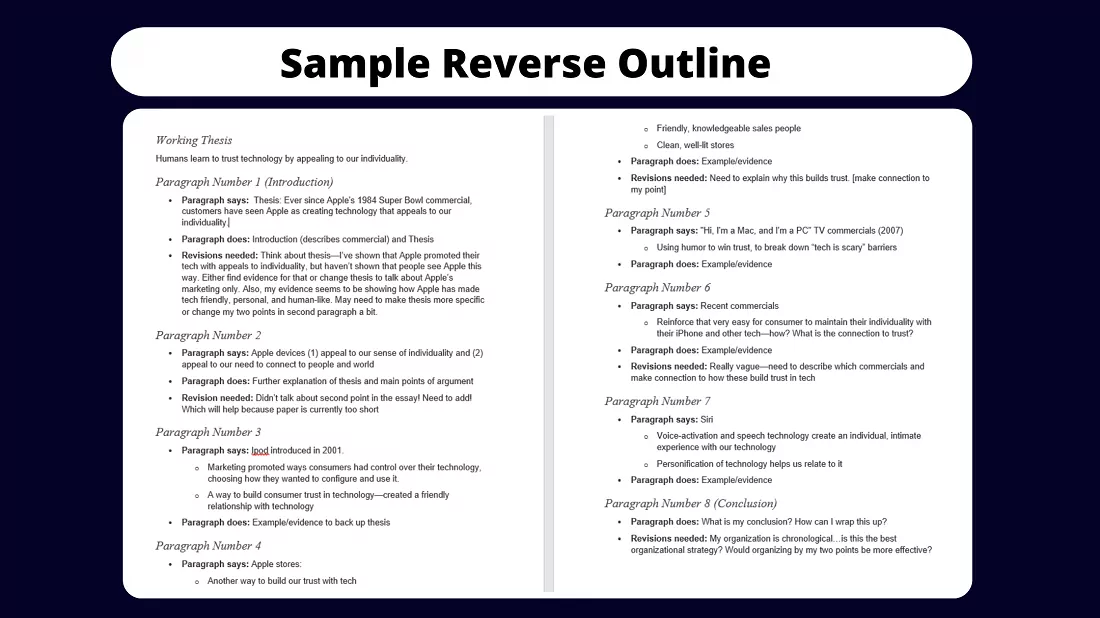
The most effective tool for transforming a messy draft is the reverse outline. Instead of creating an outline before you write, you create it from your completed draft. This acts like an X-ray, revealing the true skeleton of your argument and showing you exactly where the bones are strong, broken, or missing.
The ‘Reverse Outline’ Hack That Cut My Research Paper Writing Time in Half
This article, 'The ‘Reverse Outline’ Hack,' provides a fantastic guide to this process. It validates the 'brain-dump' first draft and offers a clear, step-by-step method for structuring it.
Read the article from the section 'What is the Reverse Outline?' through to the end of 'Why This Crazy Method Works.' Focus on: The definition of a reverse outline. The 5-step guide (as shown in the infographic) for creating one. The benefits it provides, such as revealing logical flow, flagging repetition, and identifying 'monster' paragraphs.
To make this even more concrete, here is a sample of what a reverse outline can look like. It diagnoses what each paragraph says and what it does.
3. The Test: The "Therefore & But" Rule
A reverse outline helps you see your individual points clearly. The next step is to ensure they connect in a logical chain, not just a list. A simple but incredibly powerful test for this comes from the world of filmmaking and storytelling.
F for Fake (1973) - How to Structure a Video Essay
The video essay channel Every Frame a Painting, in an analysis of Orson Welles's film 'F for Fake,' explains a fundamental rule of structure. This rule is your best tool for ensuring your argument has forward momentum.
Watch from 00:54 to 02:03. Absorb the core rule: the ideas in your argument should be connected by 'Therefore' or 'But,' not by 'And then...'. This forces a cause-and-effect or a tension/contrast relationship between your points.
If you look at your reverse outline and find that your points are just connected by "and also this...", your argument is likely a list, not a progression. By forcing yourself to use "therefore" (this follows from that) or "but" (this complicates or contrasts with that), you build a chain of reasoning that pulls the reader forward.
4. Your Turn: From Mess to Map
It's time to apply these tools. We will use the work you've done in the past few lessons as the "messy draft" and give it a coherent structure.
Step 1: Assemble Your "Messy Draft" (5 minutes)
Create a new document. Copy and paste the following items into it, in any order that feels natural right now:
- A paragraph or two of your freewriting from lesson 2.1.
- The central question you developed in lesson 2.2.
- The 100-word summary of the philosophical concept from lesson 2.3.
- The 150-word paragraph connecting that concept to a concrete example from lesson 2.4.
Read it over. It will likely feel disjointed. This is your raw material, your "brain dump."
Step 2: Create Your Reverse Outline (15 minutes)
Go through your assembled messy draft, paragraph by paragraph. For each paragraph, write one single sentence that summarizes its main point. You will be left with a simple list of sentences (probably 3-5 sentences long). This is your reverse outline.
Step 3: Analyze and Re-order Your Outline (10 minutes)
Now, look only at your list of summary sentences. This is the skeleton of your paper. Critically analyze it:
- Find the Thesis: Which sentence is the main claim or the core answer to your central question? This is your thesis. It might be buried at the end. Drag it to the top, right after your introduction/question.
- Check for Logic: Apply the "Therefore & But" test. Read your sentences in order and see if you can mentally insert "therefore" or "but" between them.
- Re-order, Combine, Delete: Drag the sentences into a new, more logical order. Does the concrete example better support a different point? Do two sentences say the same thing? (If so, combine or delete one). Is there a point that doesn't support the thesis at all? (If so, delete it).
Step 4: Write Your Final Blueprint (5 minutes)
Based on your revised list of sentences, write a clean, final outline for your argument. This is the blueprint for your "smarter self" to use. It should look something like this:
Topic: [Your philosophical concept]
Central Question: [Your question from lesson 2.2]
- Introduction: Hook the reader and introduce the central question.
- Thesis Statement: State my main argument/answer to the question in one clear sentence.
- Supporting Point 1: Explain the abstract philosophical concept.
- Supporting Point 2 (Therefore...): Illustrate this concept with a concrete example, showing how the example demonstrates the principle.
- Supporting Point 3 (But.../Therefore...): Explore an implication, a tension, or a consequence of this idea.
- Conclusion: Briefly summarize the argument and offer a final thought on why this question matters.
This structured outline is the main deliverable for today's lesson. It's the map you've created from the territory you explored.
Test your understanding!
You've created a reverse outline and notice that the connection between paragraph 3's main idea and paragraph 4's main idea feels weak. Neither "therefore" nor "but" seems to fit. What does this likely indicate?
- You should make paragraph 4 longer.
- Your thesis statement is wrong.
- There is a logical gap in your argument, and you may need to add a transitional idea, re-order the paragraphs, or delete one of them.
- You should use more complex vocabulary.
Show answer
The correct answer is 3. The "Therefore & But" test is a diagnostic tool. If it fails, it signals a problem with the logical structure of your argument. The solution is architectural: you need to fix the underlying flow of ideas, not just paint over the cracks with more words.
Conclusion
Today you've acquired one of the most essential skills in writing: the ability to find order in chaos. You've learned that the messy thinking process is valuable, but that a structured argument is what makes your ideas persuasive and clear to others.
Key Takeaways:
- A messy first draft is a tool for discovery. Revision is the process of presenting that discovery clearly.
- The Reverse Outline is a diagnostic tool that reveals your argument's actual structure.
- The "Therefore & But" rule is a powerful test to ensure your argument has logical momentum.
- The goal is to move from a "brain dump" to a clear blueprint that your "smarter self" can execute.
You now have all the individual skills from this module. In our next and final lesson for "Thinking Through Writing," we will execute the blueprint you've created today. You will write a short, complete piece that raises a philosophical question and explores its implications, bringing all these elements together into a polished whole.