Hello! Welcome to the third lesson in our "Thinking Through Writing" module.
In our last session, we took the raw material from your freewriting and honed it into a single, focused question. You now have an intellectual puzzle that you've chosen to explore. This is the starting point for a great essay.
But to answer a question, especially a philosophical one, we first need to understand the existing conversation around it. Today, we'll focus on a fundamental skill for this process: summarizing a complex philosophical concept in your own words. This isn't about simply reporting facts; it's about deeply understanding an idea so you can engage with it, critique it, and ultimately build your own unique perspective upon it. Think of this as forging the intellectual tools you'll need to construct your answer.
1. How to Truly Understand Anything: The Feynman Technique
Before you can articulate a complex idea, you must genuinely understand it. Memorizing definitions is not enough. We need a method to break a concept down, internalize it, and reassemble it in our own language.
A powerful tool for this is the Feynman Technique, named after the Nobel Prize-winning physicist Richard Feynman. Given your interests in physics and mathematics, you'll likely appreciate this structured approach to learning. Feynman was known as "The Great Explainer" for his ability to make incredibly complex topics feel intuitive. His technique is, at its core, a way to use writing and teaching as a medium for thought and deep understanding.
How to Learn Faster with the Feynman Technique (Example Included)
Let's start with a clear overview of the Feynman Technique. This video from Thomas Frank explains the four-step process effectively.
Please watch from the beginning until the 4:50 mark. Pay close attention to the four distinct steps of the technique and the reasoning behind each one, especially the emphasis on using simple language and challenging your own assumptions.
As the video explains, the process consists of four key steps. Here is a visual summary:

Let's break down how we'll apply these steps to a philosophical concept:
- Choose Your Concept: Select a philosophical idea you want to understand.
- Teach It to a Novice: Write an explanation of the concept on a blank piece of paper. Crucially, pretend you are explaining it to someone who knows nothing about the topic (like a younger sibling or a friend from a different field). This forces you to avoid jargon and complicated phrasing.
- Identify Gaps & Return to the Source: When you get stuck, or find yourself using a term you can't easily define, you've found a gap in your knowledge. This is the most valuable part of the process! Go back to your source material (a book, an article, a lecture) to fill that gap until you can explain it simply.
- Review, Simplify, and Use Analogies: Read your explanation aloud. Does it sound convoluted? Simplify your language further. Are there any metaphors or analogies you can create to make the core idea more concrete? Refine it until it's crystal clear.
Test your understanding!
According to the Feynman Technique, what is the main benefit of finding a "gap" in your knowledge while you're trying to explain a concept?
- It shows you that the concept is too difficult to understand.
- It gives you a reason to stop studying and take a break.
- It precisely pinpoints what you don't yet understand, allowing for targeted learning.
- It proves that your source material is poorly written.
Show answer
The correct answer is 3. The gaps you identify are not failures; they are signposts that direct you to the exact areas where your understanding is weak. Filling these gaps is how true learning happens.
2. Clarity in Philosophy: Writing for the "Lazy, Stupid, and Mean" Reader
The Feynman Technique's emphasis on simplicity is not just a learning hack; it is the hallmark of excellent philosophical writing. Philosophers deal with abstract and often counter-intuitive ideas. The only way to handle them effectively is with maximum clarity.
Let's look at some guidelines from a professional philosopher that echo Feynman's principles.
Guidelines on Writing a Philosophy Paper
This guide by philosopher Jim Pryor is a classic text on how to write a philosophy paper. We'll focus on the sections that directly address the principles of clarity and effective explanation.
Please read the following three sections: Start with 'Use simple prose'. Read until the end of the sentence, 'So do not try to emulate their writing styles.' Next, read the section 'Be concise, but explain yourself fully'. Pay special attention to the box describing the 'lazy, stupid, and mean' reader. This is a memorable and powerful mental model. Finally, read the sub-section titled 'Paraphrases' within the larger 'Presenting and assessing the views of others' section. This will show you a concrete example of a bad paraphrase versus a good one.
Pryor's advice reinforces what we've learned. To summarize a concept in your own words means:
- Using simple, direct language: Avoid trying to sound "philosophical." If your writing sounds like something you could say in a conversation, you're on the right track.
- Explaining fully: Don't just state a point. Unpack it. Give an example. Assume your reader (even if it's just you) needs everything spelled out.
- Truly paraphrasing, not just rearranging: The goal is to digest an idea and then express its meaning in your own conceptual framework, not just to swap out a few words from the original text. This demonstrates genuine understanding.
The idea of writing for a "lazy, stupid, and mean" reader is a powerful, if humorous, exaggeration of the Feynman Technique's "teach it to a child" principle. It forces you to be not just simple, but rigorously logical and explicit.
3. Your Turn: Summarize a Concept
Now it's time to put this all together. You will choose a philosophical concept and use the Feynman Technique to produce a clear, concise summary in your own words.
Step 1: Choose a Concept (2 minutes)
Pick one concept from the list below that sparks your curiosity. These cover a range of philosophical areas.
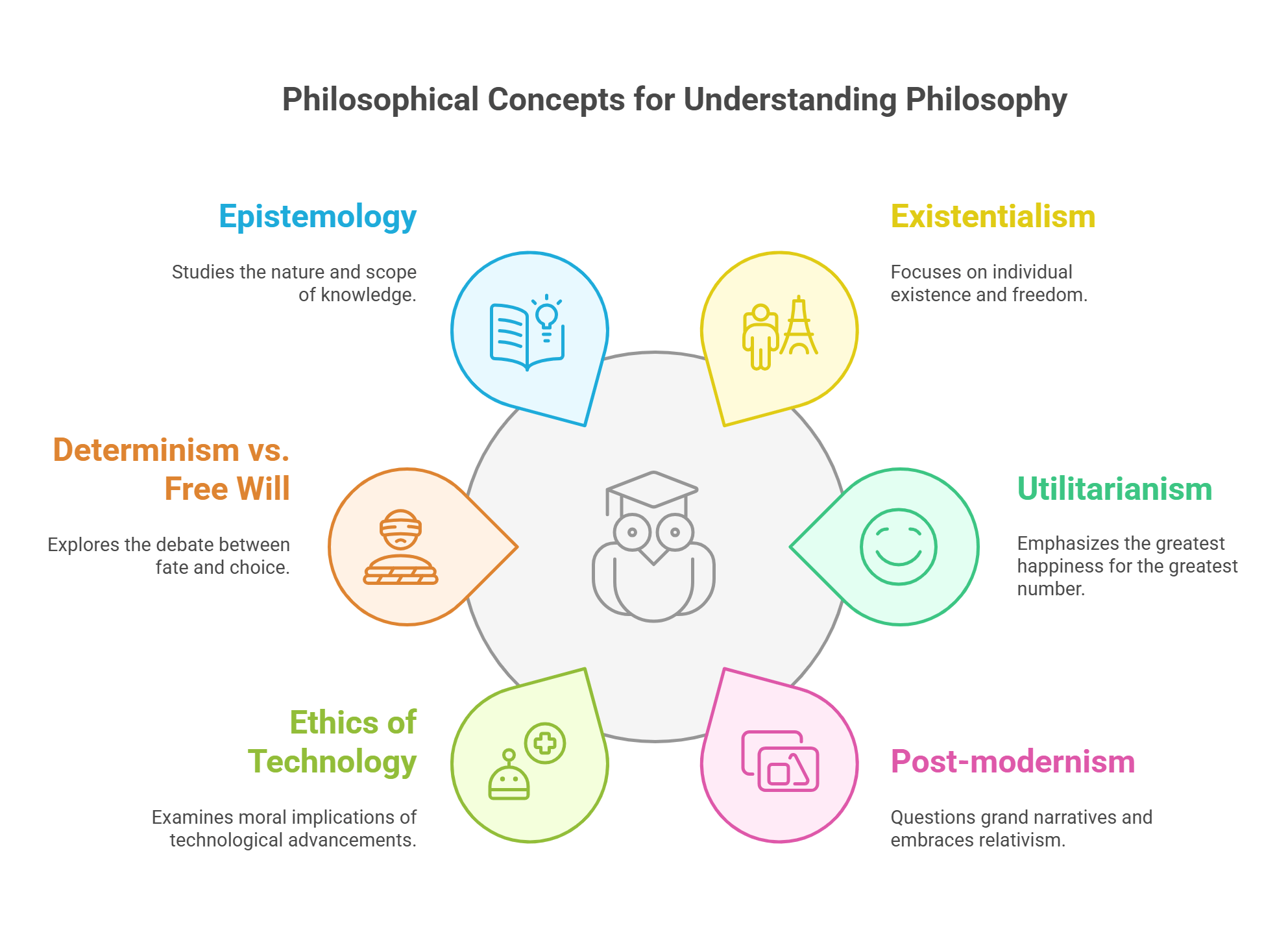
Here are the concepts from the image, plus a few others:
- Utilitarianism: The idea that the most ethical choice is the one that will produce the greatest good for the greatest number.
- Existentialism: A philosophy focused on individual freedom, responsibility, and the search for meaning in a meaningless world.
- Determinism vs. Free Will: The debate over whether our actions are predetermined by prior causes or if we have genuine freedom to choose.
- Epistemology: The branch of philosophy concerned with the nature of knowledge itself. (What does it mean to know something?)
- The Simulation Hypothesis: The idea that our reality is an artificial simulation, like a computer game.
Step 2: Initial Research (5 minutes)
Once you've chosen a concept, do a brief initial search. Good starting points are the Stanford Encyclopedia of Philosophy (SEP) or Wikipedia. Read only the introduction or the first few paragraphs to get the basic outline of the idea. Do not try to master it. Just get enough raw material to work with.
Step 3: Apply the Feynman Technique (15-20 minutes)
- First Pass (Write): Close your source material. Open a blank document and set a timer for 5-7 minutes. Write out an explanation of the concept as if you were explaining it to a friend. Write continuously.
- Second Pass (Identify Gaps): Read what you wrote. Where did you feel uncertain? What terms did you use without being 100% sure of their meaning? Did you wave your hands over a key connection? Highlight or circle these fuzzy spots. These are your knowledge gaps.
- Third Pass (Fill Gaps): Return to your source material only to clarify the specific points you highlighted. Spend a few minutes researching just those gaps until they feel solid.
- Fourth Pass (Rewrite & Simplify): Now, rewrite your explanation from scratch in a new paragraph. Your goal is a summary of about 100-150 words. Focus on using the simplest language possible (as advised by Pryor). Read it aloud to catch any awkward phrasing. This is your final summary.
This exercise is not about producing a perfect, exhaustive definition. It is about practicing the process of understanding.
Conclusion
Today, you've practiced a technique that is central to both learning and writing. By forcing yourself to explain a complex idea in simple terms, you move from passively receiving information to actively constructing understanding.
Key Takeaways:
- The Feynman Technique is a four-step method (Choose, Teach, Identify Gaps, Simplify) for achieving deep understanding of any topic.
- Writing is a tool for thinking. The act of explaining an idea reveals the gaps in your knowledge and forces you to build a more robust mental model.
- Clarity is King: In philosophy, as in science, the goal is to make complex ideas clear, not to make simple ideas sound complex. Simple language is a sign of mastery, not of a simple mind.
You now have a powerful method for engaging with the ideas of other thinkers. In our next lesson, we will build directly on this skill. We'll explore how to connect an abstract philosophical idea to a concrete, everyday example, taking your clear summary and making it vivid, relatable, and compelling for a reader.