Introduction
Welcome to the first lesson of our final module, "Leading Six Sigma Projects." In the previous modules, we completed a deep dive into the technical tools of the DMAIC framework, culminating in our last lesson on compiling the final project report. You've mastered the 'what' and 'how' of process improvement. Now, we shift our focus to the 'who'—the people who can make or break your project.
As an experienced professional, you know that even the most technically brilliant solution can fail if it doesn't get buy-in from the right people. This lesson addresses that challenge head-on by focusing on a foundational leadership skill: conducting a stakeholder analysis to identify sponsors, champions, and potential resistors.
Mastering this will equip you to navigate the complex human dynamics of a manufacturing environment. It's a critical competency for any Green Belt aspiring to a Black Belt role, as it lays the groundwork for effective change management, communication, and ultimately, project success.
1. Identifying Your Stakeholders
Before you can analyze stakeholders, you must first identify who they are. A stakeholder is any person, group, or entity that can affect, be affected by, or perceives themselves to be affected by your project. In a manufacturing setting, this list can be extensive.
To begin, let's get a clear definition and see some common methods for identifying these individuals and groups.
How to Identify Stakeholders Easily
This video from Adriana Girdler provides a concise overview of who stakeholders are and, more importantly, offers practical techniques for identifying them.
Please watch from 00:36 to 04:24. As you watch, pay close attention to the distinction between internal and external stakeholders and the suggested methods for identification, such as reviewing the project charter and using a SIPOC diagram.
As the video highlights, stakeholder identification is a discovery process. Key methods that are highly relevant to your Six Sigma work include:
- Reviewing Project Documents: Your Project Charter (which you learned to create in Module 1) is an excellent starting point, as it often lists the project sponsor, process owner, and key team members.
- Brainstorming: A simple, powerful technique. Sit with your core project team and ask: "Who will this project impact? Who needs to provide input? Who has to approve the changes? Who will have to live with the new process?"
- Using Process Maps and SIPOC: Your SIPOC diagram (also from Module 1) is a fantastic tool for this. It explicitly identifies Suppliers and Customers who are, by definition, key stakeholders. A more detailed process map can reveal departments or individuals involved in specific steps who might otherwise be overlooked.
2. The Stakeholder Analysis Matrix: From Identification to Understanding
Once you have a comprehensive list of stakeholders, the next step is to analyze them to understand their relative importance to your project. The most common tool for this is a stakeholder analysis matrix, often called a Power/Interest Grid. This tool helps you categorize stakeholders to prioritize your focus and tailor your engagement strategies.
This next video explains this fundamental matrix and its four quadrants.
Mastering Stakeholder Analysis: A Complete Guide to Effective Stakeholder Mapping
This video from Talent and Skills HuB introduces Mendelow's Matrix, a classic Power/Interest Grid. It clearly explains how to categorize stakeholders, which is the core of the analysis process.
Please watch from 00:44 to 02:20. Focus on understanding the definition of each of the four quadrants and the basic engagement strategy associated with each one.
The Power/Interest Grid provides a clear framework for thinking about your stakeholders:
- High Power, High Interest (Manage Closely): These are your most critical stakeholders. They have significant influence and are highly interested in your project's outcome. This group typically includes your Project Sponsor and key decision-makers like the Plant Manager or VP of Manufacturing. Your goal here is full engagement.
- High Power, Low Interest (Keep Satisfied): These stakeholders have significant influence but aren't involved in the project's daily details (e.g., a senior executive in another division, an HR director). The risk here is that they could become a powerful resistor if their needs are ignored. The goal is to keep them informed and satisfied so they don't impede your progress.
- Low Power, High Interest (Keep Informed): This group is passionate about the project but has little direct authority (e.g., machine operators on the line, quality technicians). They are often an excellent source of champions and advocates. Keeping them informed and involved builds grassroots support and provides valuable feedback. Ignoring them can create a source of passive resistance.
- Low Power, Low Interest (Monitor): These stakeholders require minimal effort, but you should not forget them entirely. An example might be a department indirectly affected by a supply chain change. It's wise to monitor them in case their interest or power changes over the course of the project.
3. Applying the Analysis in a Manufacturing Context
Now, let's move from theory to a practical application. A stakeholder analysis isn't just an academic exercise; it's a working document that guides your actions throughout the project.
The following resource from iSixSigma provides a step-by-step guide and, most importantly, an excellent example from a manufacturing environment.
How to Identify and Manage Stakeholders in Your Six Sigma Projects
Please read this article from iSixSigma. It frames stakeholder analysis within the context of a Six Sigma project and provides a concrete example that you should find very relatable.
First, read the sections 'Here Are the Steps for Doing a Stakeholder Analysis' and 'An Industry Example of a Stakeholder Analysis.' Pay close attention to the warehouse picking-and-packing example. Notice how they plot stakeholders on the Influence-Support Grid and then detail the action plan in the subsequent matrix.
The example in the article illustrates a crucial evolution of the Power/Interest grid by adding another dimension: Support. Your analysis isn't just about power and interest, but also about their current disposition towards your project. This is how you explicitly identify potential resistors and champions.
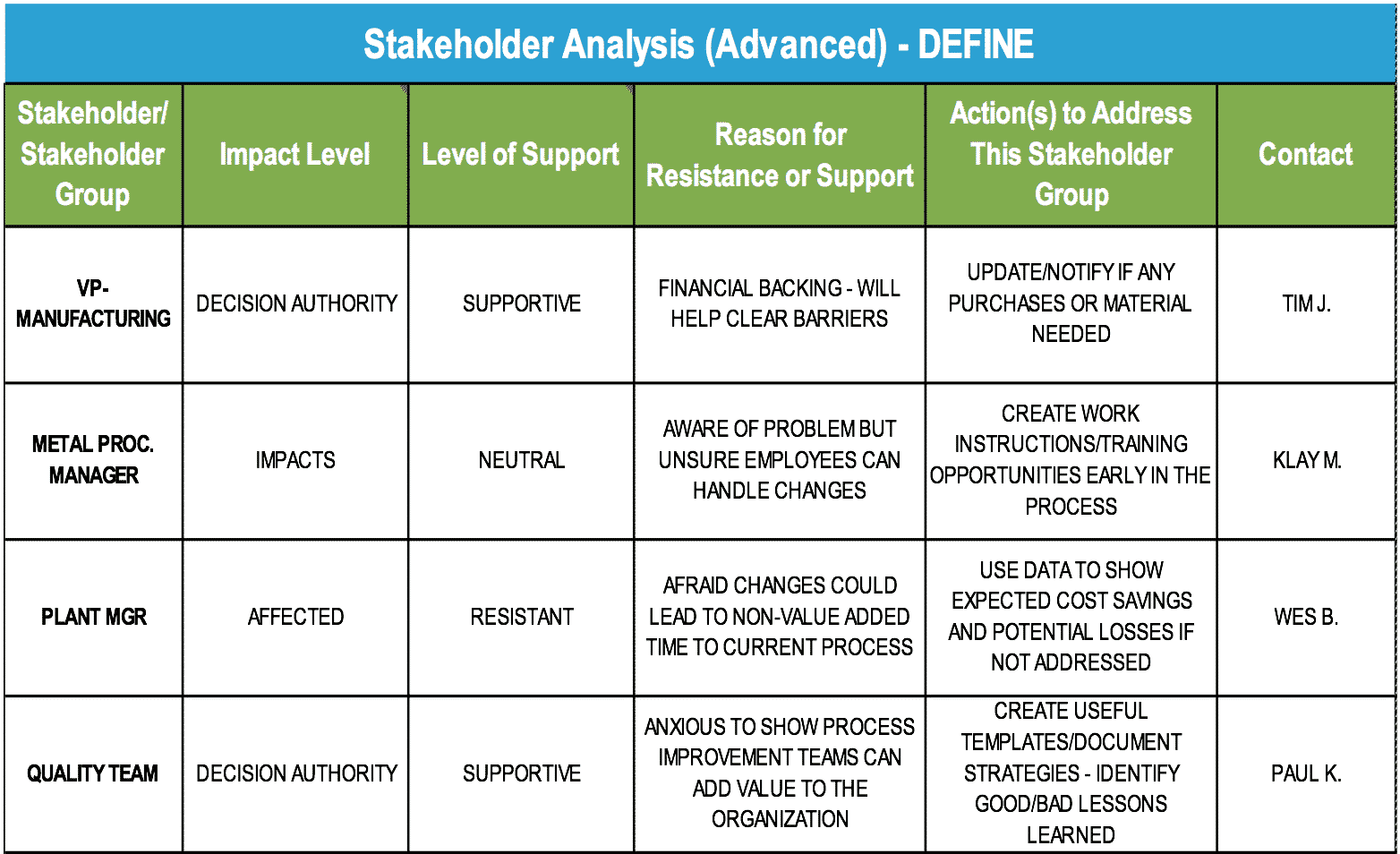
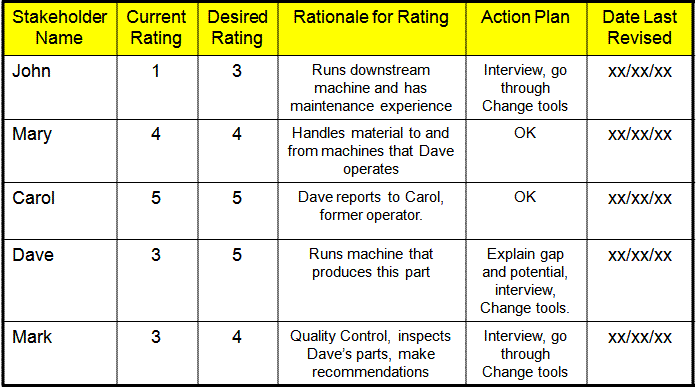
Here are two examples of what a completed stakeholder analysis might look like in a manufacturing project. These tables are the practical output of your analysis.
4. Identifying Sponsors, Champions, and Resistors
With your analysis complete and documented in a matrix, you can now clearly identify the key players:
- Sponsors: As mentioned, these are almost always in the High Power/High Interest quadrant. They are officially designated to authorize the project, secure resources, and remove roadblocks. Your analysis should confirm that your designated sponsor indeed has the power and interest to fulfill this role.
- Champions: These are supporters who advocate for your project. They can come from any quadrant but are often found in the High Interest groups (both high and low power). A machine operator (Low Power, High Interest) who speaks positively about the project to their peers can be just as valuable as a manager (High Power, High Interest) who defends your project in a leadership meeting. Your analysis helps you find and nurture these allies.
- Resistors: These are individuals who actively or passively oppose the project. The most dangerous resistors are in the High Power quadrants. A skeptical department head (High Power, Low Interest) or a competing manager (High Power, High Interest) can stop a project in its tracks. Your analysis must identify these individuals early and help you build a specific action plan to mitigate their resistance—either by addressing their concerns, demonstrating the project's benefits to them, or leveraging your sponsor to manage their opposition.
Conclusion
In this lesson, you've moved beyond the technical aspects of Six Sigma to explore the critical leadership skill of stakeholder analysis. You are now equipped to systematically identify and analyze the key people in your project's ecosystem.
Key Takeaways:
- Stakeholder Identification is Systematic: Use tools you're already familiar with, like the Project Charter and SIPOC, to ensure no one is missed.
- Analysis Provides Clarity: The Power/Interest Grid is a simple but powerful tool for categorizing stakeholders and prioritizing your efforts.
- From Analysis to Action: The goal of the analysis is to create a practical action plan, documenting a stakeholder's power, interest, and level of support to manage the relationship effectively.
- Identify Key Roles: A thorough analysis allows you to pinpoint your project's sponsors, cultivate champions, and, most importantly, proactively identify and manage potential resistors.
Preview of the Next Lesson:
Now that you know how to identify and analyze your stakeholders, the next logical question is: "What do I do with this information?" In our next lesson, we will answer that by learning how to develop a communication plan to engage stakeholders and manage expectations throughout the project. You'll learn how to use the insights from your stakeholder analysis to build a targeted communication strategy that keeps everyone informed, engaged, and aligned with your project's goals.