Introduction
Welcome back! In our last lesson, we focused on identifying and analyzing your project stakeholders, distinguishing between sponsors, champions, and potential resistors using the Power/Interest Grid. This analysis gave you a clear map of the human landscape of your project.
But a map is only useful if you use it to navigate. This lesson is about taking that analysis and turning it into a concrete action plan. Today, you will learn how to develop a communication plan to engage stakeholders and manage expectations throughout the project.
For a project leader in a manufacturing environment, a formal communication plan is not bureaucratic overhead—it's a critical control mechanism. It ensures that the right information gets to the right people at the right time, preventing the rumors, misunderstandings, and misaligned expectations that can derail even the most promising Six Sigma projects. This skill is a cornerstone of effective project leadership and essential for moving into Black Belt responsibilities.
1. The "Why" and "What" of a Communication Plan
Before we build a plan, let's solidify why it's so important. In your 11 years in industrial engineering, you've likely seen projects stall not because of technical flaws, but because of poor communication. A communication plan is your proactive strategy to prevent this.
Project Management: Creating a Communications Plan
To start, watch this short segment from ProjectManager. It does an excellent job of framing the communication plan as a tool for actively managing your project's message and preventing the spread of misinformation.
Please watch the first 1 minute and 49 seconds of the video. Note the speaker's emphasis on how a lack of a formal plan can lead to rumors and misconceptions that can ultimately harm or even 'kill' your project.
As the video states, the plan's purpose is to communicate "the right messages to the right people at the right times." This isn't just about avoiding problems; it's about driving success. A well-structured plan directly contributes to key performance indicators.
How to Create an Effective Project Communication Plan
This article from SixSigma.us provides some hard data on the impact of effective communication. As someone with a background in process improvement, you'll appreciate these quantifiable benefits.
Read the sections 'What Is a Project Communication Plan?' and 'The Importance of a Project Communication Plan.' Focus on the statistics cited regarding project completion rates, risk mitigation, and stakeholder satisfaction.
The key takeaway is that a communication plan is a formal document that structures information flow. It has a direct, measurable impact on project performance, risk, and stakeholder buy-in.
2. Building Your Communication Plan: The Key Components
A comprehensive communication plan can be captured in a simple but powerful matrix. The stakeholder analysis you completed in the last lesson is the primary input for this matrix.
This next video provides an excellent walkthrough of a practical template. It breaks the plan down into clear, actionable components.
Project Communication Plan [STEP-BY-STEP INSTRUCTIONS]
Adriana Girdler offers a step-by-step guide to filling out a communication plan matrix. This is a very practical approach that you can directly apply to your own projects.
Watch from 01:56 to 10:55. Pay close attention to the columns she uses in her template, such as 'Communication Method,' 'Purpose,' 'Recipients,' and 'Frequency.' Notice how she tailors the type of communication to different stakeholder groups, from the core project team to senior executives.
Let's synthesize the key components from the video and our previous reading into a core template. A strong communication plan should answer the following questions for each stakeholder or stakeholder group:
- Who? (Stakeholder): The person or group you need to communicate with (e.g., Plant Manager, Machine Operators).
- Why? (Purpose/Objective): What is the goal of the communication? (e.g., To inform, to get a decision, to gather feedback, to build support).
- What? (Key Message): What specific information do they need? This should be tailored based on their power and interest level from your analysis.
- How? (Method/Channel): What is the best way to deliver this message? (e.g., Formal email, tollgate review meeting, daily stand-up, visual display on the shop floor).
- When? (Frequency): How often will you communicate? (e.g., Daily, weekly, monthly, at project milestones).
- By Whom? (Owner): Who is responsible for initiating the communication? (e.g., Project Lead, Sponsor, Line Supervisor).
3. A Practical Manufacturing Example
Let's apply this to a hypothetical defect reduction project on a bottling line. Your stakeholder analysis identified the Plant Manager (Sponsor), Line Supervisors, and Operators as key stakeholders.
Here is a template for a communication plan, similar to the ones seen in the resources.
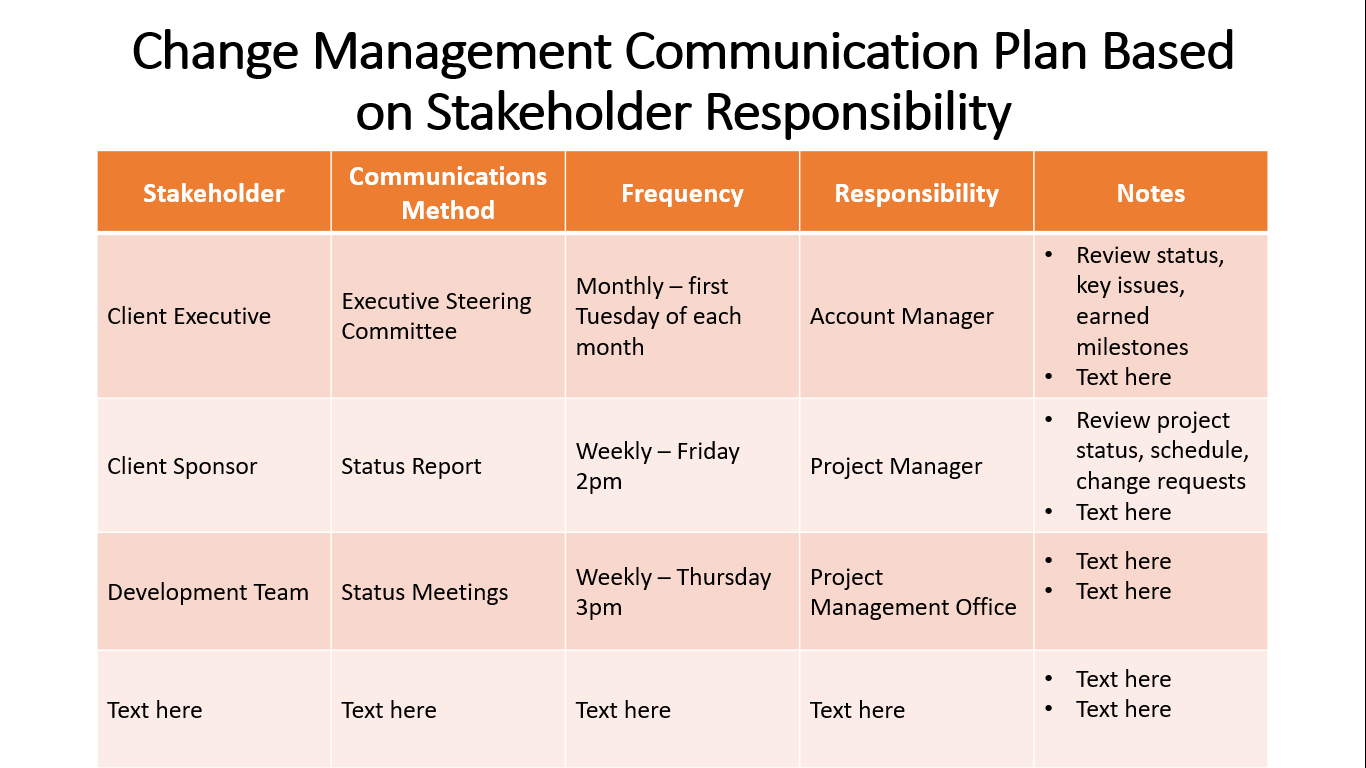
Now, let's fill it out for our bottling line project:
| Stakeholder | Purpose (Why?) | Key Message (What?) | Method (How?) | Frequency (When?) | Owner (By Whom?) |
|---|---|---|---|---|---|
| Plant Manager (Sponsor) | Gain approval, secure resources, remove roadblocks. | Project status, key risks, schedule adherence, financial impact (ROI). | Formal Tollgate Review Meeting & Weekly Summary Email. | Monthly (Tollgate), Weekly (Email). | Project Lead. |
| Line Supervisors | Ensure buy-in, coordinate operator involvement, provide feedback on feasibility. | Upcoming changes, pilot test schedules, impact on daily operations, feedback on issues. | Weekly Project Update Meeting & informal daily check-ins. | Weekly (Meeting), Daily (Check-ins). | Project Lead. |
| Machine Operators | Build trust, gather practical insights, minimize resistance. | "What's in it for me?", training plans, how to provide feedback, progress on their suggestions. | Daily Stand-up Huddles on the floor, Visual Idea Board. | Daily (during pilot), Weekly (updates). | Line Supervisor. |
| Quality Dept. | Ensure compliance with standards, validate data. | Measurement System Analysis (MSA) results, data collection plan, proposed process changes. | Formal report review & scheduled meetings. | At Measure & Improve phases. | Project Lead. |
This structured approach ensures you are systematically managing expectations. You are not just broadcasting information; you are engaging each group with the specific message and method that fits their needs, which you uncovered during your stakeholder analysis.
This example from a real Six Sigma project thesis shows a very similar, concise plan used during the Define phase.
Excerpt on Communication Plan from 'The Application Of Lean Six Sigma To Improve A Business Process'
This resource shows a communication plan from a real-world Lean Six Sigma project. It's a simple table, demonstrating that this tool doesn't need to be overly complex to be effective.
Review Table 5.3, the 'Communication Plan.' Notice how it clearly maps stakeholders to the types of information they will receive (e.g., Tollgate materials, Meeting Minutes) and the method (Meeting or Email).
4. Integrating the Plan into Your Project Rhythm
A plan on paper is not enough. You must integrate it into the project's operating rhythm. Two key integration points are the project kickoff and the DMAIC tollgate reviews.
- Project Kickoff: Your communication plan should be presented at the project kickoff meeting. This sets expectations from day one about how information will flow, demonstrating transparency and a structured approach to leadership.
- Tollgate Reviews: Tollgate reviews are one of the most critical communication events in any Six Sigma project. They are the formal checkpoints where you present your progress and deliverables to your Sponsor and other key stakeholders to get approval to move to the next phase. Your communication plan should explicitly list these reviews.

Finally, remember that your communication plan is a living document. Just as a process control plan is updated, your communication plan should be reviewed and adjusted as stakeholders change or as the project evolves.
Conclusion
In this lesson, you've learned how to translate your stakeholder analysis into a powerful leadership tool: the communication plan. By being deliberate about how you engage with each stakeholder, you move from a reactive to a proactive management style, significantly increasing your project's chance of success.
Key Takeaways:
- A communication plan is a strategic document that answers the Who, What, Why, How, When, and By Whom of project communication.
- The plan's effectiveness comes from tailoring the message and method to each stakeholder group, based on the insights from your stakeholder analysis.
- The plan should be built around a structured matrix that is easy to understand and maintain.
- Effective communication is not an add-on; it must be integrated into the project's rhythm, especially at the kickoff meeting and during formal tollgate reviews.
Preview of the Next Lesson:
We've established that tollgate reviews are critical communication events. In the next lesson, we will focus exclusively on them. You will learn how to facilitate effective tollgate reviews to gain leadership approval at each DMAIC phase. This will involve preparing your materials, managing the meeting, and ensuring you get the clear 'go/no-go' decision needed to maintain project momentum.