Hello! Welcome back.
In our previous lessons, we established the "why" and "what" of our project. We created a project charter to define the business case and problem statement, and then used a CTQ tree to translate the customer's needs into specific, measurable requirements.
Today, we will synthesize all that information into a single, powerful sentence: the project goal. By the end of this 60-minute lesson, you will be able to define SMART project goals that are directly linked to key manufacturing metrics like yield, cycle time, and defect rates. This formal goal statement will serve as your project's north star, providing a clear and unambiguous definition of success for you, your team, and your stakeholders.
From Vague Objectives to SMART Goals
In any project, it's easy to start with a broad objective like "improve quality" or "reduce waste." While the intent is good, these statements are too vague to be actionable. They don't tell you what to measure, how much to improve, or when you should be done.
This is where the SMART framework comes in. It provides a simple checklist to transform a fuzzy objective into a powerful goal statement. As an Industrial Engineer, you've likely encountered this framework, but we will focus on its rigorous application within a Six Sigma project structure.
To start, let's get a detailed breakdown of the SMART framework, tailored specifically for a manufacturing environment.
How to Set SMART Goals for Manufacturing Excellence
The article 'How to Set SMART Goals for Manufacturing Excellence' from LeanSuite provides an excellent, in-depth look at each component of the SMART acronym.
Please read the following sections: 'What are SMART goals?', 'Breaking down the SMART acronym', 'The process of writing SMART objectives for manufacturing', and 'Examples of SMART goals in a manufacturing context'. As you read, pay close attention to how each example connects a general goal to a specific manufacturing metric (e.g., scrap rate, OEE, defect rate).
The key takeaway is that a SMART goal forces you to move from a general problem to a specific, quantified target. This is the essence of the data-driven DMAIC methodology.
The Goal Statement in a Six Sigma Project
The SMART goal isn't just an abstract exercise; it's a formal and critical component of your Project Charter. It gives the entire project a clear endpoint.
Look at this example of a project charter. Notice where the SMART goal sits and how it quantifies the project's objective.
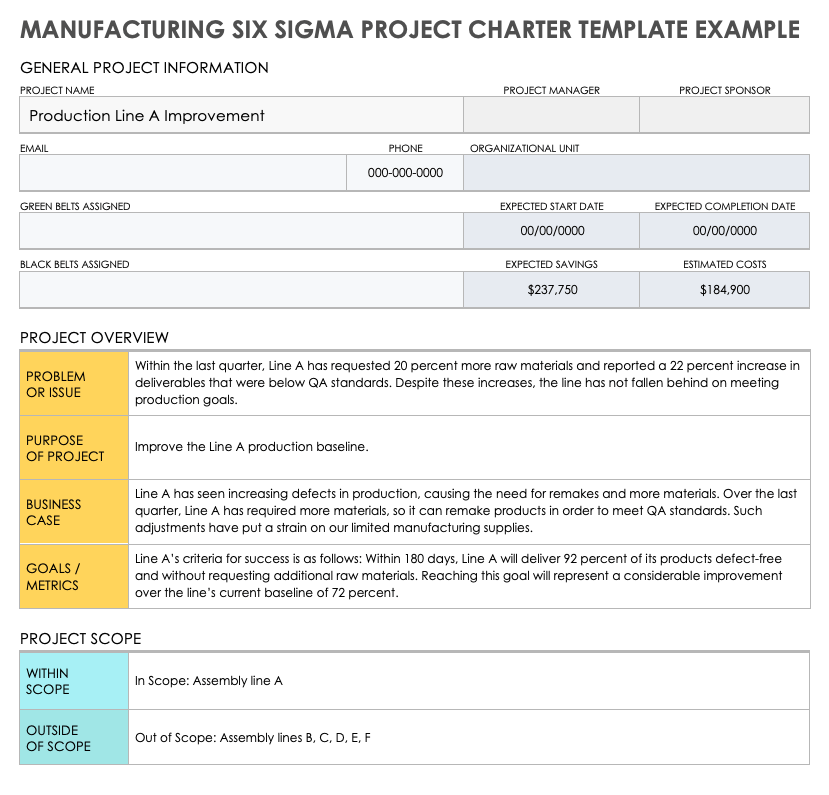
Furthermore, a well-defined project goal should always be Relevant (the 'R' in SMART) to the broader business strategy. Your project to reduce defects on one line should connect to a higher-level business objective, such as improving profitability or increasing customer satisfaction.

Practical Examples of SMART Goals
Let's see how this looks in the context of real Six Sigma projects. The following videos provide excellent, concise examples of well-formed project goals.
Six Sigma Complete Project Example HD
First, this clip from QuikSigma's 'Six Sigma Complete Project Example' demonstrates a perfectly stated SMART goal for defect reduction. It also introduces the valuable concept of 'side conditions' or constraints.
Watch from 03:16 to 05:33. Listen carefully to how the goal is phrased: it includes the metric (weld defects per week), the baseline (188), the target (65), and the deadline (June 30th). Note the constraints: 'without compromising weld strength or worker safety'.
This second example focuses on a different, but equally important, manufacturing metric: cycle time.
Lean Six Sigma Project Example with DMAIC - Green Belt Training
This video from Six Sigma Global Institute provides another clear example, this time related to improving delivery time.
Watch from 00:37 to 02:04. The goal is 'to reduce the time from customer orders to delivery by 30%' within a 3-month timeline. This is a classic example of a goal tied to a cycle time metric.
Guidelines for Crafting a Powerful Goal Statement
Beyond the SMART acronym, there are several best practices for writing goal statements in a Lean Six Sigma context. These guidelines help ensure clarity and focus.
10 Guidelines for Great Goal Statements
The article '10 Guidelines for Great Goal Statements' from GoLeanSixSigma.com offers practical advice for refining your project goals. We'll focus on a few key guidelines.
Please read the following guidelines: '1. Be Specific!', '3. Make It Your One and Only!', '4. Make It Achievable!', and '9. Don’t Include Solutions!'. These sections provide a disciplined format for your goal and warn against common pitfalls like having multiple goals or embedding a solution in the problem statement.
These guidelines are crucial. A common mistake is to write a goal like, "Reduce order errors from 4% to 1% by implementing a new CRM system." This pre-supposes the solution. A proper goal statement—"Reduce order errors from 4% to 1% by March 31st"—defines the problem and leaves the how to be determined through your analysis in the later DMAIC phases.
Your Turn: Define a SMART Goal
Let's bring this all together by returning to our brake pad scenario from the last lesson.
Scenario Recap:
Your project is addressing a customer VOC of "excessive brake noise." In the last lesson, you created a CTQ tree and likely identified several measurable CTQs. Let's assume your team's analysis has pinpointed one primary CTQ: sound level during a standardized braking test.
Your Task:
Imagine your team has collected initial data in the Measure phase (we'll cover this formally later). The data shows:
- Current Baseline: The average sound level is 85 decibels (dB).
- Customer Specification Limit: Customers start to complain when the noise exceeds 75 dB.
- Engineering Analysis: Your team believes a target of 72 dB is aggressive but achievable with process changes.
Based on this information, write a SMART goal for the brake noise reduction project. Use the format recommended in the GoLeanSixSigma article: "Increase/Decrease [Metric] from [Baseline] to [Target] by [Date]." You can invent a reasonable project timeline.
Conclusion
You have now completed the core elements of the Define phase. You have a business case, a problem statement, a defined scope, an understanding of the customer's requirements (CTQs), and now, a sharp, actionable SMART goal. This goal statement is the contract for your project—it defines success for everyone involved.
Key Takeaways:
- A SMART goal is Specific, Measurable, Achievable, Relevant, and Time-bound.
- The goal statement should focus on a single, primary metric and follow a clear format: "Decrease defect rate from 10% to 3% by Q3."
- The goal is about the "what," not the "how." The solution should never be part of the goal statement.
- Your project's goal must be relevant to larger business objectives and tied to key manufacturing metrics like yield, cycle time, or defect rates.
Preview of the Next Lesson:
With the project's objective clearly defined, our next step is to understand the process itself. In the next lesson, we will create a SIPOC diagram. This high-level process map will help us establish the boundaries of our process (the "start" and "end" points), which is essential before we dive deep into data collection in the Measure phase.