Hello! Welcome back to your Lean Six Sigma course.
In our last lesson, we built the foundation for a Six Sigma project by creating a project charter. We defined the business case, a data-driven problem statement, and a clear scope. This gave us the "what" and "why" from the business's perspective. Now, we need to understand the problem from the most important viewpoint: the customer's.
Today's lesson focuses on translating the often-vague Voice of the Customer (VOC) into concrete, measurable engineering requirements. By the end of this 60-minute session, you will be able to translate VOC into Critical-to-Quality (CTQ) requirements using a powerful tool called a CTQ tree. This is a critical skill that connects high-level customer complaints to the specific process metrics you will measure and improve.
From Vague Feedback to Specific Requirements
In manufacturing, you've likely encountered customer feedback that is important but not immediately actionable. A customer might say a product is "unreliable," "noisy," or "difficult to use." This is the Voice of the Customer (VOC). While it tells you that a problem exists, it doesn't tell you what to measure or fix.
The goal of this lesson is to systematically break down that qualitative feedback into quantitative specifications. These specific, measurable characteristics are known as Critical-to-Quality requirements, or CTQs.
To start, let's watch a video that introduces the concept of CTQs and the process of translating customer needs.
Using CTQ to translate Voice Of Customer (with example)
This video, 'Using CTQ to translate Voice Of Customer,' provides a clear explanation of how to move from a qualitative customer statement to a specific, measurable requirement. It uses a simple, relatable example to demonstrate the core idea.
Watch the video from the beginning until 02:41. Pay close attention to how a vague statement like 'I really hate filling out this form' is clarified through questions to become a measurable requirement: 'the form should take less than five minutes to complete'.
As the video shows, the key is to ask clarifying questions to drill down from a general feeling to a specific condition that defines success.
Structuring the Translation: The CTQ Tree
The most common tool for this translation is the CTQ Tree. It provides a logical, hierarchical structure to deconstruct a customer need. The tree helps ensure that your project efforts remain directly linked to what the customer truly values.
A CTQ tree typically has three main levels:
- Need: The high-level, initial statement from the customer (the VOC).
- Quality Drivers: The broad categories that the customer uses to evaluate the product or service. These are the factors that must be right to satisfy the need.
- CTQ Requirements: The specific, measurable performance requirements for each driver. This is what your process must deliver.
Let's see how this tree is built. The next part of the video we just started walks through creating a CTQ tree for a dining experience.
Using CTQ to translate Voice Of Customer (with example)
Now, let's continue with the same video to see how the CTQ tree structure is applied in practice.
Watch from 02:41 to 05:32. Observe how the general need ('nice dining experience') is broken down into drivers (experience, food quality, price, service) and then into measurable performance requirements (e.g., 'waiting time less than five minutes').
This systematic breakdown prevents teams from making assumptions and ensures everyone is working towards the same, clearly defined goals.

A Manufacturing-Focused Approach
While restaurant and pizza examples are useful for understanding the concept, let's ground this in the manufacturing world you operate in. In manufacturing, customer needs often relate to the "iron triangle" of Quality, Cost, and Delivery. These often serve as excellent high-level quality drivers.
The following resource provides a practical, step-by-step guide and includes a superb example of a CTQ tree for manufacturing operations.
CTQ Six Sigma: Drive Measurable Quality Gains at Scale.
This article, 'CTQ Six Sigma: Drive Measurable Quality Gains at Scale,' from Air Academy Associates is highly practical. It shows how to directly apply the CTQ tree concept in a business environment.
Please read 'Step 1: Capture VOC and Define Scope' and 'Step 2: Build & Prioritize the CTQ Tree'. Pay special attention to the table 'Content Matrix: Example CTQ Tree Slice'. Notice how it translates customer needs like 'Get my order on time' into a precise CTQ: 'OTIF ≥ 98%'. This is exactly the kind of translation you'll perform in your projects.
The example matrix in the article is a model of a good CTQ. It's not just a metric; it includes a target, a specification limit, a measurement method, and an owner. This level of detail is what makes a CTQ truly actionable.
To see this drill-down in even greater detail, look at the following example. While it's for a data entry process, the logic is identical for any manufacturing process where accuracy, dimensions, or other specifications are critical.
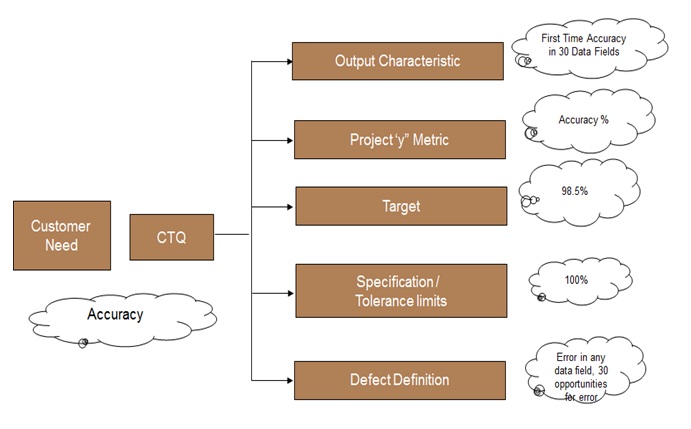
Your Turn: Create a CTQ Tree for a Manufacturing Problem
Let's apply this to the scenario from our last lesson.
Scenario Recap:
A customer's Voice of the Customer (VOC) is reporting "excessive brake noise" from your company's premium brake pads.
This is a classic, vague customer complaint. Your task is to translate this VOC into a CTQ tree. This will turn an ambiguous problem into a set of specific engineering characteristics to investigate.
Your Task:
Take about 15 minutes to build a CTQ tree for this scenario. Don't worry about getting the exact engineering values perfect; focus on the logical breakdown.
- Need: Start with the core customer need. What are they really asking for? (e.g., Quiet braking performance).
- Quality Drivers: What broad factors would a customer or engineer associate with a "quiet" brake pad? Think about what could cause noise. (Hint: Consider the material, the physical interaction, and consistency).
- CTQ Requirements: For each driver, define at least one specific, measurable requirement. Think about what you would measure in a lab or on the production line to quantify that driver. For at least one CTQ, try to define a hypothetical target and specification limit.
Use this structure for your answer:
- Need: [Your statement of the customer need]
- Driver 1: [Name of the first driver]
- CTQ 1a: [Measurable requirement with units, e.g., 'Sound level (dB)']
- Driver 2: [Name of the second driver]
- CTQ 2a: [Measurable requirement, e.g., 'Pad thickness variation (mm)']
- CTQ 2b: [Another measurable requirement for this driver]
- Driver 1: [Name of the first driver]
Conclusion
Today, you've learned how to bridge the gap between a subjective customer complaint and an objective engineering problem. This is a foundational skill in the Define phase that sets the stage for meaningful measurement and analysis.
Key Takeaways:
- Voice of the Customer (VOC) is the raw, often qualitative, feedback from your customers.
- Critical-to-Quality (CTQ) requirements are the specific, measurable product/process characteristics that must be met to satisfy the VOC.
- The CTQ Tree is a structured tool for translating the VOC into CTQs by breaking it down into Needs, Drivers, and Requirements.
- A strong CTQ is not just a metric; it has a clear operational definition, a target, and specification limits.
By creating a CTQ tree, you ensure your project is focused on what truly matters to the customer, preventing wasted effort on characteristics that don't impact their satisfaction.
Preview of the Next Lesson:
We've now defined the project with a charter and clarified the customer's requirements with a CTQ tree. The final step in the Define phase is to synthesize this into a formal project objective. In our next lesson, we will focus on how to Define SMART project goals that are directly linked to the CTQs and other key manufacturing metrics like yield, cycle time, and defect rates. This will give us a crystal-clear definition of success before we move into the Measure phase.