In our first lesson, we established the three foundational principles of Mandarin Chinese: it is a tonal, isolating, and SVO language. You learned that the pitch with which a syllable is spoken is not just for emotional emphasis but is a fundamental part of its identity, capable of changing its meaning entirely.
Today, we move from theoretical understanding to practical application. This lesson is dedicated to mastering that first and most crucial principle: the tones. We will dissect the four main lexical tones and the fifth neutral tone. Your goal for this session is to be able to hear the difference between them and, most importantly, to start producing them accurately on a single syllable. This is a foundational physical skill, much like learning the correct finger placement for a musical instrument, and it will be the bedrock of your spoken Mandarin.
The Five Tones: Pitch as a Function of Time
In the previous lesson, we saw visual diagrams of the tones. Let's start with another clear example using the syllable ma.
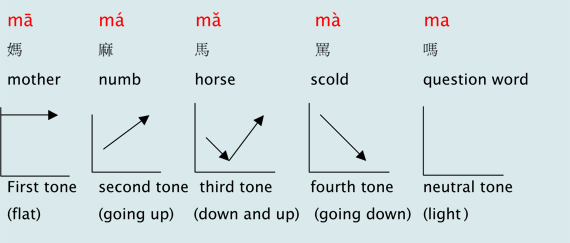
As you can see, the same sound, ma, becomes five distinct words depending on its pitch contour. Given your background in mathematics, you can think of each tone as a simple function of vocal pitch (frequency) over time, , for the duration of a syllable, say .
- First Tone (mā): A high, flat tone. The pitch function is constant and high: , where is in the upper part of your vocal range.
- Second Tone (má): A rising tone. The pitch function is roughly linear with a positive slope, starting from your mid-range and rising: , with .
- Third Tone (mǎ): A dipping tone. The full version of this tone falls and then rises, approximating a parabolic curve: . However, as we'll see, it's often simplified in practice.
- Fourth Tone (mà): A falling tone. This is a sharp drop from a high to a low pitch, like a linear function with a steep negative slope: , with .
- Neutral Tone (ma): This is a short, unstressed syllable whose pitch depends on the preceding tone. It doesn't have its own inherent pitch function.
This framework might help you conceptualize the tones not as vague sounds, but as well-defined, reproducible shapes.
Learning to Produce the Tones
Now, let's learn how to actually make these sounds. We will use a video from the "Grace Mandarin Chinese" channel that breaks down the tones in a very logical order, contrasting the highest and lowest tones first.
Master Chinese Tones | Pronunciation Training
This video, "Master Chinese Tones," provides excellent explanations, practical tips, and useful analogies for each tone. We will go through it section by section.
First, watch the instructor's introduction to tones, where she uses the English word "okay" to illustrate how we already use pitch changes in our speech: introduction to tones. First Tone & Third Tone: The video pairs the highest and lowest tones to help you feel the contrast. Watch the explanation of the First Tone (high and flat): high tone. Try to produce a sustained, high, level sound. Next, watch the explanation of the Third Tone (low and dipping): low tone. Pay close attention to the crucial advice that in most conversational contexts, the full "dipping and rising" shape is simplified to just a low, creaky tone (often called a "half-third tone"). This is a vital practical shortcut. Second Tone & Fourth Tone: Now for the moving tones. Watch the explanation of the Second Tone (rising): rising tone. The analogy to a questioning intonation ("Tea?") is very helpful. Then, watch the explanation of the Fourth Tone (falling): falling tone. Think of it as a sharp, definite command ("Go!"). Neutral Tone: Watch the brief introduction to the Neutral Tone: light and short. The key is that it's unstressed and quick. Review: Finally, watch the quick recap to consolidate your understanding of all five tones.
Drills and Practice
Understanding the tones is one thing; training your vocal muscles to produce them on command is another. This requires repetition. The following video from "ChineseFor.Us" is excellent for structured drills.
Master Chinese Tones to Sound Like A Native (Pronunciation Guide)
This video, "Master Chinese Tones to Sound Like A Native," offers guided practice. We'll use it to drill the sounds you just learned.
Begin by listening and repeating the four main tones on the syllable 'a'. This will help you get a feel for them in sequence. Watch from the four tones. For more focused practice on each individual tone, you can work through these detailed sections: First Tone: practice Second Tone: practice Third Tone: practice Fourth Tone: practice The video also offers great insight into the Neutral Tone. It reinforces that it's light and short, but also explains that its actual pitch is determined by the tone that comes before it. Listen to the initial examples: neutral tone examples. Then, pay close attention to this section, which demonstrates how the neutral tone's pitch changes depending on the preceding tone: pitch changes.
Interactive Auditory Practice
To complete this lesson, let's use an interactive resource that allows you to hear and repeat tones for different simple syllables. This will help you begin to generalize the skill beyond just the syllable 'a'.
Chinese Pronunciation Guide Pinyin Chart
The website New Concept Mandarin has an excellent interactive Pinyin chart with audio for every sound.
On the page, scroll down to the "Mandarin Pronunciation Table." You will see a large grid with letters A-Z at the top. Click on 'A'. A table will appear with rows for a, ai, an, ang, and ao. Each column represents a tone (1st, 2nd, 3rd, 4th, Neutral). Each cell is a clickable audio link. Your task is to: Click on ā (first tone) and listen. Then try to imitate it. Do the same for á (second tone), ǎ (third tone), à (fourth tone), and a (neutral tone). Work your way through the entire row for 'a', then proceed to the rows for ai, an, ang, and ao. Listen and repeat each sound. The goal is active production, not just passive listening.
Key Takeaways
You've now taken your first major step into the sound system of Mandarin. Let's summarize the key points:
- Mandarin has four primary tones and a fifth neutral tone, which are essential for distinguishing meaning.
- First Tone: High and flat.
- Second Tone: Rising from mid to high.
- Third Tone: A low-dipping tone. Crucially, in conversation, it's often pronounced as a simplified, low, "half-third tone."
- Fourth Tone: A sharp falling tone from high to low.
- Neutral Tone: A light, short, and unstressed syllable whose pitch is influenced by the preceding tone.
- Producing tones is a physical skill that improves with consistent, deliberate practice.
In our next lesson, we will begin learning the building blocks that these tones apply to: the Pinyin initials. These are the consonant sounds that start a syllable. Once you have the initials, you'll be able to combine them with finals (the vowels you've started practicing today) and tones to pronounce a huge range of Mandarin syllables.