Welcome to the start of your journey to learn Mandarin Chinese! This first lesson is designed to give you a high-level overview of the language's fundamental architecture. Think of it as looking at the system specifications before you start coding. By the end of this session, you'll be able to describe the three core linguistic features of Mandarin—its tonal nature, its isolating structure, and its basic word order—and see how they compare and contrast with English. Understanding these principles from the outset will provide you with a solid mental model for everything that follows.
The Three Pillars of Mandarin Chinese
To begin learning a new language, especially one as different from English as Mandarin, it's helpful to first understand its basic design. We'll explore three defining characteristics:
- Mandarin is a tonal language. The pitch you use to say a syllable changes its meaning.
- Mandarin is an isolating language. Words don't change their form for tense, number, or gender.
- Mandarin has a Subject-Verb-Object (SVO) word order. This is a key similarity with English.
Let's examine each of these in turn.
1. A Tonal Language
The most famous feature of Mandarin is its use of tones. In English, we use intonation to convey emotion or to frame a question, but it doesn't change the dictionary definition of a word. For example, saying "Really?" with a rising pitch versus "Really." with a falling pitch changes the sentence's function, but the word "really" still means the same thing.
In Mandarin, the pitch contour of a syllable is part of the word itself and is as important as its vowels and consonants. Changing the tone changes the word's meaning entirely.
Watch This Before Learning Mandarin Chinese - Ultimate Tutorial for Beginners
To get a first impression, watch this brief segment from the video "Watch This Before Learning Mandarin Chinese" by Chinese with Jessie.
The presenter will introduce the concept of tones and give a quick example. Watch the segment from the introduction to tones. Note how she explains that tones can change the meaning of a word.
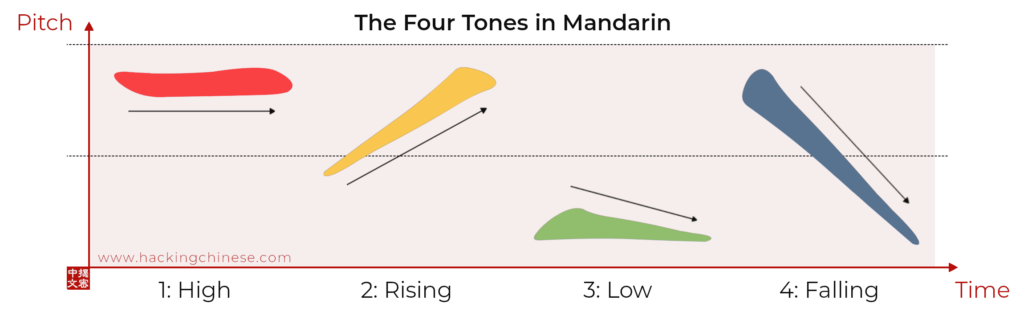
Mandarin has four main tones, plus a fifth "neutral" tone. Here’s how they are typically described:
- First Tone (ā): High and flat.
- Second Tone (á): Rising.
- Third Tone (ǎ): Falling then rising.
- Fourth Tone (à): Sharply falling.
- Neutral Tone (a): Short and light, with no specific pitch.
This might seem daunting, but it's a finite system with clear rules. For example, the syllable ma can mean "mother" (mā), "hemp" (má), "horse" (mǎ), or "to scold" (mà), depending entirely on the tone. We will dedicate the entire next lesson to practicing these tones, so for now, just focus on understanding the concept.
2. An Isolating Language
Here is some good news: Chinese grammar can be surprisingly straightforward in some respects. Mandarin is what linguists call an "isolating" or "analytic" language. This means that words are generally single, unchanging units of meaning (morphemes) that get arranged in a sentence.
This is a profound difference from English, which is a "synthetic" language. In English, we add prefixes and suffixes to words to change their grammatical function. For example:
go->goes(third-person singular) ->went(past tense)cat->cats(plural)
In Mandarin, this does not happen. Verbs don't conjugate for tense, and nouns don't have plural forms.
Long and Short Words: Language Typology
For a brilliantly clear explanation of this concept, watch the beginning of this video from Tom Scott. His breakdown of language typology will give you the precise terminology for this feature.
First, watch the introduction, where he defines a "morpheme" and the analytic-to-synthetic spectrum. Then, watch the section on isolating languages, where he specifically uses Chinese as the primary example.
As the video explains, a word in Chinese generally has one fixed form. Grammatical meaning like tense or plurality is expressed by adding other words to the sentence.
Chinese grammar rules: 5 general rules for Chinese grammar | Chinese Boost | Learn Chinese
The article "Chinese grammar rules" from Chinese Boost provides excellent, simple examples of this principle in action.
Please read the section titled Rule #2. Focus on the examples that show how the verb 去 (qù, "to go") remains unchanged regardless of the subject ("I go," "she goes," "they go"), and how the adjective 黑色的 (hēisè de, "black") doesn't change whether it's modifying a car or cats. This is the core of what makes Chinese an isolating language.
This isolating nature means that word order and the use of special "function particles" are extremely important for conveying grammatical relationships—much more so than in English.
3. Subject-Verb-Object (SVO) Word Order
The third key feature is a point of reassuring similarity. Like English, the basic, neutral word order of a simple Mandarin sentence is Subject-Verb-Object (SVO).
- English: I love you. (Subject - Verb - Object)
- Mandarin: 我爱你 (wǒ ài nǐ). (Subject - Verb - Object)
This is not universal. Many other languages, such as Japanese and Korean, use SOV (Subject-Object-Verb), and others use VSO (Verb-Subject-Object). The fact that Mandarin shares this core structure with English provides a helpful anchor as you begin to construct sentences.
Language classification, typology / Babylon :: lingvo.info
This short article on linguistic typology provides useful context.
Read the section on Basic word order. It confirms that Chinese, like English, is an SVO language, and contrasts this with other major world languages.
Putting It All Together: A Systems View
So, we have a tonal, isolating, SVO language. How do these features interact?
While the core SVO order is familiar, the way information is structured around that core is different. Because words are isolated and don't change form, their position becomes critical. A key principle in Chinese is that modifiers (adjectives, adverbs, descriptive phrases) almost always come before the word they modify.
This is where things can look very different from English. Consider the sentence: "The apples I bought yesterday are very tasty."
Let's look at how it would be constructed in Chinese. The following diagram breaks down the process of translating this sentence. It visually demonstrates how Chinese re-organizes the components to follow its own grammatical logic, primarily the "modifier before the noun" rule.
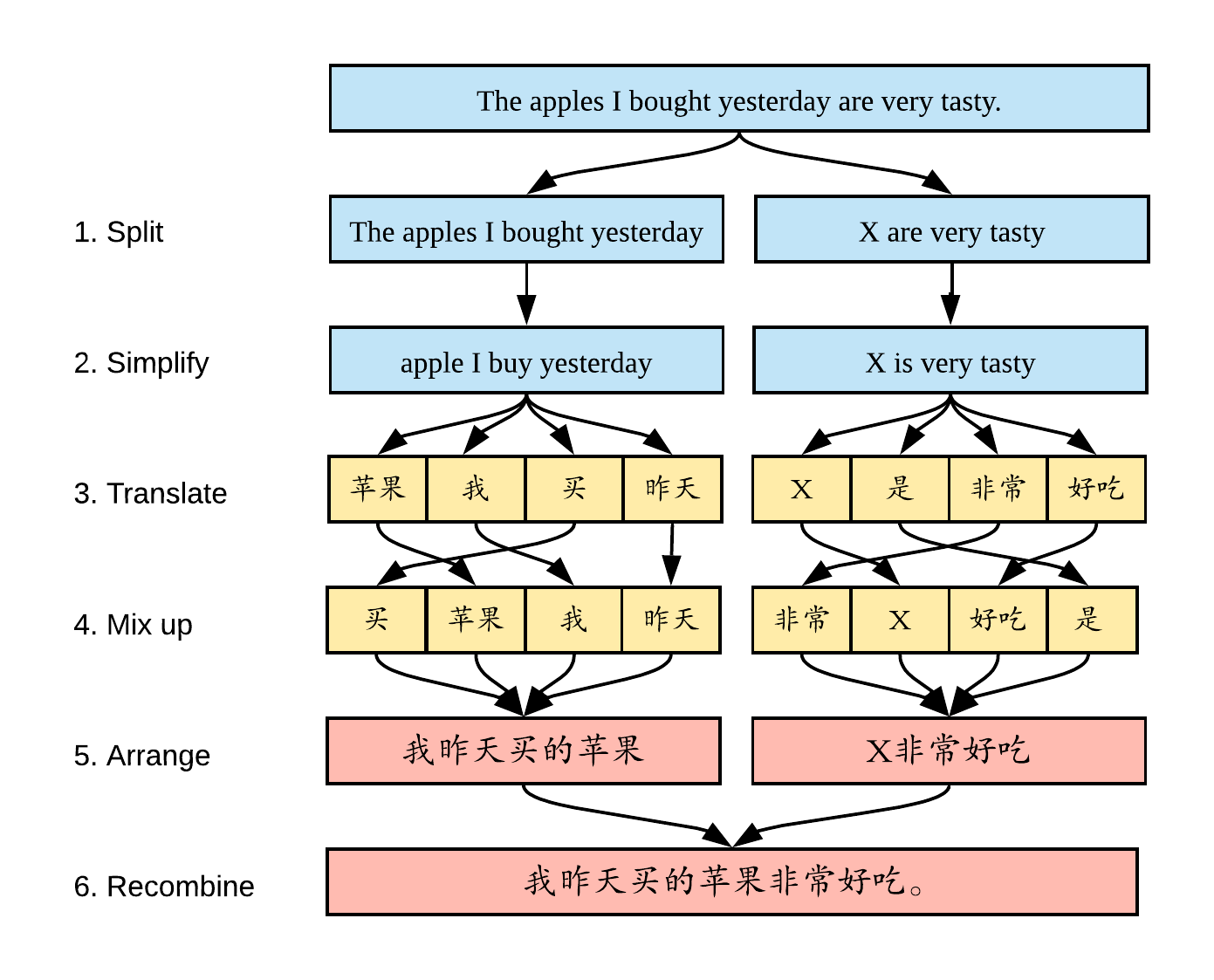
In the English sentence, the modifying clause "I bought yesterday" comes after the noun "apples". In Chinese, the entire phrase 我昨天买的 (wǒ zuótiān mǎi de - "I yesterday bought") must come before the noun 苹果 (píngguǒ - "apples").
This is a direct consequence of the language's structure. Since words don't have inflections to show their relationships, word order does the heavy lifting. This systematic, rule-based approach to sentence construction is something you will see time and again.
Key Takeaways
This lesson provided a bird's-eye view of Mandarin's structure. Here are the key points to remember:
- Tonal: Pitch is part of a word's identity. The same syllable pronounced with a different tone is a different word.
- Isolating: Words have a fixed form. There is no verb conjugation or noun pluralization. Grammar is handled by word order and adding function words.
- SVO: The basic sentence structure (Subject-Verb-Object) is the same as in English, providing a familiar starting point.
- Word Order is Key: Because the language is isolating, the position of words in a sentence is critical. A general rule is that modifiers come before the things they modify.
You now have a foundational mental model of how the Mandarin language is built. This is the "architecture" upon which all the vocabulary and grammar you learn will be assembled.
In our next lesson, we will zoom in on the first and most crucial of these features: the tones. You will learn to distinguish and produce the four main tones, a fundamental skill for spoken Mandarin.