Welcome to our third lesson. In the previous session, you began the practical work of mastering Mandarin pronunciation by learning to produce the five tones. You can now conceptualize tones as distinct pitch functions over time, and you've started the physical practice of forming them on simple syllables. This is a crucial first step.
Today, we will build upon that foundation by learning the Pinyin initials. These are the consonant sounds that begin a Mandarin syllable. The syllable is the fundamental unit of Mandarin speech, typically structured as Initial + Final + Tone. You've learned the tones; now we'll master the initials. Our goal is to pronounce all 21 initials correctly, paying special attention to several groups of sounds that are notoriously difficult for English speakers because they rely on distinctions not present in English.
Aspiration: The Key to b/p, d/t, and g/k
Let's begin with a concept that is fundamental to many Pinyin initials: aspiration. In English, pairs like 'b'/'p' and 'd'/'t' are primarily distinguished by voicing—the vibration of your vocal cords. In Mandarin, the primary distinction is aspiration—a puff of air.
- Unaspirated initials (b, d, g, z, zh, j): These are pronounced without a significant puff of air. The Pinyin 'b' sound is phonetically closer to the English 'p' in 'spot', not the 'b' in 'bot'.
- Aspirated initials (p, t, k, c, ch, q): These are pronounced with a strong puff of air, much like the initial 'p', 't', and 'k' in the English words 'pot', 'top', and 'kit'.
You can feel this difference physically. Hold your hand or a piece of paper in front of your mouth and say the English word "pit." You should feel a distinct puff of air on the 'p'. Now say "spit." The 'p' sound here is unaspirated, and you should feel little to no air. This second, unaspirated sound is what you should aim for when pronouncing the Pinyin initial 'b'.
To formalize this, please read the following brief explanation from a foundational Chinese course provided by MIT.
Sounds and symbols: An overview of pinyin
This document provides a linguistic overview of the Pinyin system. We will focus on the section discussing the initial consonants.
Please read the section titled "3.2 Notes," focusing on the first paragraph under the heading Columns I and II. This text explains the phonetic difference between pairs like b/p, noting that in Chinese it is a distinction of aspiration (unaspirated vs. aspirated) rather than voicing.
This distinction is one of the most important "parameter shifts" you need to make when learning Mandarin pronunciation. Think of it as re-mapping your existing knowledge of consonant production to a new system of features.
A Systematic Map of the Initials
Now, let's look at the complete set of Mandarin initials. The following chart organizes them systematically according to phonetics. The columns represent the place of articulation (where in your mouth the sound is formed, from the lips at the front to the velum at the back). The rows represent the manner of articulation (how your tongue and airflow are configured).
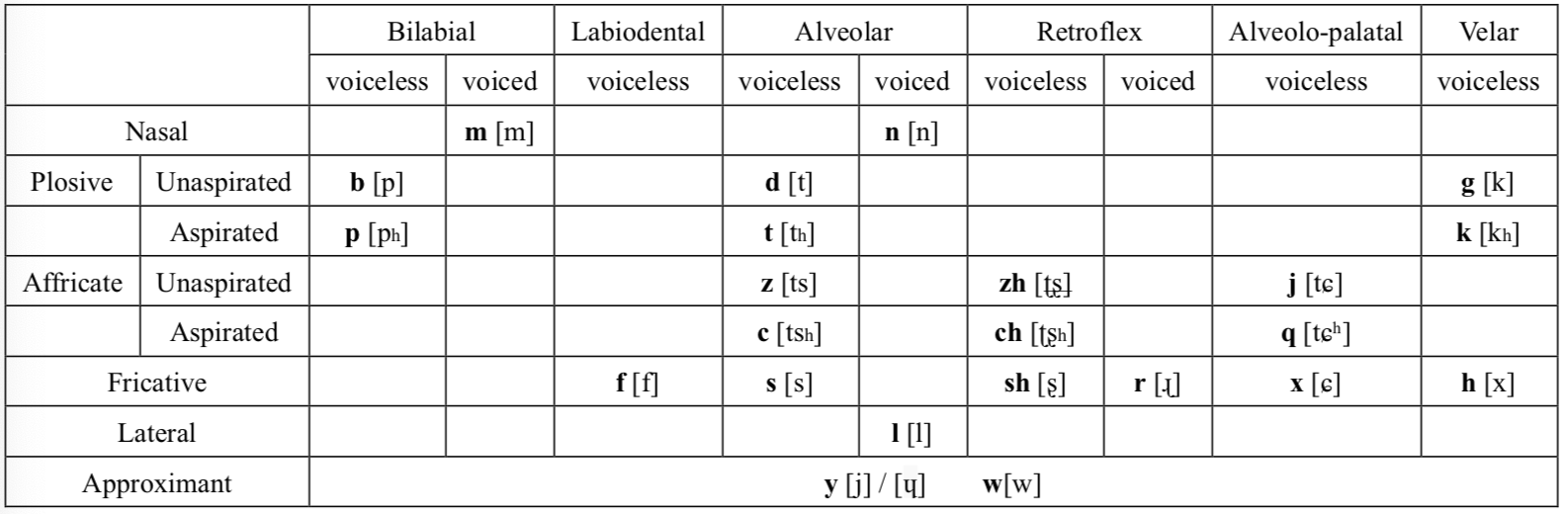
Take a moment to locate the pairs we just discussed:
- b [p] and p [pʰ] are Bilabial (lips) Plosives (stops).
- d [t] and t [tʰ] are Alveolar (tongue-on-tooth-ridge) Plosives.
- g [k] and k [kʰ] are Velar (back-of-tongue) Plosives.
Notice the small 'h' superscript [ʰ] in the IPA for p, t, and k. This symbol specifically denotes aspiration. The chart makes it clear that their unaspirated counterparts b, d, and g are in the same position, just without that feature.
The Three "Tricky" Groups
We now turn to the three groups of initials that present the most difficulty: the alveolars (z, c, s), the retroflexes (zh, ch, sh), and the alveolo-palatals (j, q, x). The key to mastering them is understanding that each group is produced with a unique, fixed tongue position. Within each group, the sounds are differentiated by the same aspiration/frication pattern.
The following video provides an excellent mental model for this, using clear diagrams of tongue positions.
How to pronounce j q x, z c s & zh ch sh? The hardest sounds in Chinese
This video from Espresso Chinese breaks down the nine hardest sounds in Pinyin. We'll focus on its core model of tongue position and airflow.
First, watch the instructor introduce the three key tongue positions. He shows a diagram that will be your mental map for these sounds: three positions. Position 1 (Front): Tip of the tongue just behind the upper front teeth. This is for z, c, s. Position 2 (Middle): Tip of the tongue down, with the blade (the part just behind the tip) raised to the hard palate. This is for j, q, x. Position 3 (Back/Curled): Tip of the tongue curled up and back towards the hard palate. This is for zh, ch, sh. Next, watch how this applies to each group. The instructor uses a simple and effective model: Unaspirated (z, j, zh): Tongue makes contact, then releases. Aspirated (c, q, ch): Tongue makes brief contact, releasing with a strong puff of air. Fricative (s, x, sh): Tongue stays close but doesn't fully touch, letting air escape with friction. Watch these three segments to see the model in action: The z, c, s group (Front Position): Alveolars. The j, q, x group (Middle Position): Alveolo-palatals. The zh, ch, sh group (Back/Curled Position): Retroflexes.
This tongue position + aspiration/frication model provides a complete system for generating these nine sounds. Now, let's get some more detailed descriptions and practice distinguishing them.
Detailed Articulation and Practice
The MIT resource we consulted earlier also offers excellent descriptions of these sounds, with helpful analogies to English.
Sounds and symbols: An overview of pinyin
This resource offers precise phonetic descriptions and targeted drills.
First, read the section the crucial rows. This text details the tongue positions for each of the three tricky groups. Pay special attention to: Row 3 (z, c, s): Analogy to "pads" and "cats". Row 4 (zh, ch, sh): Analogy to "drill", "trill", and "shrill" to get the retroflex tongue position. Row 5 (j, q, x): Analogy to "yield" for the tongue position. It also makes a crucial point: these initials are only followed by i or ü sounds. Now it's time for drills. Your primary goal is to be able to distinguish sounds between the groups (e.g., zi vs zhi vs ji) and within the groups (e.g., zi vs ci). Go to Exercise 7 e) at the end of the document. Read through and pronounce the pairs in part i. This drill contrasts the j/q/x group with the z/c/s group. Next, practice the pairs in part ii. This drill contrasts all three groups. Try to consciously set your tongue to the correct position (front, middle, or back/curled) before making each sound.
To reinforce the most difficult distinction for many learners—the palatal j/q/x versus the retroflex zh/ch/sh—we'll watch one more short, focused video.
Master Chinese “j q x” and “zh ch sh” | Pronunciation Training
This "Grace Mandarin Chinese" video provides very clear animations of the tongue for the j/q/x and zh/ch/sh sounds.
Watch the segment from this comparison. The animations clearly show the retroflex (tongue tip up) posture for zh/ch/sh versus the palatal (tongue tip down, blade up) posture for j/q/x. Listen to and repeat the contrasting pairs she demonstrates, such as zhī vs jī.
Summary and Next Steps
You have now covered all the initial consonants of Mandarin Chinese. Let's consolidate the key takeaways.
- Aspiration is Key: The primary difference between
b/p,d/t, andg/kis the presence or absence of a puff of air, not voicing. - Three Tricky Groups: The sibilant and affricate sounds fall into three groups defined by tongue position:
- Alveolar (z, c, s): Tongue tip behind upper front teeth.
- Retroflex (zh, ch, sh, r): Tongue tip curled up and back.
- Alveolo-palatal (j, q, x): Tongue tip down, blade of the tongue up.
- A Systematic Pattern: Within each of these three groups, the sounds are consistently differentiated: one is unaspirated (e.g.,
z,zh,j), one is aspirated (e.g.,c,ch,q), and one is a fricative (e.g.,s,sh,x).
In our next lesson, we will complete the syllable by learning the Pinyin finals. These are the vowel-based sounds that follow the initials. Once you combine your knowledge of initials, finals, and tones, you will be able to pronounce any syllable in the Mandarin language.