Welcome back. In the previous lesson, you practiced allowing irritation and its action urge to be present without acting immediately. That pause leaves a practical choice: when a minor interaction points to an unmet need, how do you say what would help without snapping or pretending nothing matters? This lesson focuses on making a specific, respectful request or stating a boundary you can carry out yourself.
Turn the feeling into a clear request
Suppose someone begins speaking while you are still explaining a point. Your irritation may be worth noticing, but it does not establish why they interrupted. They might be impatient, excited, or unaware that you had more to say. You do not need to settle that question before asking for a turn to finish.
A useful request names the observable situation, its effect on you if relevant, and the behavior you want. For example:
“I was still explaining my point when you started speaking. I lost my train of thought. Please let me finish this part, then I’d like to hear your idea.”
Compare that with “You never listen to me.” The second statement may convey how frustrated you feel, but never is difficult to establish and leaves the other person guessing what to do differently. The first gives them something they can do now. It also protects the underlying need—a chance to be heard—without making a claim about their motives.
The Centre for Clinical Interventions’ How to Behave More Assertively explains both brief “I” statements and a fuller way to raise behavior that has affected you. Read the specified portions rather than treating every technique in the module as necessary for a small frustration.
[PDF] Module 4: How to Behave More Assertively
Read the Centre for Clinical Interventions’ guidance for making a need known clearly, then its four-part example for addressing an upsetting behavior.
On p. 2, under “Warning! Remember the Nonverbal,” read the nonverbal guidance. Continue under “Basic Assertion” from basic assertion. Focus on making a short, specific statement rather than adding apologies or accusations. Then find “Negative feelings assertion” on pp. 4–5. Read the four steps, ending after the example about being interrupted while working. Notice the distinction between describing a behavior and interpreting or judging it. For a mild interaction, you can use a shorter version of this sequence.
Expressing a feeling is an option, not an obligation to deliver a speech. “I’m frustrated because I keep losing my place” may help explain a request. “Please let me finish this thought” may be enough when the situation is already clear. In either case, the request should identify an action the other person can recognize: let me finish this point, check with me before borrowing it, or tell me earlier if the time changes. “Be more considerate” names a wish, but not yet a clear action.
Keep the message respectful without making it vague
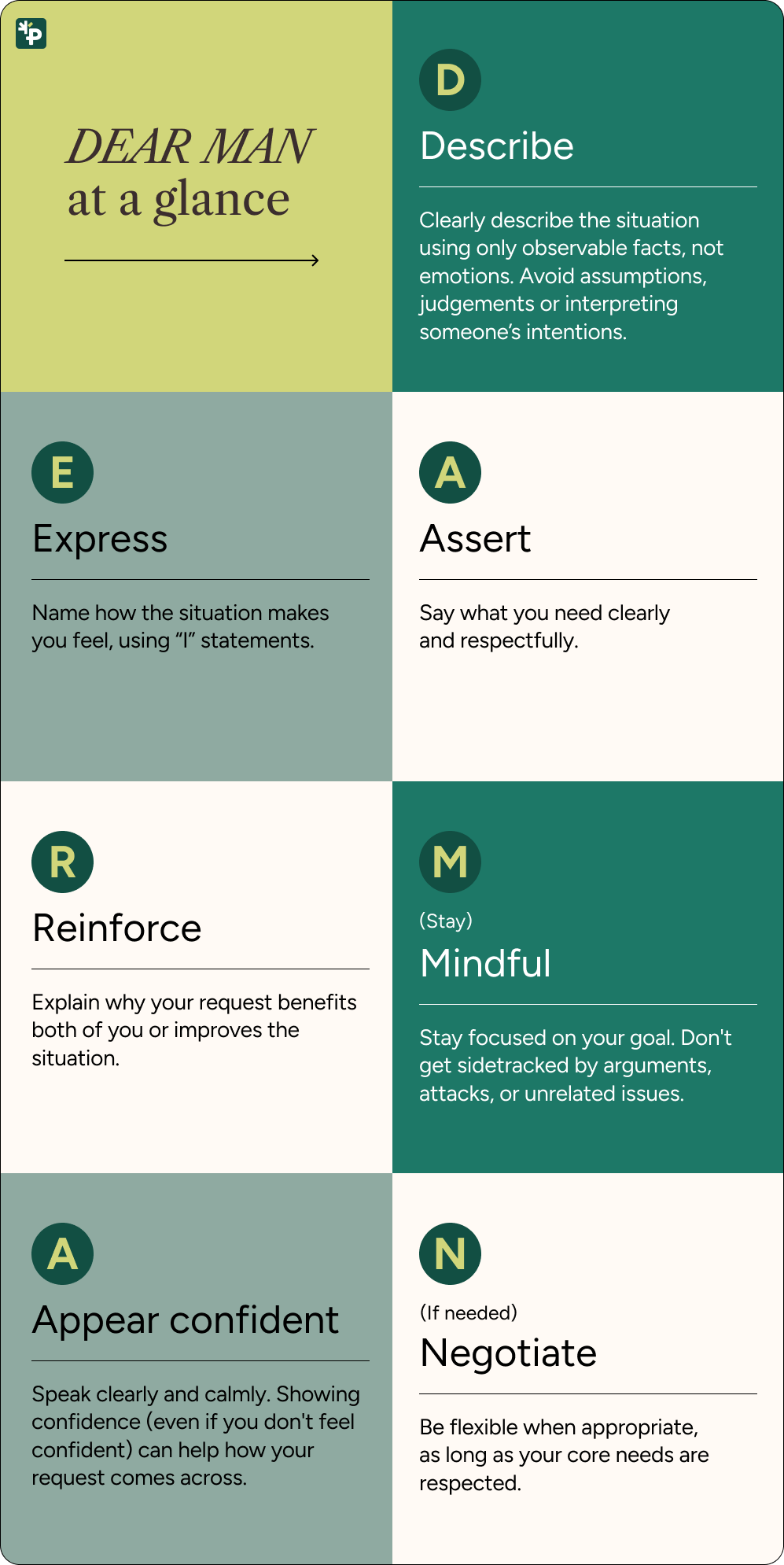
DEAR MAN is a communication aid for pursuing an interpersonal objective. Its first four letters help shape the message: Describe the facts, Express your experience, Assert what you want, and Reinforce by explaining how cooperation would help. The remaining letters concern how you deliver and sustain that message: stay Mindful of the aim, Appear confident, and Negotiate where appropriate.
Watch the selected portions of DBT Dear Man from Counseling Center Group. Pay particular attention to the difference between staying on topic and getting drawn into a dispute about blame.
DBT Dear Man | Counseling Center Group
Counseling Center Group introduces DEAR MAN as an assertiveness skill. These portions explain the structure and show what can happen when a request meets defensiveness.
Watch the request structure for Describe, Express, Assert, and Reinforce. Then watch delivery skills for Mindful, Appear confident, and Negotiate. In the housemate example, notice how a complaint about dishes gets diverted into other grievances, and how the speaker returns to the original request.
For a small interruption, the full idea need not sound like a memorized script:
“I was midway through that point when we switched speakers. I feel frustrated when I can’t finish. Please give me a moment to complete it; then I can give your idea my attention.”
Here, “give me a moment” is the request. “Then I can give your idea my attention” explains a benefit without promising that your frustration will instantly disappear. A steady voice helps the words land as intended; sounding respectful does not require you to feel perfectly calm.
Staying mindful also does not mean repeating the same sentence regardless of what the other person says. If they clarify that they thought you had finished, you can acknowledge that and restate your need: “I see how it looked that way. I have one more point to make.” If their suggestion meets the need—for instance, agreeing to return to you after a brief interruption—there may be room to negotiate. The aim is to protect the need, not win a contest of persistence.
Know when to state a boundary instead
A request asks someone else to do something: “Please let me finish before responding.” A boundary states what you will do or decline to do within your own control: “If we keep talking over each other, I’ll take a short break and return in ten minutes.” You can make a request first and state a boundary if the pattern continues. You can also state a simple boundary immediately when it concerns your own time or belongings: “I’m not available to talk tonight,” or “I’m keeping this book at home.”
Watch these sections of Boundaries for Anxious Folk from Therapy in a Nutshell. The useful distinction here is between voicing a preference and naming an action you can actually take.
Boundaries for Anxious Folk - Break the Anxiety Cycle in 30 Days 28/30
Therapy in a Nutshell contrasts a request with a boundary grounded in your own actions. Use the distinction to make low-stakes limits clear rather than trying to control another person.
Watch making a request for the initial preference and examples of clear “I” statements. Continue through setting a limit for actions within your control. Finish with their response: the other person’s reaction is not yours to dictate, which is one reason a conversation often begins with a request.
A boundary works best when its action is proportionate, feasible, and relevant to the need. If the need is to speak without interruption, a short pause in a repeatedly overlapping conversation may help. Threatening to end a friendship over a single interruption would usually obscure the modest need you were trying to address. A boundary is not a penalty designed to make someone agree with you; it tells them how you will look after your time, attention, or participation.
This distinction also keeps acceptance from becoming resignation. You can acknowledge, “I’m irritated, and they may not have meant harm,” while still saying, “I’d like to finish.” You can allow the discomfort of making that request without suppressing it. And if the person declines, you can decide what you will do rather than trying to force their response.
Put the pieces together in an ordinary interaction
Imagine a shared plan has been changed at short notice. The first impulse might be, “You don’t respect my time.” That is an interpretation, not the most useful opening. A respectful request could be:
“The meeting time changed this morning, and I had planned around the earlier time. I feel rushed when I hear about a change so late. Please let me know as soon as you know the time needs to move.”
This names an event, its impact, and a future action. If the other person explains that they only learned of the change that morning, you can revise the interpretation without withdrawing your need. “Thanks for letting me know when you found out. I still need to check whether I can make the new time” acknowledges their information and preserves your choice.
If repeated short-notice changes make participation difficult, a boundary might be:
“I’ll confirm times the day before. If the time changes after that and I can’t rearrange my plans, I’ll sit that one out.”
Unlike “You must stop changing plans,” this says what you will do. It does not require the other person to agree that your frustration is justified. It does require you to choose an action you can reasonably follow through on.
A brief rehearsal can help the wording feel less unfamiliar. Say one of the examples aloud at a measured pace, then shorten it until the request or boundary is unmistakable. The goal is not a flawless script. It is a sentence you could use while still feeling a little irritated.
The takeaway
A feeling can signal a need without proving someone else’s intent. For a low-stakes frustration, start with what happened, what you need, and one specific action you are requesting. If a limit is needed, state what you will do in terms you can carry out. Keep the delivery respectful and allow room for information you did not have.
The next lesson moves from a single interaction to a recurring source of frustration, where a problem-solving sequence can help change the conditions that keep producing it.